Home
Class 12
PHYSICS
There is a uniform spherically symmetri...

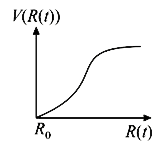
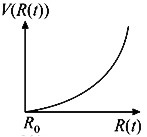
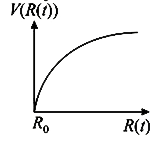
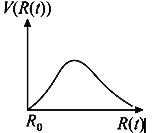
There is a uniform spherically symmetric surface charge density at a distance `R_(0)` from the origin . The charge distribution is intially at rest and starts expanding because of mutual repulsion , the figure that repeesents best the speed V (r(t)) of the distribution as a function of its instant radius R(t) is :

A

B

C

D

Text Solution

AI Generated Solution

The correct Answer is:

To solve the problem, we need to analyze the behavior of a uniformly charged spherical surface as it expands due to mutual repulsion. We'll derive the relationship between the speed \( V(r(t)) \) of the charge distribution and its instantaneous radius \( R(t) \). ### Step-by-Step Solution: 1. **Understanding the System**: - We have a uniform spherical surface charge density at a distance \( R_0 \) from the origin. - The charge distribution is initially at rest and begins to expand due to the mutual electrostatic repulsion between the charges. 2. **Energy Conservation**: - The total energy of the charge distribution remains constant during the expansion. - The total energy \( E \) can be expressed as the sum of kinetic energy \( K \) and potential energy \( U \): \[ E = K + U \] 3. **Kinetic Energy**: - The kinetic energy \( K \) of the charge distribution can be expressed as: \[ K = \frac{1}{2} mv^2 \] - Here, \( m \) is the mass of the charge distribution and \( v \) is the speed of the charge distribution. 4. **Potential Energy**: - The potential energy \( U \) due to the electrostatic interaction can be given by: \[ U = -\frac{kQ^2}{R} \] - Where \( k \) is Coulomb's constant and \( Q \) is the total charge. 5. **Setting Up the Energy Equation**: - At the initial state (when the radius is \( R_0 \)): \[ E = \frac{1}{2} mv^2 + U \] - At the final state (when the radius is \( R(t) \)): \[ E = 0 + U = -\frac{kQ^2}{R_0} \] 6. **Equating Energies**: - Since total energy is conserved, we can write: \[ \frac{1}{2} mv^2 - \frac{kQ^2}{R} = -\frac{kQ^2}{R_0} \] - Rearranging gives: \[ \frac{1}{2} mv^2 = -\frac{kQ^2}{R} + \frac{kQ^2}{R_0} \] 7. **Solving for Velocity**: - We can express the velocity \( v \) in terms of \( R \): \[ mv^2 = 2kQ^2\left(\frac{1}{R_0} - \frac{1}{R}\right) \] - Thus, \[ v = \sqrt{\frac{2kQ^2}{m}\left(\frac{1}{R_0} - \frac{1}{R}\right)} \] 8. **Analyzing the Function**: - As the radius \( R \) increases, the term \( \left(\frac{1}{R_0} - \frac{1}{R}\right) \) decreases, which means that \( v \) decreases as \( R \) increases. - Therefore, \( v(R) \) is a decreasing function of \( R \). 9. **Choosing the Correct Graph**: - From the analysis, we conclude that the speed \( v(R) \) decreases as the radius \( R \) increases. - Among the given options, we look for a graph that shows a decreasing trend as \( R \) increases. ### Conclusion: Based on the analysis, the correct option that represents the speed \( V(r(t)) \) as a function of the instantaneous radius \( R(t) \) is **Graph C**, which shows a decreasing trend.

To solve the problem, we need to analyze the behavior of a uniformly charged spherical surface as it expands due to mutual repulsion. We'll derive the relationship between the speed \( V(r(t)) \) of the charge distribution and its instantaneous radius \( R(t) \). ### Step-by-Step Solution: 1. **Understanding the System**: - We have a uniform spherical surface charge density at a distance \( R_0 \) from the origin. - The charge distribution is initially at rest and begins to expand due to the mutual electrostatic repulsion between the charges. ...
Promotional Banner

Topper's Solved these Questions

  • ELECTROSTATICS

    VMC MODULES ENGLISH|Exercise JEE Advanced (Archive)|89 Videos
  • ELECTROSTATICS

    VMC MODULES ENGLISH|Exercise LEVEL - 2|60 Videos
  • ELECTROMAGNETIC INDUCTION & ALTERNATIVE CURRENT

    VMC MODULES ENGLISH|Exercise IMPECCABLE|52 Videos
  • ENERGY & MOMENTUM

    VMC MODULES ENGLISH|Exercise JEE ADVANCE (ARCHIVE) - TRUE/FALSE TYPE|1 Videos

Similar Questions

Explore conceptually related problems

There is a uniform spherically symmetric surface charge density at a distance R_(0) from the origin . The charge distribution is intially at rest and starts expanding because of mutual repulsion , the figure that repeesents best the speed V (r(t)) of the distribution as a function of its intantanradius R(t) is :

The maximum surface charge density of a uniformly charged spherical radius R and wall thickness 't', so that it will not burst apart, is

For spherically symmetrical charge distribution, electric field at a distance r from the centre of sphere is vec(E)=kr^(7) vec(r) , where k is a constant. What will be the volume charge density at a distance r from the centre of sphere?

The energy density u is plotted against the distance r from the centre of a spherical charge distribution on a log-log scale. Find the magnitude of slope of obtained straight line.

An insulating solid sphere of radius R has a uniformly positive charge density rho . As a result of this uniform charge distribution there is a finite value of electric potential at the centre of the sphere, at the surface of the sphere and also at a point out side the sphere. The electric potential at infinity is zero. Statement-1: When a charge 'q' is taken from the centre to the surface of the sphere, its potential energy changes by (qrho)/(3 in_(0)) Statement-2 : The electric field at a distance r (r lt R) from the centre of the the sphere is (rho r)/(3in_(0))

A long thin flat sheet has a uniform surface charge density sigma . The magnitude of the electric field at a distance .r. from it is given by

A positive charge is released from rest at a distance r_(0) from a positive line charge with uniform density . The speed (v) of the point charge , as a function of instantaneous distance r from line charge, is proportional to:

Consider a uniform spherical charge distribution of radius R_(1) centred at the origin O . In this distribution a spherical cavity of radius R_(2) , centred at P with distance OP = a = R_(1) - R_(2) (fig) is made.If the electric field inside the cavity at position vec(r ) , then the correct statement is

Let there be a spherical symmetric charge density varying as p(r )=p_(0)(r )/(R ) upto r = R and rho(r )=0 for r gt R , where r is the distance from the origin. The electric field at on a distance r(r lt R) from the origin is given by -

Find the electric field due to an infinitely long cylindrical charge distribution of radius R and having linear charge density lambda at a distance half of the radius from its axis.

VMC MODULES ENGLISH-ELECTROSTATICS-JEE MAIN
  1. Two electric dipoles, A, B with respective dipole moments vec(d(A))=-4...

    Text Solution

    |

  2. A particle of mass m and charge q is in a electric and magnetic f...

    Text Solution

    |

  3. An electric field of 1000 V//m is applied to an electric dipole at an...

    Text Solution

    |

  4. Three charges Q+q and + q are placed at the vertices of a right -angle...

    Text Solution

    |

  5. The given graph shows variation (with distance r form center) of :

    Text Solution

    |

  6. There is a uniform spherically symmetric surface charge density at a ...

    Text Solution

    |

  7. Determine the electric dipole moment of the syatem of three charg...

    Text Solution

    |

  8. The bob of a simple pendulum has mass 2g and a charge of 5.0muC. It is...

    Text Solution

    |

  9. A solid conducting sphere, having a charge Q, is surrounded by an unch...

    Text Solution

    |

  10. A positive charge is released from rest at a distance r(0) from a posi...

    Text Solution

    |

  11. In Region of Electric field Given by vec(E)=(Ax-B)hat(I). Where A=20 u...

    Text Solution

    |

  12. A electric dipole is in equilibrium having charge q and -q are placed ...

    Text Solution

    |

  13. A system of three charges are placed as shown in the figure : If ...

    Text Solution

    |

  14. Four points charges -q,+q,+q and -q are placed on y-axis at y=-2d, y=-...

    Text Solution

    |

  15. A particle A of charge 1 mu C is held fixed at a point P in free spa...

    Text Solution

    |

  16. A simple pendulum of length L is placed between the plates of a parall...

    Text Solution

    |

  17. A Circular ring of radius 3a is uniformly charged with charge q is kep...

    Text Solution

    |

  18. A solid sphere of radius R has total charge 2Q and volume charge densi...

    Text Solution

    |

  19. Shown in the figure is a shell made of a conductor. It has inner radiu...

    Text Solution

    |

  20. A point dipole vecp=-p(0)xhatx is kept at the origin. The potential an...

    Text Solution

    |
