Home
Class 12
PHYSICS
A point charge +Q is place just outside ...

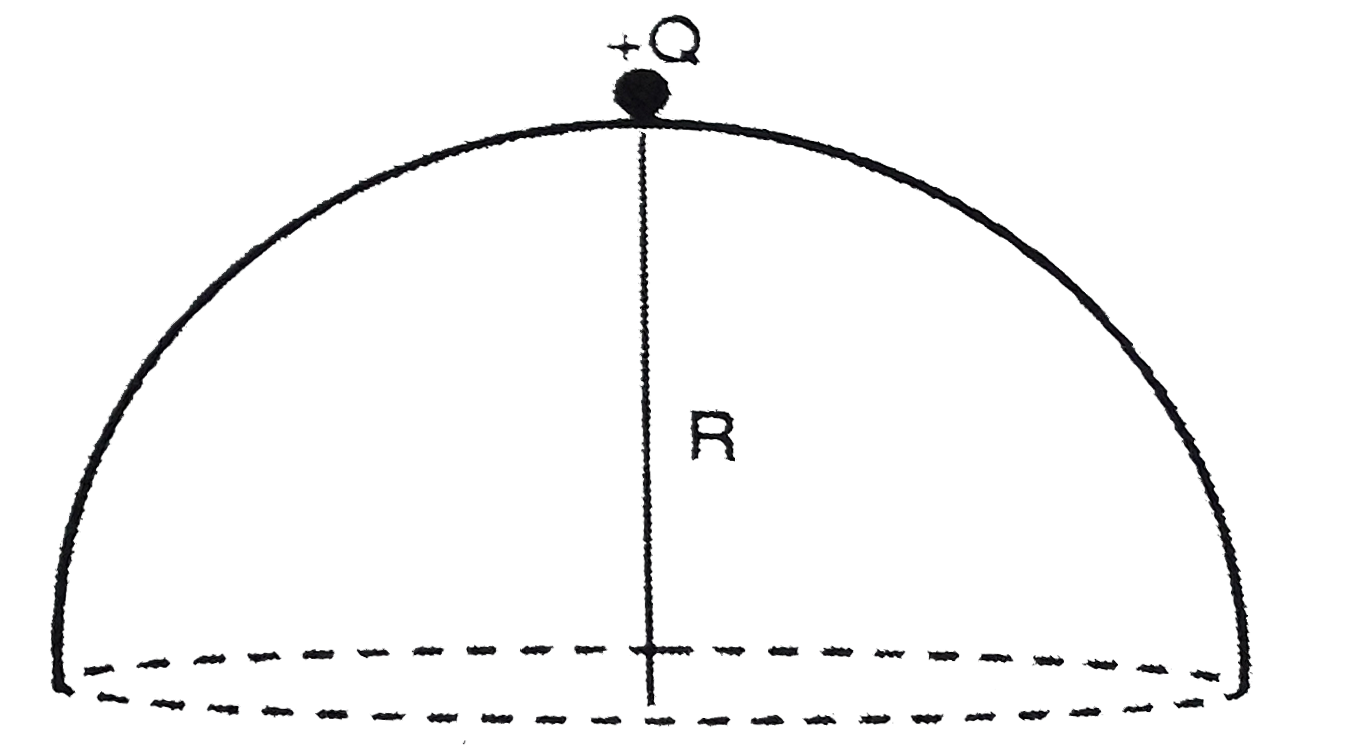
A point charge +Q is place just outside an imaginary hemispherical surface of radius R as shown in the figure. Which of the following statements is/are correct ?

A

The electric flux passing through the curved surface of the hemisphere is `- (Q)/( 2 epsi_(0)) ( 1-(1)/(sqrt(2))`

B

The component of the electric field normal to the flat surface is constant over the surface

C

Total flux through the curved and the flat surfaces is `(Q_(0))/(epsi_(0))`

D

The circumference of the flat surface is an equipotential

Text Solution

Verified by Experts

The correct Answer is:
A, D

Since the charge lies outside the hemi-sphere, net flux passing through the sphere is zero.
`phi_("curved surface")+phi_("disc")=0`
Option (C) is incorrect
`phi_("curved surface")=-phi_("disc")`
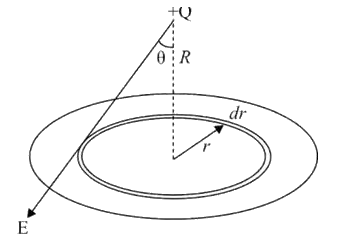
`costheta=R/(sqrt(R^(2)+r^(2))`, `phi_("disc")=intvecE.dvecA`

`=int(1/(4piepsi_(0))Q/((R^(2)+r^(2)))xx2pirdrxxcostheta)=(Q.2pi)/(4piepsi_(0))int(rdr)/(R^(2)+r^(2))xxR/((R^(2)+r^(2))^(1//2))`
`=(QR)/(2epsi_(0))int_(0)^(R)(rdr)/((R^(2)+r^(2))^(3//2))=(QR)/(2epsi_(0))[1/2((R^(2)+r^(2))^(-1//2))/(-1//2)]_(0)^(R)=(QR)/(2epsi_(0))[1/R-1/(sqrt(R^(2)+R^(2)))]=Q/(2epsi_(0))[1-1/(sqrt2)]`
`thereforephi_("curved surface")=-Q/(2epsi_(0))[1-1/(sqrt2)]` Option (A) is correct
Potential at any point on the circumference of the flat surface is `1/(4piepsi_(0))Q/(sqrt(R^(2)+R^(2)))=Q/(4piepsi_(0)(sqrt2R))`
Hence it is equipotential
Option (D) is correct
`E=1/(4piepsi_(0))Q/((R//costheta)^(2))=(theta)/(4piepsi_(0)R^(2))cos^(2)theta`
`E_("normal")=Ecostheta=Q/(4piepsi_(0)R^(2))cos^(3)theta`

Which is not constant. Option (B) is in correct
Promotional Banner

Topper's Solved these Questions

  • ELECTROSTATICS

    VMC MODULES ENGLISH|Exercise JEE MAIN|65 Videos
  • ELECTROMAGNETIC INDUCTION & ALTERNATIVE CURRENT

    VMC MODULES ENGLISH|Exercise IMPECCABLE|52 Videos
  • ENERGY & MOMENTUM

    VMC MODULES ENGLISH|Exercise JEE ADVANCE (ARCHIVE) - TRUE/FALSE TYPE|1 Videos

Similar Questions

Explore conceptually related problems

Figure shows electric field lines in which an electric dipole p is placed as shown. Which of the following statements is correct ?

Figure shows electric field lines in which an electric dipole p is placed as shown. Which of the following statements is correct ?

q_(1),q_(2),q_(3) and q_(4) are point charges located at point as shown in the figure and s is a spherical Gaussian surface of radius R . Which of the following is true according to the Gauss's law

Figure shows electric field lines in which an electric dipole vecP is placed as shown. Which of the following statements is correct?

A charge Q is placed at the centre of an inaginary hemispherical surface. Using symmetry arguments and the Gauss's law, find the flux of the electric field due to this charge through the surface of the hemisphere (figure ).

A point charge q is placed at some distance d away from the centre of a grounded conducting sphere of radius r, as shown in the figure. The charge that flows the earth to the sphere is

A point charge +Q is placed at a distance r from a short dipole of dipole moment vecp as shown in figure. The line joining the point charge Q to the centre dipole is perpendicular to dipole moment vecp , which of the following statement are true?

A charge 'Q' is placed at the centre of a hemispherical surface of radius 'R'. The flux of electric field due to charge 'Q' through the surface of hemisphere is

The point charge is placed outside a spherical shell as shown i the figure. Find the electric potential (in kilo volt) on the surface of shell (Take: q=1 mu c and R=50cm )

If a charge q is placed at the centre of a hemispherical body as shown below then the flux linked with the curved surface is

VMC MODULES ENGLISH-ELECTROSTATICS-JEE Advanced (Archive)
  1. Two nonconducting solid spheres of radii R and 2R, having uniform volu...

    Text Solution

    |

  2. Two nonconducting spheres of radii R1 and R2 and carrying uniform volu...

    Text Solution

    |

  3. A point charge +Q is place just outside an imaginary hemispherical sur...

    Text Solution

    |

  4. An infinitely long thin non-conduction wire is parallel to the z-axis ...

    Text Solution

    |

  5. A charged shell of radius R carries a total charge Q. Given phi as the...

    Text Solution

    |

  6. A dipole of Dipole moment vec(p)=(p(0))/(sqrt(2))(hat(i)+hat(j)). Is p...

    Text Solution

    |

  7. The nuclear charge (Ze) is non uniformlly distribute with in a nucleus...

    Text Solution

    |

  8. The nuclear charge (Ze) is non uniformlly distribute with in a nucleus...

    Text Solution

    |

  9. The nuclear charge (Ze) is non uniformlly distribute with in a nucleus...

    Text Solution

    |

  10. Four charges Q(1), Q(2), Q(3) and Q(4) of same magnitude are fixed alo...

    Text Solution

    |

  11. The electric field is measured at a point 0,0, generated due to vario...

    Text Solution

    |

  12. A charge Q is distributed over two concentric conducting thin spherica...

    Text Solution

    |

  13. A thin fixed ring of radius a has a positive charge q uniformly distri...

    Text Solution

    |

  14. Two fixed, equal, positive charges, each of magnitude 5xx 10^-5 C are ...

    Text Solution

    |

  15. Three point charges q, 2q and 8q are to be placed on a . 9cm long st...

    Text Solution

    |

  16. Three particles, each of mass m and carrying a charge q each, are susp...

    Text Solution

    |

  17. Three concentric spherical metallic shells A,B and C of radii a,b a...

    Text Solution

    |

  18. Three concentric spherical metallic shells A, B and C of radii a, b an...

    Text Solution

    |

  19. Two fixed charges -2Q and Q are located at the point with coordi...

    Text Solution

    |

  20. Two fixed charges -2Q and +Q are located at points (-3a,0) and (+3a,0)...

    Text Solution

    |