Home
Class 12
PHYSICS
P, Q and R are three coplanar forces act...

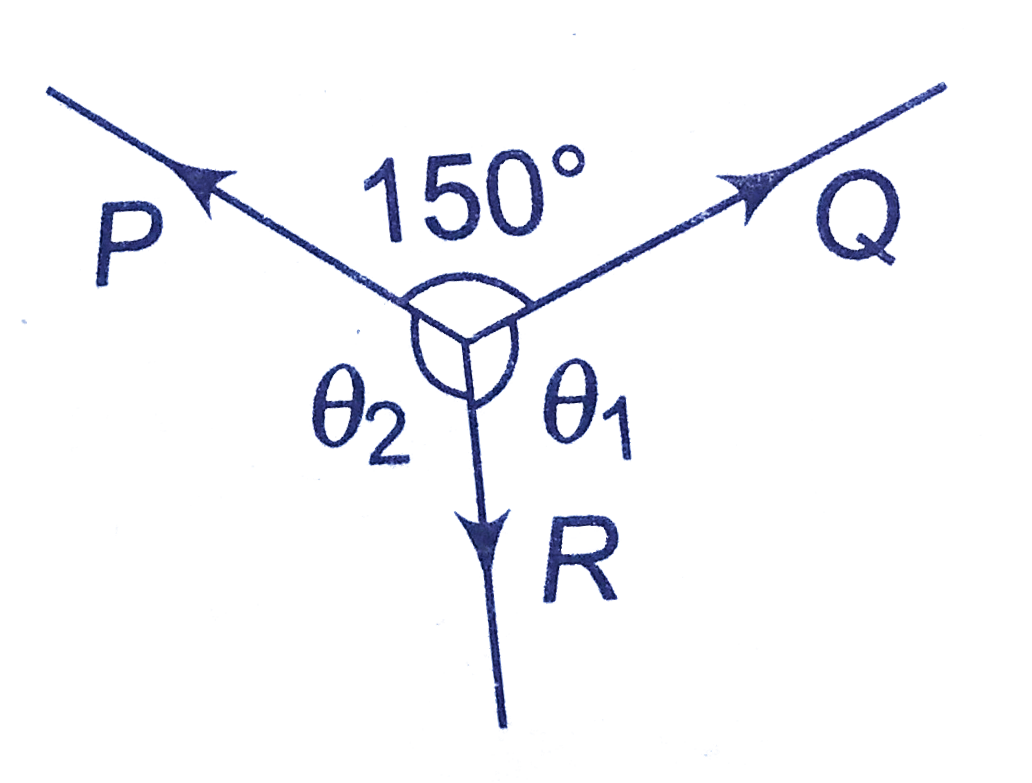
P, Q and R are three coplanar forces acting at a point and are in equilibrium. Given `P= 1.9318 kg-wt, sin theta_(1)= 0.9659`, the value of R is `(in kg-wt)`

A

0.9659

B

2

C

1

D

`(1)/(2)`

Text Solution

Verified by Experts

The correct Answer is:

C
Promotional Banner

Topper's Solved these Questions

  • BASIC MATHEMATICS & VECTORS

    VMC MODULES ENGLISH|Exercise Enable|50 Videos
  • BASIC MATHEMATICS & VECTORS

    VMC MODULES ENGLISH|Exercise Efficient|50 Videos
  • CAPACITORS

    VMC MODULES ENGLISH|Exercise JEE Advance ( Archive ) LEVEL 48|1 Videos

Similar Questions

Explore conceptually related problems

P,Q and R are three coplanar forces acting at a point and are in equilibrium. Given P=1N , sintheta_1 =1/2 , the value of R is

If four forces act at a point 'O' as shown in the figure and if O is in equilibrium then the value of 'theta' & 'P' are

P,Q and R are three forces acting simultaneously on a particle . vec(S) is the vector sum, of the three forces show that if vec(S) = 0 , the vector representing these forces form a triangle.

If P ,Q and R are three collinear points such that vec P Q= vec a and vec Q R = vec bdot Find the vector vec P R .

The resultant R of two forces P and Q acting at an angle theta (obtuse angle i.e. theta gt 90^@ ) is given by

A body of mass 60 kg suspended by means of three strings, P, Q and R as shown in the figure is in equlibrium. The tension in the string P is

A body of mass 60 kg suspended by means of three strings, P, Q and R as shown in the figure is in equlibrium. The tension in the string P is

A body of mass 60 kg suspended by means of three strings, P, Q and R as shown in the figure is in equlibrium. The tension in the string P is

Given that P(3,1),Q(6. 5), and R(x , y) are three points such that the angle P R Q is a right angle and the area of R Q P is 7, find the number of such points Rdot

If P(0, 1, 2), Q(4, -2, 1) and R(0, 0, 0) are three points, then anglePRQ is

VMC MODULES ENGLISH-BASIC MATHEMATICS & VECTORS-Impeccable
  1. P, Q and R are three coplanar forces acting at a point and are in equi...

    Text Solution

    |

  2. Square of the resultant of two forces of equal magnitude is equal to t...

    Text Solution

    |

  3. If |vec(A)xxvec(B)|=sqrt(3)vec(A).vec(B), then the value of |vec(A)+ve...

    Text Solution

    |

  4. The vectors from origin to the points A and B are vec(a)=3hat(i)-6hat(...

    Text Solution

    |

  5. Which of the following is incorrect ?

    Text Solution

    |

  6. The minimum number of vectors to give zero resultant is …………………………………....

    Text Solution

    |

  7. Two vectors vec(A) and vec(B) are such that |vec(A)+vec(B)|=|vec(A)-ve...

    Text Solution

    |

  8. OF the vectors given below, the parallel vectors are : vec(A) = 6hat...

    Text Solution

    |

  9. If |vec(A) xx vec(B)| = sqrt(3) vec(A).vec(B) then the value of |vec(A...

    Text Solution

    |

  10. For any two vectors vec(A) and vec(B), if vec(A).vec(B) = |vec(A) xx v...

    Text Solution

    |

  11. A particle moves from position 3hat(i) + 2hat(j) - 6hat(k) to 14hat(i)...

    Text Solution

    |

  12. The sides of a parallelogram represented by vectors p = 5hat(i) - 4hat...

    Text Solution

    |

  13. If overset(rarr)A=2 hat i + 3 hat j- hat k and overset(rarr)B=-hat i...

    Text Solution

    |

  14. Given two vectors vec(A) = -hat(i) + 2hat(j) - 3hat(k) and vec(B) = 4h...

    Text Solution

    |

  15. Which of the following is a vector quantity ?

    Text Solution

    |

  16. A unit radial vector hatr makes angles of alpha = 30^(@) relative to ...

    Text Solution

    |

  17. What is the value of m if the vectors 2hat(i)-hat(j)+hat(k), hat(i)+...

    Text Solution

    |

  18. Three forces A = (hat(i) + hat(j) + hat(k)), B = (2hat(i) - hat(j) + 3...

    Text Solution

    |

  19. vec(A) is a vector with magnitude A, then the unit vector hat(A) in th...

    Text Solution

    |

  20. Two forces of 12N and 8N act upon a body. The resultant force on the b...

    Text Solution

    |

  21. Given two vectors A = -4hat(i) + 4hat(j) + 2hat(k) and B = 2hat(i) - h...

    Text Solution

    |
