Home
Class 12
PHYSICS
Two horizontal forces of magnitudes of 1...

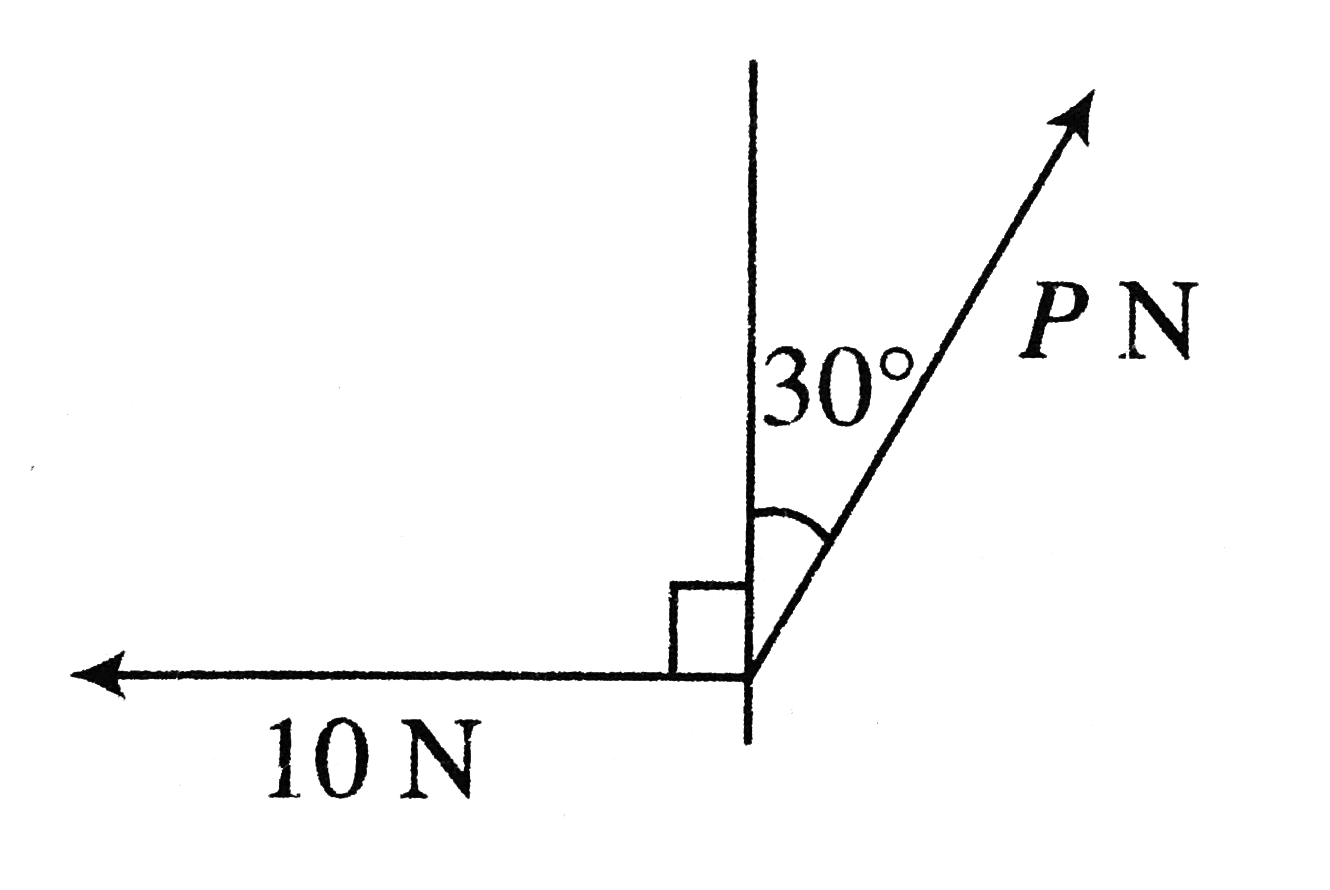
Two horizontal forces of magnitudes of `10N` and `P N` act on a particle. The force of magnitude `10N` acts due west and the force of magnitude `P N` acts on a bearing of `30^(@)` east of north as shown in (figure) The resultant of these two force acts due north. Find the magnitude of the resultant.

A

`10sqrt(2)N`

B

`15sqrt(2) N`

C

`12sqrt(5)N`

D

`10sqrt(3) N`

Text Solution

Verified by Experts

The correct Answer is:

D
Promotional Banner

Topper's Solved these Questions

  • BASIC MATHEMATICS & VECTORS

    VMC MODULES ENGLISH|Exercise Enable|50 Videos
  • BASIC MATHEMATICS & VECTORS

    VMC MODULES ENGLISH|Exercise Efficient|50 Videos
  • CAPACITORS

    VMC MODULES ENGLISH|Exercise JEE Advance ( Archive ) LEVEL 48|1 Videos

Similar Questions

Explore conceptually related problems

Find the magnitude of the resultant of shown forces :-

Three forces of magnitudes 2N, 3N and 6N act at corners of a cube along three sides as shown in figure. Find the resultant of these forces in N.

Two perpendicular forces of magnitudes 10 N and 5 N act at a point. Find their resultant.

Three forces of magnitudes 6 N, 6 N an d sqrt(72) N act at corner of cube along three sides as shown in figure. Resultant of these forces is

Three forces of magnitudes 6 N, 6 N an d sqrt(72) N act at corner of cube along three sides as shown in figure. Resultant of these forces is

Two forces, each equal to F, act as shown in (figure) Their resultant is

Two forces of magnitudes 3N and 4N are acted on a body. The ratio of magnitude of minimum and maximum resultant force on the body is

Four forces are acting on a body as shown in figure. The magnitude of resultant of the forces is

Two forces each of magnitude 2N, act at an angle of 60^(@) . The magnitude of the resultant force

If the resultant of the two forces has a magnitude smalle than the magnitude of larger force,the two forces must be

VMC MODULES ENGLISH-BASIC MATHEMATICS & VECTORS-Impeccable
  1. Two horizontal forces of magnitudes of 10N and P N act on a particle. ...

    Text Solution

    |

  2. Square of the resultant of two forces of equal magnitude is equal to t...

    Text Solution

    |

  3. If |vec(A)xxvec(B)|=sqrt(3)vec(A).vec(B), then the value of |vec(A)+ve...

    Text Solution

    |

  4. The vectors from origin to the points A and B are vec(a)=3hat(i)-6hat(...

    Text Solution

    |

  5. Which of the following is incorrect ?

    Text Solution

    |

  6. The minimum number of vectors to give zero resultant is …………………………………....

    Text Solution

    |

  7. Two vectors vec(A) and vec(B) are such that |vec(A)+vec(B)|=|vec(A)-ve...

    Text Solution

    |

  8. OF the vectors given below, the parallel vectors are : vec(A) = 6hat...

    Text Solution

    |

  9. If |vec(A) xx vec(B)| = sqrt(3) vec(A).vec(B) then the value of |vec(A...

    Text Solution

    |

  10. For any two vectors vec(A) and vec(B), if vec(A).vec(B) = |vec(A) xx v...

    Text Solution

    |

  11. A particle moves from position 3hat(i) + 2hat(j) - 6hat(k) to 14hat(i)...

    Text Solution

    |

  12. The sides of a parallelogram represented by vectors p = 5hat(i) - 4hat...

    Text Solution

    |

  13. If overset(rarr)A=2 hat i + 3 hat j- hat k and overset(rarr)B=-hat i...

    Text Solution

    |

  14. Given two vectors vec(A) = -hat(i) + 2hat(j) - 3hat(k) and vec(B) = 4h...

    Text Solution

    |

  15. Which of the following is a vector quantity ?

    Text Solution

    |

  16. A unit radial vector hatr makes angles of alpha = 30^(@) relative to ...

    Text Solution

    |

  17. What is the value of m if the vectors 2hat(i)-hat(j)+hat(k), hat(i)+...

    Text Solution

    |

  18. Three forces A = (hat(i) + hat(j) + hat(k)), B = (2hat(i) - hat(j) + 3...

    Text Solution

    |

  19. vec(A) is a vector with magnitude A, then the unit vector hat(A) in th...

    Text Solution

    |

  20. Two forces of 12N and 8N act upon a body. The resultant force on the b...

    Text Solution

    |

  21. Given two vectors A = -4hat(i) + 4hat(j) + 2hat(k) and B = 2hat(i) - h...

    Text Solution

    |
