Home
Class 12
PHYSICS
A body is in equilibrium under the actio...

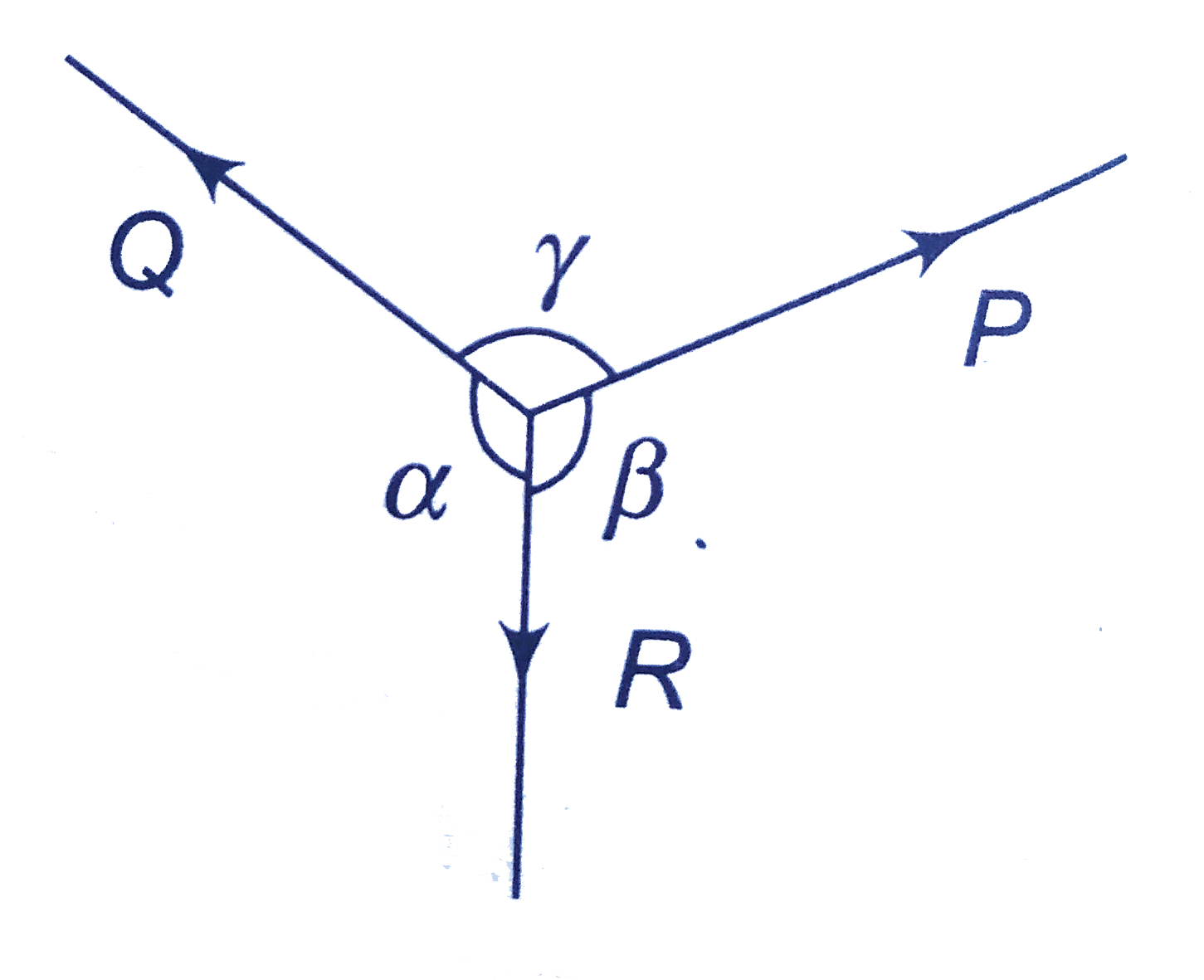
A body is in equilibrium under the action of three coplanar forces `P,Q and R` as shown in figure. Select the correct statement.

A

`(P)/(sin alpha) = (Q)/(sin beta) = (R )/(sin gamma)`

B

`(P)/(cos alpha) = (Q)/(cos beta) = (R )/(cos gamma)`

C

`(P)/(tan alpha) = (Q)/(tan beta) = (R )/(tan gamma)`

D

`(P)/(sin beta) = (Q)/(sin gamma) = (R )/(sin alpha)`

Text Solution

Verified by Experts

The correct Answer is:

A
Promotional Banner

Topper's Solved these Questions

  • BASIC MATHEMATICS & VECTORS

    VMC MODULES ENGLISH|Exercise Impeccable|50 Videos
  • BASIC MATHEMATICS & VECTORS

    VMC MODULES ENGLISH|Exercise Enable|50 Videos
  • CAPACITORS

    VMC MODULES ENGLISH|Exercise JEE Advance ( Archive ) LEVEL 48|1 Videos

Similar Questions

Explore conceptually related problems

For a body to be in equilibrium under the combined action of several forces

Select the correct statement regarding R.Q. ?

The one - dimensional motion of a point particle is shown in the figure. Select the correct statement

A ray of light enters a spherical drop of water of refractive index mu as shown in figure. Q. Select the correct statement:

Identify the plants shown in figure and select the correct option:

A block of mass m is at rest under the action of force F against a wall as shown in figure. Which of the following statement is incorrect?

A body is in translational equilibrium under the sctin of coplanar forces. If the torque of these force is zero about a point is it necessary that it will also be zero abut any other point?

A uniform rod of length 2L, area of cross - section A and Young's modulus Y is lying at rest under the action of three forces as shown. Select the correct alternatives.

A body moves from point A to B under the action of a force, varying in magnitude as shown in figure. Obtain the work done. Force is expressed in newton and displacement in meter.

Identify the gymnosperms shown in figure and select the correct option

VMC MODULES ENGLISH-BASIC MATHEMATICS & VECTORS-Efficient
  1. The resultant of two vectors vec(P) and vec(Q) is vec(R). If vec(Q) is...

    Text Solution

    |

  2. Vector vecP angle alpha,beta and gamma with the x,y and z axes respect...

    Text Solution

    |

  3. A body is in equilibrium under the action of three coplanar forces P,Q...

    Text Solution

    |

  4. If a body is in equiliburium under a set of non-collinear forces, then...

    Text Solution

    |

  5. The position vectors of two balls are given by vec(r )(1)=2 (m)i+7(m...

    Text Solution

    |

  6. A particle whose speed is 50ms^(-1) moves along the line from A(2,1) t...

    Text Solution

    |

  7. A car travles 6km towards north at an angle of 45^(@) to the east and ...

    Text Solution

    |

  8. Three forces vec(F)(1), vec(F)(2) and vec(F)(3) are represented as sho...

    Text Solution

    |

  9. The sum of the magnitudes of two forces acting at a point is 18 and th...

    Text Solution

    |

  10. Three forces P, Q and R are acting on a particel in the plane, the ang...

    Text Solution

    |

  11. IF |vec(A)| = 2 and |vec(B)| = 4, then match the relation in Column I ...

    Text Solution

    |

  12. Forces X,Y and Z have magnitudes 10N, 5(sqrt(3)-1) N and 5(sqrt(3)+1) ...

    Text Solution

    |

  13. A unit vector in the dirction of resultant vector of vec(A)= -2hat(i)+...

    Text Solution

    |

  14. A person pushes a box kept on a horizontal surface with force of 100 N...

    Text Solution

    |

  15. In figure, vec(E) equals :

    Text Solution

    |

  16. Three vector vec(A),vec(B), vec(C ) satisfy the relation vec(A)*vec(B)...

    Text Solution

    |

  17. As shown in figure the tension in the horizontal cord is 30 N. The wei...

    Text Solution

    |

  18. A scooter going due east at 10 ms^(-1) turns right through an angle of...

    Text Solution

    |

  19. A car is moving on a straight road due north with a uniform speed of 5...

    Text Solution

    |

  20. What can be the angle between (vec(P) + vec(Q)) and (vec(P) - vec(Q))...

    Text Solution

    |
