Home
Class 12
PHYSICS
A particle falls from a height h and reb...

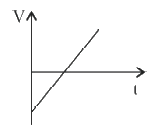
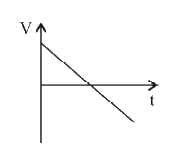
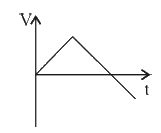
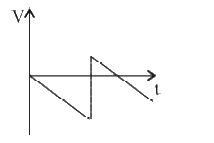
A particle falls from a height h and rebounds to a height `h _(1) ( h _(1) lt h),` then which of the graph represents the motion correct ?

A

B

C

D

Text Solution

AI Generated Solution

The correct Answer is:

To solve the problem of determining which graph represents the motion of a particle falling from height \( h \) and rebounding to height \( h_1 \) (where \( h_1 < h \)), we will analyze the motion step by step. ### Step 1: Understand the Motion The particle falls freely from height \( h \) under the influence of gravity. Initially, it has zero velocity and accelerates downwards due to gravity. ### Step 2: Analyze the Falling Motion When the particle is falling, its velocity \( v \) can be expressed as: \[ v = -gt \] where \( g \) is the acceleration due to gravity and \( t \) is the time of fall. The negative sign indicates that the velocity is directed downwards. ### Step 3: Identify the Velocity During Fall As the particle falls, its velocity increases in the negative direction (downwards). Therefore, during this phase, the graph of velocity vs. time should show a line with a negative slope starting from zero and moving downwards. ### Step 4: Analyze the Rebound Motion Upon reaching the ground, the particle rebounds to a height \( h_1 \). The rebound is not elastic, meaning it does not reach the original height \( h \). The velocity just before the rebound is negative (downward), and upon hitting the ground, it instantaneously changes direction to positive. ### Step 5: Express the Velocity During Rebound For the upward motion after the rebound, the velocity can be expressed as: \[ v = u - gt \] where \( u \) is the initial velocity at the moment of rebound (which is now positive). The particle will decelerate until it reaches the peak height \( h_1 \) where the velocity will be zero. ### Step 6: Identify the Velocity During Rebound During the rebound phase, the velocity starts from a positive value and decreases to zero as the particle reaches the maximum height \( h_1 \). Thus, the graph should show a line starting from a positive value and decreasing to zero. ### Step 7: Combine Both Phases The complete motion consists of two parts: 1. A downward motion with negative velocity increasing in magnitude. 2. An upward motion starting from a positive velocity and decreasing to zero. ### Step 8: Determine the Correct Graph From the analysis, the correct graph should: - Start from zero, go downwards (negative velocity) as time increases during the fall. - Then, instantaneously change direction at the ground (velocity becomes positive). - Finally, decrease to zero as it reaches the height \( h_1 \). ### Conclusion The graph that represents this motion correctly is the one that shows negative velocity during the fall and a positive velocity that decreases to zero during the rebound.
Promotional Banner

Topper's Solved these Questions

  • MOTION IN A STRAIGHT LINE & PLANE

    VMC MODULES ENGLISH|Exercise EFFICIENT|50 Videos
  • MOTION IN A STRAIGHT LINE & PLANE

    VMC MODULES ENGLISH|Exercise IMPECCABLE|52 Videos
  • MOTION IN A STRAIGHT LINE & PLANE

    VMC MODULES ENGLISH|Exercise IMPECCABLE|52 Videos
  • MOCK TEST 9

    VMC MODULES ENGLISH|Exercise PHYSICS (SECTION 2)|5 Videos
  • Motion in Straight Line

    VMC MODULES ENGLISH|Exercise IN-CHAPTER EXERCISE-J|10 Videos

Similar Questions

Explore conceptually related problems

A rubber ball falls from a height h and rebounds to a height h/2. A rubber ball of double the mass falling from the same height h rebounds to a height

A ball released from a height ho above a horizontal surface rebounds to a height h_(1) , after one bounce. The graph that relates h_(0) to h_(1) is shown Fig. If the ball (of the mass m ) was dropped from an initial height h and made three bounces, the kinetic energy of the ball immediately after the third impact with the surface was

A body of mass m falls from a height h_1 and rises to a height h_2 . The magnitude of the change in momentum during the impact with the ground.

A ball is dropped on a horizontal surface from height h. If it rebounds upto height (h)/(2) after first collision then coefficient of restitution between ball and surface is

A partical falls from a height h upon a fixed horizontal plane and rebounds. If e is the coefficient of restitution, the total distance travelled before rebounding has stopped is

A Tennis ball is released from a height h and after freely falling on a wooden floor it rebounds and reaches height h/2 . The velocity versus height of the ball during its motion may be represented graphically by : (graph are drawn schematically and on not to scale )

A ball of mass 2kg dropped from a height H above a horizontal surface rebounds to a height h after one bounce. The graph that relates H to h is shown in figure. If the ball was dropped from an initial height of 81 m and made ten bounces, the kinetic energy of the ball immediately after the second impact with the surface was

A ball falls from a height ‘h’ and collides with the ground. Each time it collides, its velocity is halved. Which of the following graphs are correct? Here t, v and y represent time, velocity and height above ground respectively. (vertically upwards direction is taken as positive and ground as y = 0)

A particle is droped from a height H. The de-broglie wavelength of the particle as a function of height is proportional to

A particle is droped from a height H. The de-broglie wavelength of the particle as a function of height is proportional to

VMC MODULES ENGLISH-MOTION IN A STRAIGHT LINE & PLANE -ENABLE
  1. A bullet is fired from a gun eith a speed of 1000m/s on order to hit t...

    Text Solution

    |

  2. From a tower of height H, a particle is thrown vertically upwards with...

    Text Solution

    |

  3. A bullet losses 1/n of its velocity in passing through a plank. What i...

    Text Solution

    |

  4. The relation between time t and distance x t= ax^(2) +bx is , where a...

    Text Solution

    |

  5. If acceleration a(t) = 3t^(2) and initial velocity u=0 m/s , then the ...

    Text Solution

    |

  6. The velocity of any particle is related with its displacement As, x = ...

    Text Solution

    |

  7. A particle moves in a straight line with retardation proportional to i...

    Text Solution

    |

  8. An object moving with a speed of 6.25 m//s is declerated at a rate g...

    Text Solution

    |

  9. A particle falls from a height h and rebounds to a height h (1) ( h (1...

    Text Solution

    |

  10. The velocity-time plot for a particle moving on a straight line is sh...

    Text Solution

    |

  11. For the displacement-time graph shown in figure, the ratio of the magn...

    Text Solution

    |

  12. The displacement-time graph of a moving object is shown in figure. Whi...

    Text Solution

    |

  13. A particles starts from rest. Its acceleration (a) versus time (t) is ...

    Text Solution

    |

  14. Velocity of boat in still water is 13 m/s. If water flows ina river wi...

    Text Solution

    |

  15. The uniform motion in the following acceleration-time graph is

    Text Solution

    |

  16. The following shows the velocity-timegraphfor a moving object. The max...

    Text Solution

    |

  17. Rain is falling vertically downward with velocity 4 m//s. A man is mov...

    Text Solution

    |

  18. A boat man could row his boat with a speed 10 m/sec. He wants to take ...

    Text Solution

    |

  19. A particle located at x = 0 at time t = 0, starts moving along with t...

    Text Solution

    |

  20. Consider a rubber ball freely falling from a height h = 4.9 m onto a h...

    Text Solution

    |
