Home
Class 12
PHYSICS
Show here are the velocity and accelerat...

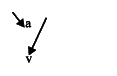
Show here are the velocity and acceleration vectors for an object in several different types of motion. In which case is the object slowing down and turning to the left ?

A

B

C

D

Text Solution

AI Generated Solution

The correct Answer is:

To determine in which case the object is slowing down and turning to the left, we need to analyze the relationship between the velocity and acceleration vectors in the given options. Here’s a step-by-step solution: ### Step 1: Understand the Concepts - **Velocity Vector**: Indicates the direction in which the object is moving. - **Acceleration Vector**: Indicates the change in velocity. If the acceleration is in the opposite direction to the velocity, the object is slowing down (deceleration). - **Turning Left**: For an object to be turning left, the acceleration vector must have a component directed to the left. ### Step 2: Analyze Each Option We have four options (A, B, C, D) to analyze. #### Option A: - **Velocity and Acceleration Direction**: Both vectors point in the same direction. - **Conclusion**: The object is speeding up, not slowing down. **(Incorrect)** #### Option B: - **Velocity Direction**: The velocity vector points in one direction. - **Acceleration Direction**: The acceleration vector points in the opposite direction to the velocity and has a leftward component. - **Conclusion**: The object is slowing down and has a leftward component in acceleration. **(Correct)** #### Option C: - **Velocity and Acceleration Direction**: The vectors are perpendicular to each other. - **Conclusion**: This represents uniform motion; the object is neither speeding up nor slowing down. **(Incorrect)** #### Option D: - **Velocity and Acceleration Direction**: Both vectors point in the same direction. - **Conclusion**: The object is speeding up. **(Incorrect)** ### Step 3: Final Conclusion After analyzing all options, we find that **Option B** is the correct answer as it satisfies both conditions: the object is slowing down and turning to the left.
Promotional Banner

Topper's Solved these Questions

  • MOTION IN A STRAIGHT LINE & PLANE

    VMC MODULES ENGLISH|Exercise IMPECCABLE|52 Videos
  • MOTION IN A STRAIGHT LINE & PLANE

    VMC MODULES ENGLISH|Exercise ENABLE|50 Videos
  • MOCK TEST 9

    VMC MODULES ENGLISH|Exercise PHYSICS (SECTION 2)|5 Videos
  • Motion in Straight Line

    VMC MODULES ENGLISH|Exercise IN-CHAPTER EXERCISE-J|10 Videos

Similar Questions

Explore conceptually related problems

Figure shows the velocity-displacement curve for an object moving along a straight line. At which of the points marked is the object speeding up?

Figure shows the velocity-displacement curve for an object moving along a straight line. At which of the points marked is the object speeding up?

Figure shows path followed by a particle and position of a particle at any instant. Four different students have represented the velocity vectors and acceleration vectors at the given instant. Which vector diagram can not be true in any situation? (In each figure velocity is tangential to the trajectory).

Figure shows a path followed by a particle and position of a particle at any instant. Four different students have represented the velocity vectors and acceleration vectors at the given instant. Which vector diagram cannot be true in any situation? (In each figure, velocity is tangential to the trajectory).

Match the following. At a certain moment in time the angle between the velocity vecv of a particle and the acceleration vector a of that particle is 0. Match the type of motion of the particle at this moment for different theta is

Mark the correct statements for a particle go ing on a straight line: (a) If the velocity and acceleration have opposite sign, the object is slowing down. (b) If the position and velocity have opposite sign, the particle is moving towards the origin. (c) If the velocity is zero at an instant, the acceleration should also be zero at that instant. (d) If the velocity is zero for a time interval, the acceleration is zero at any instant within the time interval.

The relation between the acceleration and time for an object is given below. Calculate the velocity with which the object is moving at t = 1 s. a=3t-4t^(2)

Say Yes or No: a. Can an object moving towards north have acceleration towards south? b. Can an object reverse the direction of its motion even thouth it has reverse the direcleration? C. Can an object reverse the derction of its acceleration even though it continues to move in the same dirction? d. Average speed is the magnitude of average velocity e. At any instant of time. the directions of change in velocity and acceleration are differnt.

Figure shows the velocity and acceleration of a point line body at the initial moment of its motion. The acceleration vector of the body remains constant. The minimum radius of curvature of trajectory of the body is

Assertion In projectile motion, the angle between instanteneous velocity vector and acceleration vector can be anything between o to pi (excluding the limiting case) Reason In projectile motion, acceleration vector is always pointing vertically downwards. (Neglect air friction.)

VMC MODULES ENGLISH-MOTION IN A STRAIGHT LINE & PLANE -EFFICIENT
  1. A swimmer wishes to reach directly opposite bank of a river, flowing w...

    Text Solution

    |

  2. A particle has a velocity u towards east at t = 0. Its acceleration is...

    Text Solution

    |

  3. Show here are the velocity and acceleration vectors for an object in s...

    Text Solution

    |

  4. A projectile is thrown with an initial velocity of (a hati +b hatj) ms...

    Text Solution

    |

  5. An old man moves on a semi-circular track of radius 7 km during a morn...

    Text Solution

    |

  6. A hall has the dimensions 10m xx 10m xx 10 m. A fly starting at one co...

    Text Solution

    |

  7. A train moves with a speed o f30kmh^(-1) in the first 15 minutes,with...

    Text Solution

    |

  8. Two particles are moving with velocities v(1) and v2 . Their relative ...

    Text Solution

    |

  9. A body is projected vertically up with a velocity v and after some ti...

    Text Solution

    |

  10. An aeroplane is flying in a horizontal direction with a velocity of 90...

    Text Solution

    |

  11. A body falls freely from a height of 50 m. Simultaneously, another bod...

    Text Solution

    |

  12. A particle is projected vertically upwards and it reaches the maximum ...

    Text Solution

    |

  13. A balloon rises from rest on the ground with constant acceleration g/8...

    Text Solution

    |

  14. A body iniitially at rest is moving with uniform acceleration a. Its v...

    Text Solution

    |

  15. A javelin thrown into air at an angle with the horizontal has a range ...

    Text Solution

    |

  16. Two stones are projected with the same speed but making different angl...

    Text Solution

    |

  17. The table shows the distance covered in successive seconds by a body a...

    Text Solution

    |

  18. Which of the following distance time graphs is possible ?

    Text Solution

    |

  19. Figure shows the displacement -time curve of the particles P and Q. Wh...

    Text Solution

    |

  20. A body moves in a straight line along Y-axis. Its distance y in metre...

    Text Solution

    |
