Home
Class 12
PHYSICS
The block of mass M moving on the frict...

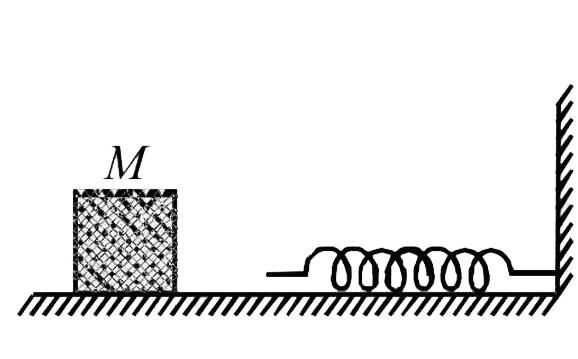
The block of mass `M` moving on the frictionless horizontal surface collides with the spring constant `k` and compresses it by length `L` . The maximum momention of the block after collision is

A

Zero

B

`(ML^(2))/(K)`

C

`sqrt(MK)L`

D

`(KL^(2))/(2M)`

Text Solution

Verified by Experts

The correct Answer is:

C
Promotional Banner

Topper's Solved these Questions

  • WORK ENERGY AND POWER

    VMC MODULES ENGLISH|Exercise EFFICIENT|50 Videos
  • WORK ENERGY AND POWER

    VMC MODULES ENGLISH|Exercise IMPECCABLE|54 Videos
  • WORK ENERGY AND POWER

    VMC MODULES ENGLISH|Exercise IMPECCABLE|54 Videos
  • WAVE MOTION

    VMC MODULES ENGLISH|Exercise JEE ADVANCED ARCHIVE LEVEL 2 (TRUE FALSE TYPE)|4 Videos

Similar Questions

Explore conceptually related problems

A block of mass m moving with velocity v_(0) on a smooth horizontal surface hits the spring of constant k as shown. The maximum compression in spring is

A body of mass 5 kg moving with a speed of 1.5 m/s on a horizontal smooth surface collides with a nearly weightless spring of force constant k = 5 N/m. The maximum compression of the spring would be

A block of mass 2.0 kg is moving on a frictionless horizontal surface with a velocity of 1.0 m/s figure towards another block of equal mass kept at rest. The spring constant of the spring fixed at one end is 100 N/m. Find the maximum compression of the spring.

A block of mass m_1 resting on a frictionless horizontal surface is connected to a spring of spring constant k that is anchored in a near by wall. A block of mass m_2 is placed on the top of the first block. The coefficient of static friction between the two blocks is mu Assuming that the two blocks move together as a unit, find the period of oscillation of the system and also find maximum oscillation amplitude that permits the two bodies to move as a unit.

A 16kg block moving on a frictionless horizontal surface with a velocity of 4m//s compresses an ideal spring and comes to rest. If the force constant of the spring be 100N//m , then how much is the spring commpressed ?

A mass of 0.5 kg moving with a speed of 1.5 m//s on a horizontal smooth surface, collides with a nearly weightless spring of force constant k =50 N//m The maximum compression of the spring would be.

Two blocks of masses m_(1)= 2 kg and m_(2) = 4 kg are moving in the same direction with speeds v_(1) = 6 m//s and v_(2) = 3 m//s , respectively on a frictionless surface as shown in the figure. An ideal spring with spring constant k = 30000 N//m is attached to the back side of m_(2) . Then the maximum compression of the spring after collision will be

A block of mass m is pushed against a spring of spring constant k fixed at one end to a wall.The block can slide on a frictionless table as shown in the figure. The natural length of the spring is L_0 and it is compressed to one fourth of natural length and the block is released.Find its velocity as a function of its distance (x) from the wall and maximum velocity of the block. The block is not attached to the spring.

Two blocks A and B of mass 2m and m respectively are connected to a massless spring of force constant K as shown in figure A and B are moving on the horizontal frcitionless surface with velocity v to right with underformed spring. If B collides with C elastically, then maximum compression of the spring will be

Two blocks A and B of masses in and 2m , respectively, are connected with the help of a spring having spring constant, k as shown in Fig. Initially, both the blocks arc moving with same velocity v on a smooth horizontal plane with the spring in its natural length. During their course of motion, block B makes an inelastic collision with block C of mass m which is initially at rest. The coefficient of restitution for the collision is 1//2 . The maximum compression in the spring is

VMC MODULES ENGLISH-WORK ENERGY AND POWER -ENABLE
  1. A small sphere of mass m is suspended by a thread of length l. It is r...

    Text Solution

    |

  2. An elastic spring of unstretched length L and spring constant K is str...

    Text Solution

    |

  3. A man weighing 60 kg climbs up a staircase carrying a load of 20 kg on...

    Text Solution

    |

  4. The average human heart forces four litre of blood per minute through ...

    Text Solution

    |

  5. The power supplied by a force acting on a particle moving in a straigh...

    Text Solution

    |

  6. The particle of mass m is moving in a circular path of constant radius...

    Text Solution

    |

  7. A particle moves with a velocity 5hati-3hatj+6hatk ms^(-1) under the i...

    Text Solution

    |

  8. A spherical ball of mass 20 kg is stationary at the top of a hill of h...

    Text Solution

    |

  9. The block of mass M moving on the frictionless horizontal surface col...

    Text Solution

    |

  10. A ball is released from the top of a tower. The ratio of work done by ...

    Text Solution

    |

  11. Power applied to a particle varices with time as P =(3t^(2)-2t + 1) wa...

    Text Solution

    |

  12. Power supplied to a mass 2 kg varies with time as P = (3t^(2))/(2) wat...

    Text Solution

    |

  13. If the heart pushes 1 cc of blood in one second under pressure 20000 N...

    Text Solution

    |

  14. A particle is moving along x-axis under the action of a force, F which...

    Text Solution

    |

  15. A stationary body explodes into two fragments of masses m(1) and m(2)....

    Text Solution

    |

  16. A particle moves with a velocity 5hati-3hatj+6hatk ms^(-1) under the i...

    Text Solution

    |

  17. An open knife edge of mass M is dropped from a height h on a wooden fl...

    Text Solution

    |

  18. A bread gives a boy of mass 40 kg an energy of 21 kJ. If the efficienc...

    Text Solution

    |

  19. A vertical spring with force constant K is fixed on a table. A ball of...

    Text Solution

    |

  20. A particle of mass m(1) is moving with a velocity v(1) and another pa...

    Text Solution

    |
