Home
Class 12
PHYSICS
According to the theorem of parallel axe...

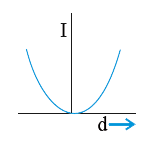
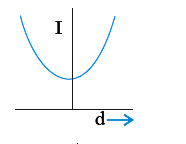
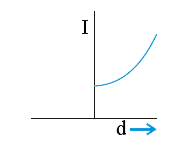
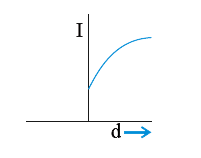
According to the theorem of parallel axes `I = I_("cm") + Mx^(2)`, the graph between I and x will be

A

B

C

D

Text Solution

AI Generated Solution

The correct Answer is:

To solve the problem regarding the graph between moment of inertia \( I \) and distance \( x \) according to the theorem of parallel axes, we can follow these steps: ### Step 1: Understand the Theorem of Parallel Axes The theorem states that the moment of inertia \( I \) about any axis parallel to an axis through the center of mass (CM) is given by: \[ I = I_{\text{cm}} + Mx^2 \] where: - \( I \) is the moment of inertia about the new axis, - \( I_{\text{cm}} \) is the moment of inertia about the center of mass axis, - \( M \) is the mass of the body, - \( x \) is the distance between the two parallel axes. ### Step 2: Analyze the Equation From the equation, we can see that \( I \) is a function of \( x^2 \). This indicates that the relationship between \( I \) and \( x \) is quadratic. ### Step 3: Determine the Value of \( I \) at \( x = 0 \) When \( x = 0 \): \[ I = I_{\text{cm}} + M(0)^2 = I_{\text{cm}} \] This means that the moment of inertia \( I \) at \( x = 0 \) is equal to \( I_{\text{cm}} \), which is a non-zero constant. ### Step 4: Behavior of \( I \) as \( x \) Increases As \( x \) increases (either positively or negatively), the term \( Mx^2 \) increases, leading to an increase in \( I \). Thus, \( I \) increases as \( |x| \) increases. ### Step 5: Graphical Representation Since \( I \) is proportional to \( x^2 \), the graph of \( I \) versus \( x \) will be a parabola opening upwards. The vertex of this parabola is at the point where \( x = 0 \) and \( I = I_{\text{cm}} \). ### Step 6: Conclusion about the Graph The graph will not intersect the x-axis (since \( I \) is never zero for \( x = 0 \)), and it will be symmetric about the y-axis because \( I \) depends on \( x^2 \). Therefore, the graph will extend upwards on both sides of the origin. ### Final Answer The graph between \( I \) and \( x \) will be a parabola that opens upwards, with its vertex at \( (0, I_{\text{cm}}) \). ---
Promotional Banner

Topper's Solved these Questions

  • SYSTEM OF PARTICLES AND ROTATIONAL MOTION

    VMC MODULES ENGLISH|Exercise ENABLE|50 Videos
  • SYSTEM OF PARTICLES AND ROTATIONAL MOTION

    VMC MODULES ENGLISH|Exercise EFFICIENT|50 Videos
  • SYSTEM OF A PARTICLES & ROTATIONAL MOTION

    VMC MODULES ENGLISH|Exercise IN-CHAPTER EXERCISE F|10 Videos
  • UNITS, MEASUREMENTS & ERRORS

    VMC MODULES ENGLISH|Exercise IN - CHAPTER EXERCISE - B|10 Videos

Similar Questions

Explore conceptually related problems

By the theorem of parallel axes:

State theorem of parallel axes.

Statement-1: if moment of inertia of a rigid body is equal about two axis, then both the axis must be parallel. Statement-2 from parallel axis theorem I=I_(cm)+md^(2) , where all terms have usual meaning.

The intensity of a light pulse travelling along a communication channel decreases exponetially with distance x according to the relation I=I_(0)e^(-ax) where I_(0) is the intensity at x=0 and alpha is the attenuation constant. The percentage decrease in intensity after a distance of (("In"4)/(alpha)) is

A, B and C are parallel conductors of equal length carrying currents I, I and 2I respectively. Distance between A and B is x . Distance between B and C is also x . F_(1) is the force exerted by B on A and F_(2) is the force exerted by B on C choose the correct answer

An alternating current I in an inductance coil varies with time t according to the graph as shown: Which one of the following graph gives the variation of voltage with time?

An alternating current I in an inductance coil varies with time t according to the graph as shown: Which one of the following graph gives the variation of voltage with time?

Assertion: Moment of inertia of a rigid body about any axis passing through its centre of mass is minimum Reason: From theorem of parallel axis I=I_(cm)+Mr^(2)

State (i) parallel axes theorem and (ii) perpendicular axes theorem.

A square plate lies in the xy plane with its centre at the origin and its edges parallel to the x and y axes. Its moments of inertia about the x, y and z axes are I_(x), I_(y) and I_(Z) respectively, and about a diagonal it is I_(D)

VMC MODULES ENGLISH-SYSTEM OF PARTICLES AND ROTATIONAL MOTION-IMPECCABLE
  1. According to the theorem of parallel axes I = I("cm") + Mx^(2), the g...

    Text Solution

    |

  2. The angular momentum of body remains conserve if :

    Text Solution

    |

  3. A circular disc is to be made using iron and aluminium. To keep its mo...

    Text Solution

    |

  4. If rotational kinetic energy is 50% of total kinetic energy then the ...

    Text Solution

    |

  5. A person is standing on the edge of a circular platform, which is movi...

    Text Solution

    |

  6. A thin circular ring of mass M and radius r is rotating about its axis...

    Text Solution

    |

  7. A solid cylinder of mass M and radius R rolls without slipping down an...

    Text Solution

    |

  8. A bull rolls without slipping. The radius of gyration of the ball abou...

    Text Solution

    |

  9. The moment of inertia in rotational motion is equivalent to :

    Text Solution

    |

  10. Two rods each of mass m and length 1 are joined at the centre to form ...

    Text Solution

    |

  11. A wheel has moment of inertia 5 xx 10^(-3) kg m^(2) and is making 20 "...

    Text Solution

    |

  12. The ratio of the radii of gyration of a circular disc about a tangenti...

    Text Solution

    |

  13. A round disc of moment of inertia I2 about its axis perpendicular to i...

    Text Solution

    |

  14. Three particles, each of mass m are situated at the vertices of an equ...

    Text Solution

    |

  15. A wheel having moment of inertia 2 kg m^(2) about its vertical axis, r...

    Text Solution

    |

  16. In an orbital motion, the angular momentum vector is :

    Text Solution

    |

  17. A solid cylinder of mass 20kg has length 1 m and radius 0.2 m. Then it...

    Text Solution

    |

  18. A constant torque acting on a uniform circular changes its angular mom...

    Text Solution

    |

  19. A dancer is standing on a rotating platform taking two sphere on her ...

    Text Solution

    |

  20. The rate of change of angular momentum is called

    Text Solution

    |

  21. Two bodies have their moments of inertia I and 2I respectively about t...

    Text Solution

    |
