Home
Class 12
PHYSICS
A student is asked to measure the wavele...

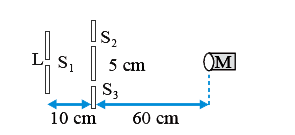
A student is asked to measure the wavelength of monochromatic light. He sets up the apparatus sketched below `S_(1),S_(2),S_(3)` are narrow parallel slits, L is a sodium lamp and M is a micrometer eye-piece. The student fails to observe interference fringes. You would advise him to:

A

Increase the width of `S_(1)`

B

Decrease the distance between `S_(2)` and `S_(3)`

C

Replace L with a white light source

D

Replace M with a telescope

Text Solution

Verified by Experts

The correct Answer is:

B
Promotional Banner

Topper's Solved these Questions

  • RAY OPTICS AND WAVE OPTICS

    VMC MODULES ENGLISH|Exercise IMPECCABLE|58 Videos
  • RAY OPTICS AND WAVE OPTICS

    VMC MODULES ENGLISH|Exercise ENABLE|50 Videos
  • RAY OPTICS

    VMC MODULES ENGLISH|Exercise IN-CHAPTER EXERCISE-J|10 Videos
  • REVISION TEST-15 JEE - 2020

    VMC MODULES ENGLISH|Exercise PHYSICS|25 Videos

Similar Questions

Explore conceptually related problems

Consider the situation shown in figure. The two slite S_1 and S_2 placed symmetrically around the centre line are illuminated by a monochromatic light of wavelength lambda. The separation between the slits is d. The light transmitted by the slits falls on a screen M_1 placed at a distance D from the slits. The slit S_3 is at the centre line and the slit S_4 is at a distance y form S_3 . Another screen M_2 is placed at a further distance D away from M_1 . Find the ration of the maximum to minimum intensity observed on M_2 if y is equal to (dltltD) .

In a young's doule slits experiment, a monochromatic source of wavelength lambda is used to illuminate the two slits S_(1) and S_(2) . The slitss S_(1) and S_(2) are identical and source S is placed symmetrically as shown. interference pattern is observed on a screen at a distance D from the centre of slit. The distance between the slits is d. If the source is moved up by a very small distance y_(0) , the central maxima will shift

Consider the situation shown in figure. The two slits S_1 and S_2 placed symmetrically around the central line are illuminated by a monochromatic light of wavelength lamda . The separation between the slits is d. The light transmitted by the slits falls on a screen Sigma_1 placed at a distance D from the slits. The slit S_3 is at the placed central line and the slit S_4 , is at a distance z from S_3 . Another screen Sigma_2 is placed a further distance D away from 1,1. Find the ratio of the maximum to minimum intensity observed on Sigma_2 if z is equal to a. z=(lamdaD)/(2d) b. (lamdaD)/d c. (lamdaD)/(4d)

In arrangement shown in figure, plane wavefront of monochromatic light of wavelength lamda is incident on identical slits S_(1) and S_(2) . There is another pair of indentical slits S_(3) and S_(4) which are having separation Z = (lamda D)/(2d) Point O is on the screen at the common perpendicular bisector of S_(1)S_(2) and S_(3) S_(4).I_(1) is the intensity at point O Now the board having slits S_(3)S_(4) is moved upward parallel to itself and perpendicular to line AO till slit S_(4) is on line AO and it is observed that now intensity at point O is I_(2) then (I_(2))/(I_(1)) is :

While conduction the Young's double slit experiment, a student replaced the two slits with a large opaque plate in the x-y plane containing two small holes that act as two coherent point sources (S_(1),S_(2)) emitting light of wavelength 600nm. The student mistakenly placed the screen parallel to the x-z plane (for zgt0) at a distance D=3 m from the mid-point of S_(1) , S_(2) , as shown schematically in the figure. The distance between the sources d=0.6003 mm . The origin O is at the intersection of the screen and the line joining S_(1)S_(2) . Which of the following is (are) true of the intensity pattern of the screen?

A vessel ABCD of 10 cm width has two small slits S_(1) and S_(2) sealed with idebtical glass plates of equal thickness. The distance between the slits is 0.8 mm . POQ is the line perpendicular to the plane AB and passing through O, the middle point of S_(1) and S_(2) . A monochromatic light source is kept at S, 40 cm below P and 2 m from the vessel, to illuminate the slits as shown in the figure. Calculate the position of the central bright fringe on the other wall CD with respect of the line OQ . Now, a liquid is poured into the vessel and filled up to OQ . The central bright fringe is fiund to be at Q. Calculate the refractive index of the liquid.

In YDSE's experiment performed in a medium of refractive index (4/3), a light of 60 nm wavelength is falling ono the slits having 0.45 mm separation.t he lower slit S_(2) is covered by a thin glass sheet of thickness 10.4 mum and refractive index 1.5 the interference pattern is observed on a screen palced 1.5m from the slits as shown int hef ignore dispersion. Q. If white light of range 400-700 nm has replaced 600 nm light, one of the wavelengths of light that forms maxima exactly at point O wll be:

A YDSE is performed in a medium of refractive index 4 // 3 , A light of 600 nm wavelength is falling on the slits having 0.45 nm separation . The lower slit S_(2) is covered b a thin glass plate of thickness 10.4 mm and refractive index 1.5. The interference pattern is observed on a screen placed 1.5 m from the slits as shown in figure. (All the wavelengths in this problem are for the given medium of refractive index 4 // 3 , ignore absorption.) Find the light intensity at point O relative t maximum fringe intensity.

A YDSE is performed in a medium of refractive index 4 // 3 , A light of 600 nm wavelength is falling on the slits having 0.45 nm separation . The lower slit S_(2) is covered b a thin glass plate of thickness 10.4 mm and refractive index 1.5. The interference pattern is observed on a screen placed 1.5 m from the slits as shown in figure. (All the wavelengths in this problem are for the given medium of refractive index 4 // 3 , ignore absorption.) The location of the central maximum (bright fringe with zero path difference) on the y-axis will be

A YDSE is performed in a medium of refractive index 4 // 3 , A light of 600 nm wavelength is falling on the slits having 0.45 nm separation . The lower slit S_(2) is covered b a thin glass plate of thickness 10.4 mm and refractive index 1.5. The interference pattern is observed on a screen placed 1.5 m from the slits as shown in figure. (All the wavelengths in this problem are for the given medium of refractive index 4 // 3 , ignore absorption.) Now, if 600 nm, find the wavelength of the ligth that forms maximum exactly at point O.

VMC MODULES ENGLISH-RAY OPTICS AND WAVE OPTICS -EFFICIENT
  1. Two ideal slits S(1) and S(2) are at a distance d aprt and illuminated...

    Text Solution

    |

  2. In a double-slit experiment, fringes are produced using light of wavel...

    Text Solution

    |

  3. A student is asked to measure the wavelength of monochromatic light. H...

    Text Solution

    |

  4. In YDSE, having slits of equal width, let beta be the fringe width and...

    Text Solution

    |

  5. In an experiment to find focal length of a concave mirror, a graph is ...

    Text Solution

    |

  6. A point source of light S, placed at a distance L in front of the cen...

    Text Solution

    |

  7. Figure shows two rays A and B beig reflected by a mirror and going as ...

    Text Solution

    |

  8. An object is initially at a distance of 100 cm from a plane mirr...

    Text Solution

    |

  9. An object placed in front of a plane mirror is displaced by 0.4 m alon...

    Text Solution

    |

  10. An object 2.5 cm high is placed at a distance of 10 cm from a concav...

    Text Solution

    |

  11. A diminished virtual image can be formed only in

    Text Solution

    |

  12. A plane mirror is placed at the bottom of a tank containing a liquid o...

    Text Solution

    |

  13. One side of a glass slab is silvered as shown. A ray of light is incid...

    Text Solution

    |

  14. If an object moves towards a plane mirror with a speed v at an angle t...

    Text Solution

    |

  15. A point object is moving on the principal axis of a concave mirror of ...

    Text Solution

    |

  16. A concave mirror of radius of curvature 60 cm is placed at the bottom ...

    Text Solution

    |

  17. A piece of wire bent into an L shape with upright and horizontal porti...

    Text Solution

    |

  18. A concave mirror has a focal length 20 cm. The distance between the tw...

    Text Solution

    |

  19. A concave mirror of focal length 10cm and a convex mirror of focal len...

    Text Solution

    |

  20. A fish rising up vertically toward the surface of water with speed 3m...

    Text Solution

    |
