Home
Class 12
PHYSICS
Two beams of light are incident normally...

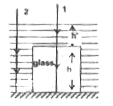
Two beams of light are incident normally on water (R.l. = `4/3`). If the beam 1 passes through a glass (R.l. = `3/2`) slab of height h as shown in the figure, the time difference for both beams for reaching the bottom is

A

zero

B

`(h^('))/(6C)`

C

`(6h)/C`

D

`h/(6C)`

Text Solution

Verified by Experts

The correct Answer is:

D
Promotional Banner

Topper's Solved these Questions

  • RAY OPTICS AND WAVE OPTICS

    VMC MODULES ENGLISH|Exercise IMPECCABLE|58 Videos
  • RAY OPTICS AND WAVE OPTICS

    VMC MODULES ENGLISH|Exercise ENABLE|50 Videos
  • RAY OPTICS

    VMC MODULES ENGLISH|Exercise IN-CHAPTER EXERCISE-J|10 Videos
  • REVISION TEST-15 JEE - 2020

    VMC MODULES ENGLISH|Exercise PHYSICS|25 Videos

Similar Questions

Explore conceptually related problems

Two parallel beams of light P and Q are incident normally on a prism and the transmitted rays are brought to focus with the help of a convergent lens as shown in Fig. 2.23. If the intensities of the upper and lower beams immediately after transmission from face AC are 4I abd I, respectively, find the resultant intensity at the focus.

A laser beam propagates through a spherically symmetric medium, as shown in the figure. The refractive index varies with the distance to the symmetry centre C by the law mu(r )=mu_(0)(r )/(r_(0)) , where mu_(0)=1 , r_(0)=3cm , r_(0) le r lt oo . The beam's trajectory lies in the plane that includes C . At distance r_(1)=8sqrt(2)cm the beam makes an angle phi=30^(@) with vecr_(1) as shown in the figure. Find the minimum distance (in cm ) the beam reach relative to the symmetry centre C .

Two parallel rays are travelling in a medium of refractive index mu_(1)=4//3 . One of the rays passes through a parallel glass slab of thickness t and refractive index mu_(2)=3//2 . The path difference between the two rays due to the glass slab will be

A massless beam of langth 5 m is placed on two wedges A and B. If three forces 3 kN, 4 kN and 5 kN are applied on the beam as shown in the figure, then find normal reaction at A and B.

A parallel beam of light is incident normally on the flat surface of a hemisphere of radius 6 cm and refractive index 1.5 , placed in air as shown in figure (i). Assume paraxial ray approxiamtion. .

Light passes through a rectangular glass slab and through a triangular glass prism. In what way does the direction of the two emergent beams differ and why?

A diverging beam of light from a point source S having devergence angle alpha , falls symmetrically on a glass slab as shown. The angles of incidence of the two extreme rays are equal. If the thickness of the glass slab is t and the refractive index n, then the divergence angle of the emergent beam is

A beam of light falls on a glass plate (mu=3//2) of thickness 6.0 cm at an angle of 60^(@) . Find the deflection of the beam on passing through the plate. (in cm).

A beam of light from the point A(3,10) reflects from the line 2x+y-6=0 and then passes through the point B(5, 6).The equation of reflected beam is :

A beam of light from the point A(3,10) reflects from the line 2x+y-6=0 and then passes through the point B(5, 6).The equation of reflected beam is :

VMC MODULES ENGLISH-RAY OPTICS AND WAVE OPTICS -EFFICIENT
  1. A concave mirror has a focal length 20 cm. The distance between the tw...

    Text Solution

    |

  2. A concave mirror of focal length 10cm and a convex mirror of focal len...

    Text Solution

    |

  3. A fish rising up vertically toward the surface of water with speed 3m...

    Text Solution

    |

  4. A point object is placed at distance of 30 cm in front of a convex mi...

    Text Solution

    |

  5. Two beams of light are incident normally on water (R.l. = 4/3). If the...

    Text Solution

    |

  6. A beaker containing liquid is placed on a table, underneath a microsco...

    Text Solution

    |

  7. A ray of light is incident at an angle i from denser to rare medium. T...

    Text Solution

    |

  8. A ray of light travelling in a transparent medium falls on a surface s...

    Text Solution

    |

  9. The size of the image of an object, which is at infinity, as formed by...

    Text Solution

    |

  10. The focal length of a convex lens of R.I. 1.5 is f when it is placed i...

    Text Solution

    |

  11. A point object O is placed on the principal axis of a convex lens of f...

    Text Solution

    |

  12. A plano-convex lens when silvered in the plane side behaves like a con...

    Text Solution

    |

  13. A glass sphere of radius 5 cm has a small bubble at a distance 2 cm fr...

    Text Solution

    |

  14. The focal length of a convex mirror is 20 cm its radius of curvature w...

    Text Solution

    |

  15. An object is placed at a point distant x from the focus of a convex le...

    Text Solution

    |

  16. The distance between object and the screen is D. Real images of an obj...

    Text Solution

    |

  17. A plano- convex lens fits exactly into a plano- concave lens. Their pl...

    Text Solution

    |

  18. A prism of refractive index m and angle A is placed in the minimum dev...

    Text Solution

    |

  19. A ray PQ incident on the refracting face BA is refracted in the prism ...

    Text Solution

    |

  20. An isosceles prism of angle 120^(@) has a refractive index 1.44. Two p...

    Text Solution

    |
