Home
Class 12
CHEMISTRY
An ideal gas is taken around the cycle A...

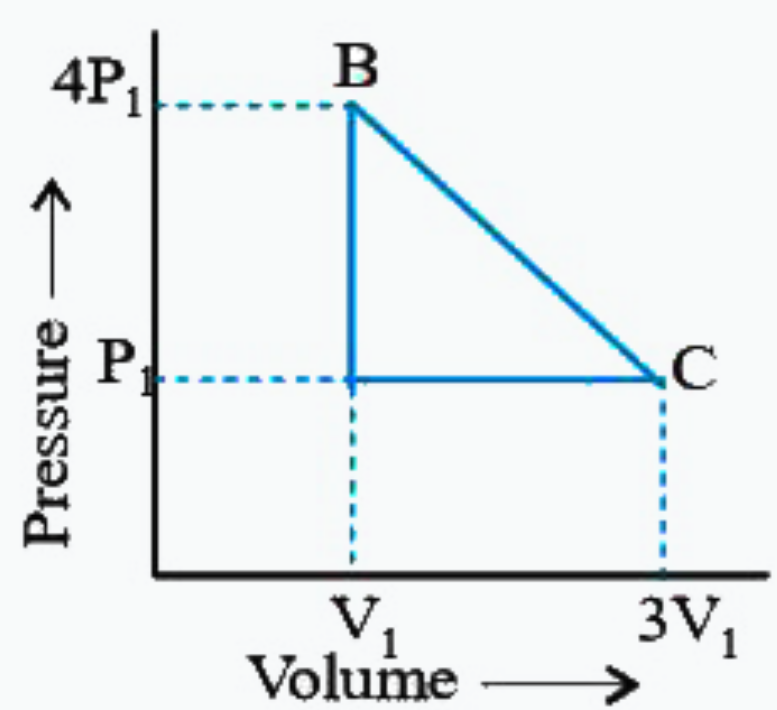
An ideal gas is taken around the cycle ABCA as shown below:
Work done in the cyclic process is

A

`12P_(1)V_(1)`

B

`6P_(1)V_(1)`

C

`3P_(1)V_(1)`

D

Zero

Text Solution

Verified by Experts

The correct Answer is:

C
Promotional Banner

Topper's Solved these Questions

  • THERMODYNAMICS & THERMOCHEMISTRY

    VMC MODULES ENGLISH|Exercise Impeccable|48 Videos
  • THERMODYNAMICS & THERMOCHEMISTRY

    VMC MODULES ENGLISH|Exercise Enable|49 Videos
  • THERMODYNAMICS

    VMC MODULES ENGLISH|Exercise JEE ADVANCED (ARCHIVE)|44 Videos

Similar Questions

Explore conceptually related problems

A sample of an ideal monoatomic gas is taken round the cycle ABCA as shown in the figure the work done during the cycle is

An ideal gas is taken around the cycle ABCA as shown in P-V diagram. The net work done by the gas during the cycle is equal to :

An ideal gas is taken around the cycle ABCA as shown in P-V diagram. The net work done by the gas during the cycle is equal to :

An ideal monoatomic gas is taken round the cycle ABCDA as shown in the P-V diagram. The work done during the cycle is

An ideal monoatomic gas is taken round the cycle ABCDA as shown in the P-V diagram. The work done during the cycle is

An ideal monoatomic gas is taken round the cycle ABCDA as shown in the P-V diagram. The work done during the cycle is

An ideal gas is taken around the cycle ABCA as shown in the P-V diagram. The total work done by the gas during the cycle is

An ideal gas is taken around the cycle ABCA shown in P - V diagram. The net work done by the gas during the cycle is equal to

An ideal gas is taken around the cycle ABCA shown in P - V diagram. The net work done by the gas during the cycle is equal to

An ideal gas is taken around the cycle ABCD shown in the P_V diagram below. The net work done by the gas during the cycle is equal to

VMC MODULES ENGLISH-THERMODYNAMICS & THERMOCHEMISTRY-Efficient
  1. Consider the following two reactions : (i) "Propene "+H(2) rarr "Pro...

    Text Solution

    |

  2. Match the thermodynamic property given in column I with its correct cx...

    Text Solution

    |

  3. An ideal gas is taken around the cycle ABCA as shown below: Work do...

    Text Solution

    |

  4. Which among the following is not an exact differential?

    Text Solution

    |

  5. A gas expands adiabatically at constant pressure such that: T prop(1...

    Text Solution

    |

  6. In the Haber 's process of ammonia manufacture: N(2) (g)+3H(2) (g) t...

    Text Solution

    |

  7. In C(2)H(4) energies of formation of (C=C) and (C-C) are -145 kJ/mol a...

    Text Solution

    |

  8. If 150 kJ of energy is needed for muscular work to walk a distance of ...

    Text Solution

    |

  9. A mol of Al(3)C(4)(s) reacts with water in a closed vessel at 27^(@)C ...

    Text Solution

    |

  10. triangleG^@ and triangleH^(@) for a reaction at 300K are -66.9 kJ/mole...

    Text Solution

    |

  11. A gaseous reaction was carried out first keeping the volume constant a...

    Text Solution

    |

  12. The standard entropies of CO(2(g)), C((s)), and O(2(g)) are 213.5, 5.7...

    Text Solution

    |

  13. Calcualte DeltaH(f)^(@) for chloride ion from the following data: 1/...

    Text Solution

    |

  14. Mg(s) + 2HCl(aq) rarr Mg Cl(2) (aq) + H(2)(g) , Delta(r )H^(@) = -467 ...

    Text Solution

    |

  15. Given the experimental information below: 2Sr(s) + O(2)(g) rarr 2SrO...

    Text Solution

    |

  16. What is the heat of reaction for the following reaction? CH(4)(g)+NH...

    Text Solution

    |

  17. 25.0 mL of 1.0M HCl is combined with 35.0 mL of 0.5 M NaOH. The initia...

    Text Solution

    |

  18. The reaction 3O(2)(g) rarr 2O(3)(g), Delta(r )H > 0. What can be conc...

    Text Solution

    |

  19. When 5.0 mL of a 1.0 M HCl solution is mixed with 5.0 mL of a 0.1 M Na...

    Text Solution

    |

  20. Which of the following reactions doesn’t represent the standard state ...

    Text Solution

    |
