Home
Class 12
CHEMISTRY
Figure explains elevation in boiling poi...

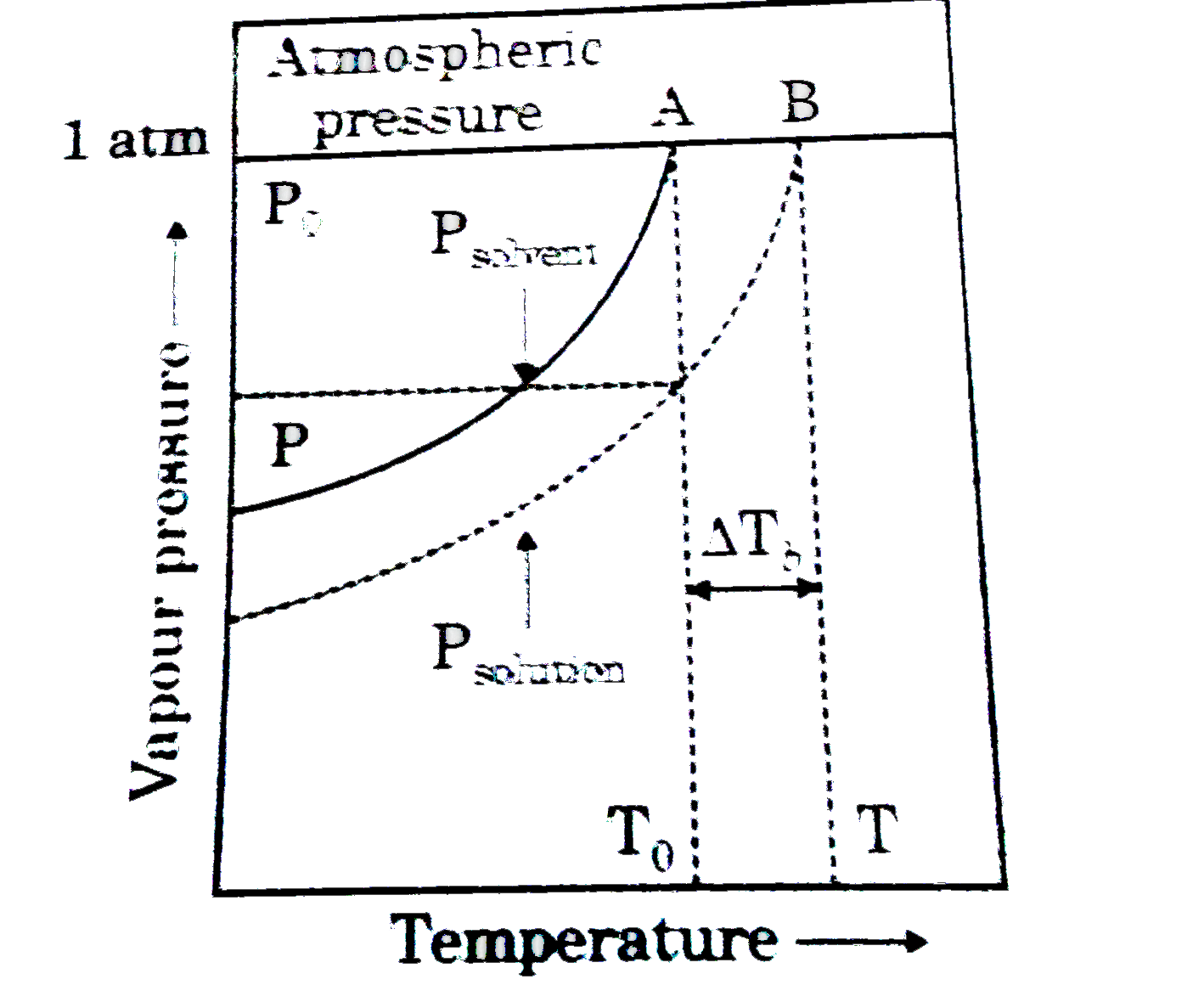
Figure explains elevation in boiling point when a non-volatile solute is added to a solvent. Variation of vapour pressure with temperaure and elevation in boiling point is marked.

Elevation in b.p of an aqueous urea solution is `0.52^(@) (K_(b) = 0.52^(@) mol^(-1)kg)`. Hence, mole fraction of urea in this solution is:

A

0.982

B

0.0567

C

0.943

D

0.018

Text Solution

Verified by Experts

The correct Answer is:

D
Promotional Banner

Topper's Solved these Questions

  • LIQUID SOLUTION

    VMC MODULES ENGLISH|Exercise IMPECCABLE|100 Videos
  • LIQUID SOLUTION

    VMC MODULES ENGLISH|Exercise ENABLE|100 Videos
  • JEE MAIN REVISON TEST-23

    VMC MODULES ENGLISH|Exercise CHEMISTRY (SECTION 1)|25 Videos
  • LIQUID SOLUTIONS

    VMC MODULES ENGLISH|Exercise IN-CHAPTER EXERCISE -L|10 Videos

Similar Questions

Explore conceptually related problems

Consider following figure and answer the questions at the end of it. Figure explains elevation in boiling point when a non-volatile solute is added to a solvent. Variation of vapour pressure with temperature and showing elevation in boiling point. Elevation in boiling point of an aqueous urea solution is 0.52^(@).(K_(b)=0.52^(@)mol^(-1)kg) . Hence, mole fraction of urea in this solution is:

Depression in f.p. of an aqueous urea solutio is 1.86^(@) .(K_(f)=1.86^(@) mol^(-1) kg) Hence, mole - fraction of urea in this soluiton is :

Consider following figure and answer the questions at the end of it. Figure explains elevation in boiling point when a non-volatile solute is added to a solvent. Variation of vapour pressure with temperature and showing elevation in boiling point. A complex of iron and cyanide ions is 100% ionized at 1m (molal). If elevation in boiling point is 2.08^(@)(K_(b)=0.52^(@)mol^(-1)kg) then the complex is:

Elevation in boiling point of an aqueous solution of urea is 0.52 ( k_(b) "for water"=0.52K"molality"^(-1)) . The mole fraction of urea in this solution is :

Consider following figure and answer the questions at the end of it. Figure explains elevation in boiling point when a non-volatile solute is added to a solvent. Variation of vapour pressure with temperature and showing elevation in boiling point. Given that DeltaT_(b) is the elevation in boiling point of the solvent in a solution of molality m then underset(mto0)(Lt)((DeltaT_(b))/(m)) is equal to

Illustrate elevation in boiling point with the help of vapour pressure-temperature curve of a solution. Show that elevation in boiling point is a colligative property.

The mole fraction of the solvent in the solution of a non-volatile solute is 0.980. The relative lowering of vapour pressure is :

An aqueous solution of 0.01 m KCl cause the same elevation in boiling point as an aqueous solution of urea. The concentration of urea solution is :

Calculate elevation in boiling point for 2 molal aqueous solution of glucose. (Given K_b(H_(2)O) = 0.5 kg mol^(-1) )

If the solution boils at a temperature T_1 and solvent at a temperature T_2 the elevation of boiling point is given by:

VMC MODULES ENGLISH-LIQUID SOLUTION -EFFICIENT
  1. Elevation in boiling point of a solution of non-electrolyte in CCl(4) ...

    Text Solution

    |

  2. A solution of a non-volatile solute in water has a boiling point of 37...

    Text Solution

    |

  3. Figure explains elevation in boiling point when a non-volatile solute ...

    Text Solution

    |

  4. Density of 1M solution of a non-electrolyte C(6)H(12)O(6) is 1.18 g/mL...

    Text Solution

    |

  5. When a solution w g of urea in 1Kg of water is cooled to -0.372^(@)C,2...

    Text Solution

    |

  6. The relative decrease in VP of an aqueous glucose dilute solution is f...

    Text Solution

    |

  7. Glucose is added to 1 litre water to such an extent that (DeltaT(f))/(...

    Text Solution

    |

  8. A solution containing 4 g of a non-volatile organic solute per 100 mL ...

    Text Solution

    |

  9. The osmotic pressure of a decimolar solution of glucose at 30^(@)C is ...

    Text Solution

    |

  10. A solution containing 8.6g per dm^(3) of urea (mol. wt. 60) was found...

    Text Solution

    |

  11. The osmotic pressure of a solution containing 100 ml of 3.4% solution ...

    Text Solution

    |

  12. Two solutions each in 100 ml have 4 g glucose and 10 g sucrose respect...

    Text Solution

    |

  13. 5 g of a polymer of molecular mass 50kg mol^(-1) is dissolved in 1dm^(...

    Text Solution

    |

  14. 100 mL aqueous solution of glucose with osmotic pressure 1.2 atm at 25...

    Text Solution

    |

  15. 10 g of solute A and 20gm of solute B are both dissolved in 500ml wate...

    Text Solution

    |

  16. At 10^(@)C, the osmotic pressure of urea solution is 500 mm.The soluti...

    Text Solution

    |

  17. The relationship between osmotic pressure (P) at 273 K when 10g glucos...

    Text Solution

    |

  18. The vapour pressure of ether at 20^(@)C is 442 mm. When 7.2 g of a sol...

    Text Solution

    |

  19. The vapour pressure of pure benzene is 639.7 mm Hg and the vapour pres...

    Text Solution

    |

  20. 1 g of monobasic acid in 100 g of water lowers the freezing point by 0...

    Text Solution

    |
