Home
Class 12
CHEMISTRY
H-C equiv C - H + 2HCl rarrFinal product...

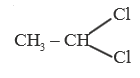
H-C `equiv` C - H + 2HCl `rarr`Final product, final product will be:

A

B

`CH_(2) = `CHCl

C

`underset(Cl)underset(|)(CH_(2)) - underset(Cl)(underset(|)(CH_(2))`

D

none of these

Text Solution

AI Generated Solution

The correct Answer is:

To solve the question regarding the reaction of an alkyne with 2 moles of HCl, we will follow a step-by-step approach to understand the mechanism and identify the final product. ### Step 1: Identify the Reactant We start with an alkyne, which has the general formula C≡C. Alkynes are characterized by having a triple bond between two carbon atoms. ### Step 2: Reaction with HCl When the alkyne reacts with HCl, it undergoes an electrophilic addition reaction. The HCl dissociates into H⁺ (proton) and Cl⁻ (chloride ion). The alkyne acts as a nucleophile and donates its electrons to the H⁺ ion, leading to the formation of a carbocation. ### Step 3: Formation of Carbocation The addition of H⁺ to one of the carbon atoms of the alkyne results in the formation of a carbocation. The structure of the carbocation can be represented as follows: - One carbon atom has an H attached, and the other carbon atom has a positive charge (C⁺). ### Step 4: Attack by Chloride Ion The chloride ion (Cl⁻) from HCl then attacks the electron-deficient carbocation, leading to the formation of a vinyl halide. The structure of the vinyl halide will have a double bond between the two carbon atoms, with one of the carbons bonded to a chlorine atom and the other to a hydrogen atom. ### Step 5: Second Equivalent of HCl Now, since we have another equivalent of HCl, the vinyl halide formed can react again with HCl. The process is similar: the vinyl halide will again donate electrons to H⁺, forming a new carbocation. ### Step 6: Formation of Germinal Dihalide The chloride ion will attack this new carbocation, leading to the formation of a germinal dihalide. The final product will have two chlorine atoms attached to the same carbon atom, along with the hydrogen atom on the other carbon. ### Final Product The final product of this reaction is a germinal dichloride, which can be represented as: - C-Cl - | - C-Cl - | - H Thus, the final product is a germinal dihalide (dichloride). ### Summary of Steps: 1. Start with an alkyne (C≡C). 2. React with HCl to form a carbocation. 3. Chloride ion attacks the carbocation to form a vinyl halide. 4. React vinyl halide with another HCl to form a second carbocation. 5. Chloride ion attacks the second carbocation to form a germinal dichloride.
Promotional Banner

Topper's Solved these Questions

  • HALOALKANES & HALOARENES

    VMC MODULES ENGLISH|Exercise IMPECCABLE|100 Videos
  • HALOALKANES & HALOARENES

    VMC MODULES ENGLISH|Exercise ENABLE|99 Videos
  • ENVIRONMENTAL CHEMISTRY

    VMC MODULES ENGLISH|Exercise JEE Main (Archive)|39 Videos
  • HALOALKANES AND HALOARENES

    VMC MODULES ENGLISH|Exercise IN-CHAPTER EXERCISE - F|6 Videos
VMC MODULES ENGLISH-HALOALKANES & HALOARENES -EFFICIENT
  1. Correct IUPAC name of alkane obtained in the reaciton of 2-chloropropa...

    Text Solution

    |

  2. What is the product formed in the following reaction? C(6)H(5)OH + "...

    Text Solution

    |

  3. H-C equiv C - H + 2HCl rarrFinal product, final product will be:

    Text Solution

    |

  4. 4. Which one of the following compounds does not given C(2)H(5)Cl by t...

    Text Solution

    |

  5. Which one of the following compounds will not given iodoform by the re...

    Text Solution

    |

  6. Ethyl alcohol gives ethyl chloride with the help of

    Text Solution

    |

  7. Hydrolysis of trichloromethane with aqueous KOH gives

    Text Solution

    |

  8. If 1,3- dibromopropane reacts with zinc and NaI, the product obtained ...

    Text Solution

    |

  9. The compound obtained by heating a mixture of a primary amine and chlo...

    Text Solution

    |

  10. product A is:

    Text Solution

    |

  11. The reaction of ethylene bromide with zinc yields:

    Text Solution

    |

  12. Phosgene is:

    Text Solution

    |

  13. Identify (Z) in the following reaction series, C2H5Ioverset("Alcoho...

    Text Solution

    |

  14. A and B in the following reactions are respectively (i) CHCl(3) over...

    Text Solution

    |

  15. Ethyl bromide reacts with sodium lead alloy to form

    Text Solution

    |

  16. Which alkyl chloride shows highest probability of SN1 mechanism?

    Text Solution

    |

  17. C(6)H(6) + CH(3) Cl underset(AlCl(3))overset("Anhydrous")(rarr) C(6)H(...

    Text Solution

    |

  18. The product obtained by the reaction of silver propanoate with bromine...

    Text Solution

    |

  19. Which one of the following gives iodoform test?

    Text Solution

    |

  20. Chloroform is:

    Text Solution

    |
