Home
Class 12
CHEMISTRY
The first and second ionization enthalpi...

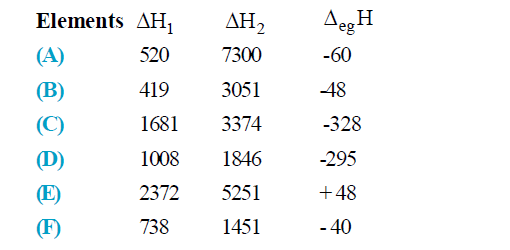
The first and second ionization enthalpies and electron gain enthalpy of some elements are as given below:

A metal which can form a stable binary halide of the type `MX_2` is (X : Halogen)

A

(A)

B

(B)

C

(F)

D

(D)

Text Solution

Verified by Experts

The correct Answer is:

C
Promotional Banner

Topper's Solved these Questions

  • PERIODIC PROPERTIES OF ELEMENTS

    VMC MODULES ENGLISH|Exercise IMPECCABLE|50 Videos
  • PERIODIC PROPERTIES OF ELEMENTS

    VMC MODULES ENGLISH|Exercise ENABLE|47 Videos
  • p-BLOCK ELEMENTS-1

    VMC MODULES ENGLISH|Exercise JEE Advanced Archive|48 Videos
  • QUIZ

    VMC MODULES ENGLISH|Exercise CHEMISTRY|30 Videos

Similar Questions

Explore conceptually related problems

The first and second ionization enthalpies and electron gain enthalpy of some elements are as given below: The metal which can predominantly form a stable cova- lent halide of the type (MX) (X : Halogen)

The first and second ionization enthalpies and electron gain enthalpy of some elements are as given below: Which of these elements is the most reactive metal?

The first and second ionization enthalpies and electron gain enthalpy of some elements are as given below: Which of these elements is the least reactive non-metal?

The first and second ionization enthalpies and electron gain enthalpy of some elements are as given below: Which of these elements is the most reactive non-metal?

The first and second ionization enthalpies and electron gain enthalpy of some elements are as given below: Which of the elements given above is the least reactive?

First and second ionisation enthalpies(in KJ/mol) of few elements are given below: Which of the above elements will form halides with formula MX_(2) ?

Which halogen has highest value of electron gain enthalpy?

Define electron gain enthalpy. Explain why electron gain enthalpies of some elements are positive. How does electron gain enthalpy vary in a group and in a period ?

The first (Delta_(i)H_(1)) and second (Delta_(i)H_(2)) ionisation enthalpies ("in" kJ mol^(-1)) and the (Delta_(eg)H^(ө)) electron gain enthalpy ("in" kJ mol^(-1)) of a few elements are given below: {:("Elements",(Delta_(i)H_(1)),(Delta_(i)H_(2)),Delta_(eg)H^(ө)),(I,520,7300,-60),(II,419,3051,-48),(III,1681,3374,-328),(IV,1008,1846,-295),(V,2372,5251,+48),(VI,738,1451,-40):} Which of the above elements is likely to be a. the least reactive element. b. the most reactive metal. c. the most reactive non-metal. d. the least reactive non-metal. e. the metal which can form a stable binary halide of the formula MX_2 (X=halogen). f. the metal which can form a predominantly stable covalent halide of the formula MX(X=halogen).

Ionization energies of five elements in kcal/mol are given below: . Which element forms stable unipositive ion ?

VMC MODULES ENGLISH-PERIODIC PROPERTIES OF ELEMENTS-EFFICIENT
  1. Predict the blocks and periods of the following elements. O (8)

    Text Solution

    |

  2. Predict the blocks and periods of the following elements. Pb (82)

    Text Solution

    |

  3. The first and second ionization enthalpies and electron gain enthalpy ...

    Text Solution

    |

  4. Predict the blocks and periods of the following elements. Se (34)

    Text Solution

    |

  5. Predict the blocks and periods of the following elements. Sn (50)

    Text Solution

    |

  6. The element with the electronic configuration [Xe]^(54) 4f^(14)5d^(1)6...

    Text Solution

    |

  7. Which among the following is not noble gas?

    Text Solution

    |

  8. With which of the following electronic configuration of an atom has th...

    Text Solution

    |

  9. Identify the correct order of the size of the following .

    Text Solution

    |

  10. Which of these salts shows the least solubility in water?

    Text Solution

    |

  11. Which among the following is not noble gas?

    Text Solution

    |

  12. Which has the highest melting point?

    Text Solution

    |

  13. Because of lanthanoid contraction, which of the following pairs of el...

    Text Solution

    |

  14. Noble gases belong to which group of periodic table.

    Text Solution

    |

  15. Ion channels have been discovered by

    Text Solution

    |

  16. The helical form of the periodic table was given by De Chancourtouis a...

    Text Solution

    |

  17. The most basic oxide among the following is

    Text Solution

    |

  18. Which of the following is a neutral oxide?

    Text Solution

    |

  19. In which element the electrons will be experiencing the highest effect...

    Text Solution

    |

  20. Among which of these element pairs is the increase in radius minimum?

    Text Solution

    |
