Home
Class 12
CHEMISTRY
FeCI(3) on reaction with K(4)[Fe(CN)(6)]...

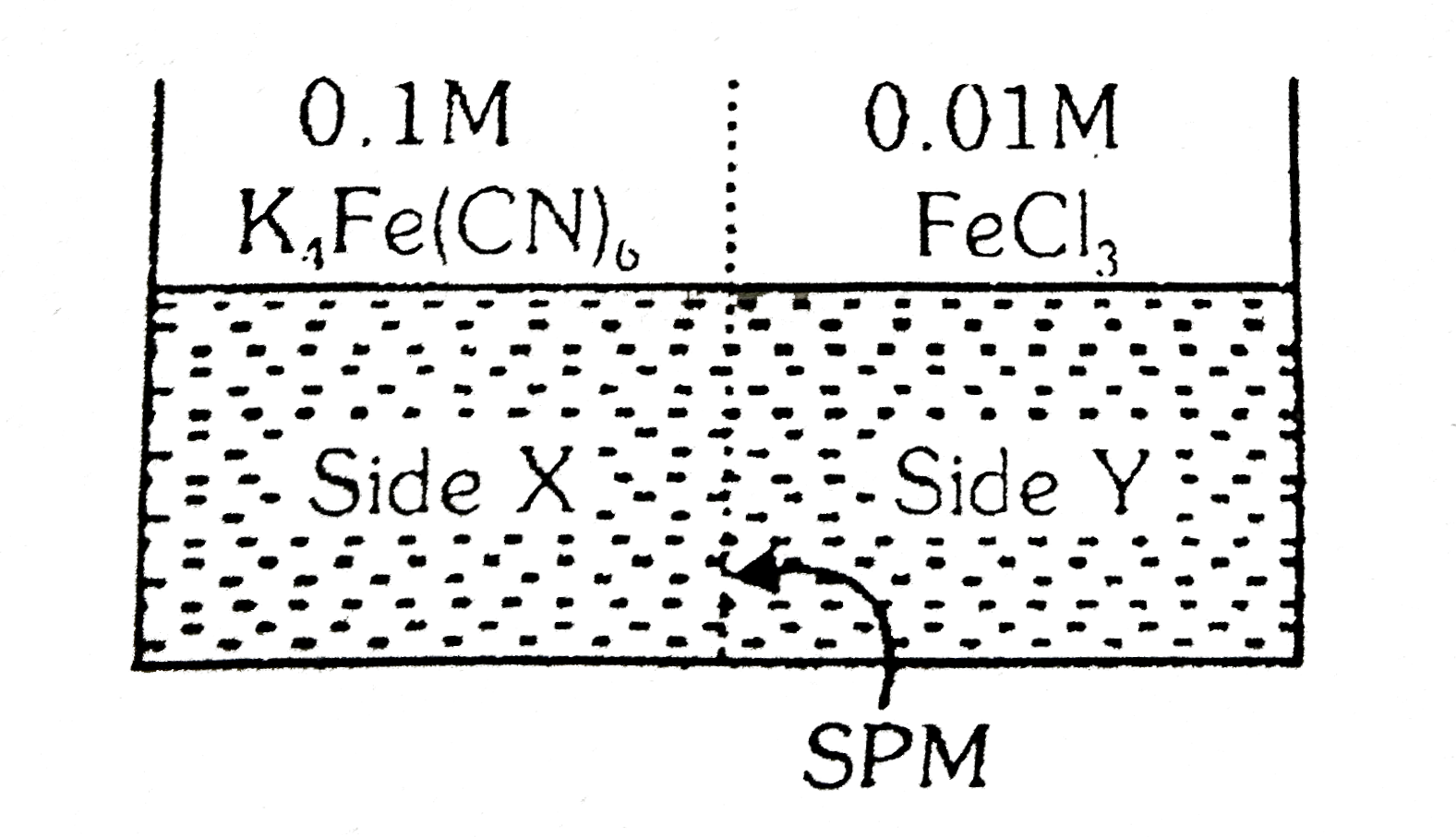
`FeCI_(3)` on reaction with `K_(4)[Fe(CN)_(6)]` in aqueous solution gives blue colour.

These are separated by a semipermeable membrane AB as shown. Due to osmosis there is:

A

Blue colour formation on side X

B

Blue colour formation on side Y

C

Blue colour formation on both sides X and Y

D

No blue colour formation

Text Solution

Verified by Experts

The correct Answer is:

D
Promotional Banner

Topper's Solved these Questions

  • LIQUID SOLUTION

    VMC MODULES ENGLISH|Exercise ENABLE|100 Videos
  • LIQUID SOLUTION

    VMC MODULES ENGLISH|Exercise EFFICIENT|98 Videos
  • JEE MAIN REVISON TEST-23

    VMC MODULES ENGLISH|Exercise CHEMISTRY (SECTION 1)|25 Videos
  • LIQUID SOLUTIONS

    VMC MODULES ENGLISH|Exercise IN-CHAPTER EXERCISE -L|10 Videos

Similar Questions

Explore conceptually related problems

FeCl_(3) on reaction with K_(4)[Fe(CN)_(6)] in aqueous solution gives blue colour. These are separated by a semipermeable membrane AB as shown. Due to osmosis there is:

FeCl_(3) on reaction with K_(4)[Fe(CN)_(6)] in aqueous solution gives blue colour. These are separated by a semi-permeable membrane AB as shown. Due to osmosis, there is

X_(3)Y_(2)(i=5) when reacted with A_(2)B_(3)(i=5 in aqueous solution gives brown colour. These are separated by a semipermeable membrane AB as shown. Due to oxmosis there is : a.brown colour formation in side X b.brown colour formation in side Y c.formation in both of the sides X and Y d.no brown colour formation

Addition of K_(4)[Fe(CN)_(6)] solution to FeCl_(3) solution gives

K_(4)[Fe(CN)_(6)] reacts with ozone is give:

Fe^(2+) does not give blue colour with K_(4)[Fe(CN)_(6)] but on its reaction with (X) ,blue colour oppears (X) can be

When K_(4)[Fe(CN)_(6)] is added to FeCl_(3) ,the complex compound formed is:

When K_(4)[Fe(CN)_(6)] is treated with FeCI_(3) a blue colour is obtained It is due to the formation of .

A light bluish-green crystalline compound responds to the following tests: (i). Its aqueous solution gives a brown precipitate on reaction with alkaline K_2[HgI_4] solution. (ii). Its aqueous solution gives a blue colour with K_3[Fe(CN)_6] solution. (iii). Its solution in hydrochloric acid gives a white precipitate with BaCl_2 solution. Identify the ions present and suggest the formula of the compound.

At 300K , two solutions of glucose in water of concentration 0.01M and 0.001M are separated by semipermeable membrane. Pressure needs to be applied on which solution, to prevent osmosis? Calculate the megitude of this applied pressure?

VMC MODULES ENGLISH-LIQUID SOLUTION -IMPECCABLE
  1. FeCI(3) on reaction with K(4)[Fe(CN)(6)] in aqueous solution gives blu...

    Text Solution

    |

  2. What is the mole fraction of the solute in a 1.00 m aqueous solution ?

    Text Solution

    |

  3. Which of the following electrolytes has the same value of van't Hoff f...

    Text Solution

    |

  4. The boiling point of 0.2 mol kg^(-1) solution of X in water is greater...

    Text Solution

    |

  5. Of the following 0.10 m aqueous solutions, which one will exhibit the ...

    Text Solution

    |

  6. How many grams of concentrated nitric acid solution should be used to ...

    Text Solution

    |

  7. If excess of AgNO(3) solution is added to 100 mL of a 0.024 M solution...

    Text Solution

    |

  8. 6.02 xx 10^(20) molecules of urea are present in 100 mL of its solutio...

    Text Solution

    |

  9. p(A) and p(B) are the vapour pressure of pure liquid components A and ...

    Text Solution

    |

  10. The vapour pressure of chloroform (CHCl)(3) and dichlorocethene (CH(2)...

    Text Solution

    |

  11. 58.5 g of NaCl and 180 g of glucose were separately dissolved in 1000 ...

    Text Solution

    |

  12. Which of the following shows negative deviation from Raoult's law?

    Text Solution

    |

  13. The mass of a non-volatile solute of molar mass 40g" "mol^(-1) that sh...

    Text Solution

    |

  14. The solution which has higher osmotic pressure than some other solutio...

    Text Solution

    |

  15. The vapour pressure lowering caused by addition of 100 g of sucrose (m...

    Text Solution

    |

  16. Molarity of a given orthophosphoric acid solution is 3M. Its normality...

    Text Solution

    |

  17. 138 g of ethyl alcohol is mixed with 72 g of water. The ratio of mole ...

    Text Solution

    |

  18. In which of these solutions Raoult’s law is not applicable?

    Text Solution

    |

  19. The freezing point of 1 m NaCl solution assuming NaCl to be 100% disso...

    Text Solution

    |

  20. A solution of two liquids boils at a temperature more than the boiling...

    Text Solution

    |

  21. Choose the correct statement: When concentration of a salt solution ...

    Text Solution

    |
