Home
Class 12
CHEMISTRY
The first and second ionization enthalpi...

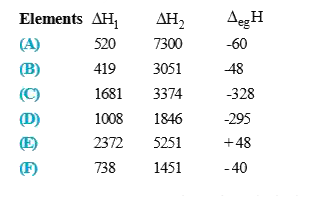
The first and second ionization enthalpies and electron gain enthalpy of some elements are as given below:

Which of these elements is the most reactive metal?

A

(A)

B

(B)

C

(F)

D

(D)

Text Solution

Verified by Experts

The correct Answer is:

B
Promotional Banner

Topper's Solved these Questions

  • PERIODIC PROPERTIES OF ELEMENTS

    VMC MODULES ENGLISH|Exercise IMPECCABLE|50 Videos
  • PERIODIC PROPERTIES OF ELEMENTS

    VMC MODULES ENGLISH|Exercise ENABLE|47 Videos
  • p-BLOCK ELEMENTS-1

    VMC MODULES ENGLISH|Exercise JEE Advanced Archive|48 Videos
  • QUIZ

    VMC MODULES ENGLISH|Exercise CHEMISTRY|30 Videos

Similar Questions

Explore conceptually related problems

The first and second ionization enthalpies and electron gain enthalpy of some elements are as given below: Which of these elements is the most reactive non-metal?

The first and second ionization enthalpies and electron gain enthalpy of some elements are as given below: Which of these elements is the least reactive non-metal?

The first and second ionization enthalpies and electron gain enthalpy of some elements are as given below: Which of the elements given above is the least reactive?

The second ionization enthalpy is

The first and second ionization enthalpies and electron gain enthalpy of some elements are as given below: A metal which can form a stable binary halide of the type MX_2 is (X : Halogen)

The first and second ionization enthalpies and electron gain enthalpy of some elements are as given below: The metal which can predominantly form a stable cova- lent halide of the type (MX) (X : Halogen)

Match the correct ionisation enthalpies and electron gain enthalpies of the following elements.

Among the elements of second period pick out the element that is the most reactive metal.

Ionization enthalpies of transition metals are

First and second ionisation enthalpies(in KJ/mol) of few elements are given below: Which of the above elements will form halides with formula MX_(2) ?

VMC MODULES ENGLISH-PERIODIC PROPERTIES OF ELEMENTS-EFFICIENT
  1. The first and second ionization enthalpies and electron gain enthalpy ...

    Text Solution

    |

  2. N(0)//2 atoms of X((g)) are converted into X((g))^(o+) by energy E(1),...

    Text Solution

    |

  3. Which of these ions possesses the smallest radius?

    Text Solution

    |

  4. An element with atomic number 64 will have the electronic configuratio...

    Text Solution

    |

  5. Which of these is an incorrect statement?

    Text Solution

    |

  6. The stability of ions of Ge Sn and Pb will be in the order .

    Text Solution

    |

  7. Which of these chlorides will have the highest melting point?

    Text Solution

    |

  8. Allred – Rochow’s electronegativity depends upon

    Text Solution

    |

  9. Which of the following transitions involves maximum amount of energy?

    Text Solution

    |

  10. IE(1) and IE(2) of Mg are 178 and 348 kcal mol^(-1). The energy requir...

    Text Solution

    |

  11. The IE1 , IE2 , IE3 and IE4 of an element are 5.7, 11.03, 42.89, 57 e...

    Text Solution

    |

  12. Among N, C, Si and P, which has highest electronegativity :

    Text Solution

    |

  13. Calculate the electronegativity of fluorine from the following data: ...

    Text Solution

    |

  14. Ionisation potential and electron affinity of fluorine are 17.42 and 3...

    Text Solution

    |

  15. The elecron affinity of chlorine is 3. 7 eV. How much energy in kcal i...

    Text Solution

    |

  16. If the covalent radius of silicon is 1.175 Å then its elec-tronegati...

    Text Solution

    |

  17. Answer the following question (Based on EA, Delta(eg)H^(ɵ) and IE). I...

    Text Solution

    |

  18. Property of the alkaline earth metals that increases down the group w...

    Text Solution

    |

  19. The ionisation potentials of atoms A and B are 400 and 300 kcal mol^(-...

    Text Solution

    |

  20. For the gaseous reaction K+F rarrK^(o+)+F^(ɵ) Delta H = 19 kcal mo...

    Text Solution

    |

  21. How many Cl atoms can you ionise in the process ClrarrCl^(o+)+e^(-) by...

    Text Solution

    |
