Home
Class 12
CHEMISTRY
The first and second ionization enthalpi...

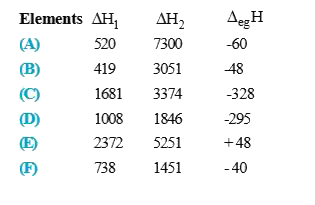
The first and second ionization enthalpies and electron gain enthalpy of some elements are as given below:

The metal which can predominantly form a stable cova- lent halide of the type (MX) (X : Halogen)

A

(F)

B

(B)

C

(D)

D

(A)

Text Solution

Verified by Experts

The correct Answer is:

D
Promotional Banner

Topper's Solved these Questions

  • PERIODIC PROPERTIES OF ELEMENTS

    VMC MODULES ENGLISH|Exercise IMPECCABLE|50 Videos
  • PERIODIC PROPERTIES OF ELEMENTS

    VMC MODULES ENGLISH|Exercise ENABLE|47 Videos
  • p-BLOCK ELEMENTS-1

    VMC MODULES ENGLISH|Exercise JEE Advanced Archive|48 Videos
  • QUIZ

    VMC MODULES ENGLISH|Exercise CHEMISTRY|30 Videos

Similar Questions

Explore conceptually related problems

The first and second ionization enthalpies and electron gain enthalpy of some elements are as given below: A metal which can form a stable binary halide of the type MX_2 is (X : Halogen)

The first and second ionization enthalpies and electron gain enthalpy of some elements are as given below: Which of these elements is the most reactive metal?

The first and second ionization enthalpies and electron gain enthalpy of some elements are as given below: Which of these elements is the most reactive non-metal?

The first and second ionization enthalpies and electron gain enthalpy of some elements are as given below: Which of these elements is the least reactive non-metal?

The first and second ionization enthalpies and electron gain enthalpy of some elements are as given below: Which of the elements given above is the least reactive?

First and second ionisation enthalpies(in KJ/mol) of few elements are given below: Which of the above elements will form halides with formula MX_(2) ?

Ionization energies of five elements in kcal/mol are given below: . Which element forms stable unipositive ion ?

Ionization energies of five elements in kcal/mol are given below: Q. Which element form stable unipositve ion?

Ionization energies of five elements in kcal/mol are given below: Q. Which element form stable unipositve ion?

The first (Delta_(i)H_(1)) and second (Delta_(i)H_(2)) ionisation enthalpies ("in" kJ mol^(-1)) and the (Delta_(eg)H^(ө)) electron gain enthalpy ("in" kJ mol^(-1)) of a few elements are given below: {:("Elements",(Delta_(i)H_(1)),(Delta_(i)H_(2)),Delta_(eg)H^(ө)),(I,520,7300,-60),(II,419,3051,-48),(III,1681,3374,-328),(IV,1008,1846,-295),(V,2372,5251,+48),(VI,738,1451,-40):} Which of the above elements is likely to be a. the least reactive element. b. the most reactive metal. c. the most reactive non-metal. d. the least reactive non-metal. e. the metal which can form a stable binary halide of the formula MX_2 (X=halogen). f. the metal which can form a predominantly stable covalent halide of the formula MX(X=halogen).

VMC MODULES ENGLISH-PERIODIC PROPERTIES OF ELEMENTS-EFFICIENT
  1. The first and second ionization enthalpies and electron gain enthalpy ...

    Text Solution

    |

  2. N(0)//2 atoms of X((g)) are converted into X((g))^(o+) by energy E(1),...

    Text Solution

    |

  3. Which of these ions possesses the smallest radius?

    Text Solution

    |

  4. An element with atomic number 64 will have the electronic configuratio...

    Text Solution

    |

  5. Which of these is an incorrect statement?

    Text Solution

    |

  6. The stability of ions of Ge Sn and Pb will be in the order .

    Text Solution

    |

  7. Which of these chlorides will have the highest melting point?

    Text Solution

    |

  8. Allred – Rochow’s electronegativity depends upon

    Text Solution

    |

  9. Which of the following transitions involves maximum amount of energy?

    Text Solution

    |

  10. IE(1) and IE(2) of Mg are 178 and 348 kcal mol^(-1). The energy requir...

    Text Solution

    |

  11. The IE1 , IE2 , IE3 and IE4 of an element are 5.7, 11.03, 42.89, 57 e...

    Text Solution

    |

  12. Among N, C, Si and P, which has highest electronegativity :

    Text Solution

    |

  13. Calculate the electronegativity of fluorine from the following data: ...

    Text Solution

    |

  14. Ionisation potential and electron affinity of fluorine are 17.42 and 3...

    Text Solution

    |

  15. The elecron affinity of chlorine is 3. 7 eV. How much energy in kcal i...

    Text Solution

    |

  16. If the covalent radius of silicon is 1.175 Å then its elec-tronegati...

    Text Solution

    |

  17. Answer the following question (Based on EA, Delta(eg)H^(ɵ) and IE). I...

    Text Solution

    |

  18. Property of the alkaline earth metals that increases down the group w...

    Text Solution

    |

  19. The ionisation potentials of atoms A and B are 400 and 300 kcal mol^(-...

    Text Solution

    |

  20. For the gaseous reaction K+F rarrK^(o+)+F^(ɵ) Delta H = 19 kcal mo...

    Text Solution

    |

  21. How many Cl atoms can you ionise in the process ClrarrCl^(o+)+e^(-) by...

    Text Solution

    |
