Home
Class 12
CHEMISTRY
An alkene A on ozonolysis yields acetone...

An alkene A on ozonolysis yields acetone and an aldehyde. The aldehyde is easily oxidised to an acid B. When B is treated with bromine in presence of yields a compound C which on hydrolysis gives a hydroxyle acid D. This acid can also be obatined from acetone by the reaction with hydrogen cyanide followed by hydrolysis. Identify the compounds A, B C and D.

Text Solution

Verified by Experts

The hydroxy acid 'D' is also obtained from acetone by the reaction with HCN followed by hydrolysis, so the structure of hydroxy acid 'D' is

Now from starting

`RCHO overset( [O])(rarr) RCOOH`
`RCHOOH overset( Br_(2) //P ) ( rarr) ` bromo compound
bromo compound `overset( H_(2)O)(rarr) underset( 'D')("hydroxy acid")`
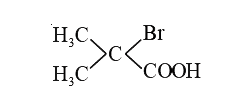
Since, hydroxy acid 'D' is obtained by the hydrolysis of 'C' with aqueous alkali, therefore the compound 'C' has a bromo group at that place where the compound 'D' has a hydroxy group. Hence, the structure of 'C' is

Compound 'C' is formed by the bromination of compound 'B' so the structure of compound 'B' is

Compound 'B' is obtained by the oxidation of aldehyde which is the ozonolysis product of alkene 'A'. Thus, the structure of aldehyde is

Thus, the structure of alkene 'A' is

Hence, the compounds A,B,C and D are, respectively
Promotional Banner

Topper's Solved these Questions

  • ALDEHYDES,KETONES & CARBOXYLIC ACIDS

    VMC MODULES ENGLISH|Exercise EXAMPLE 1|19 Videos
  • ALDEHYDES,KETONES & CARBOXYLIC ACIDS

    VMC MODULES ENGLISH|Exercise IN-CHAPTER EXERCISE-A|10 Videos
  • ALCOHOLS, PHENOLS & ETHERS

    VMC MODULES ENGLISH|Exercise Impeccable|100 Videos
  • AMINES

    VMC MODULES ENGLISH|Exercise IN CHAPTER EXERCISE H|10 Videos

Similar Questions

Explore conceptually related problems

An organic compound 'A' on treatment with KCN gave another compound B which on hydrolysis with dil. HCI gave acetic acid. Identify A.

Propyl lithium reacts with ethene to give a compound (A) , which on reaction with methanal followed by acidic hydrolysis gives compound (B) . The compound (B) is :

Two moles of organic compounds 'A' on treatment with a strong base gives two compounds 'B' and 'C'. Compound 'B' on dehydrogention with Cu gives 'A' while acidification of 'C' yields carboxylic and 'D' with molecular formula of CH_(2)O_(2) . Identify the compound A, B, C, and D.

A compound (A) is formed by the reaction of ethylene with bromine which on reacting with aqueous KOH gives a compound (B). The compound (B) can also be prepared by the reaction of ethylene with the following:

A carbonyl compound reacts with hydrogen cyanide to form cyanohydrin which on hydrolysis forms a recemic mixrture of alpha -hydroxy acid. The carbonyl compound D .

In the presence of a small amount of phosphorous, aliphatic carboxylic acids react with chlorine or bromine to yield a compound in which alpha - hydrogen has been replaced by halogen. This reaction is known as :

A compound (A) of boron react with NMe_(3) to give an adduct (B) which in hydrolysis gives a compound (C) and hydrogen gas. Compound (C) is an acid. Indenfity the compounds A,B and C. Give the reactions involved.

Calcium imide on hydrolysis will give gas (B) which on oxidation by beaching powder gives gas (C) gas (C) on reaction with magnesium give compound (D) . (D) on hydrolysis gives gas (B) . (B), (C) and (D) are

Acetoisonitrile on reaction with C_2 H_5 MgBr followed by hydrolysis, gives compound (A) , which one further hydrolysis gives (B) and ( C) . (B) and ( C) are :

An alkene on reductive ozonolysis gives two products A and B . When these products are treated with conc. KOH one of these products gives an alcohol and an acid salt. Here the alkene can be