Home
Class 12
PHYSICS
ABC is an equilateral triangle. Length o...

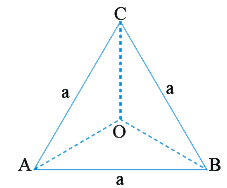
ABC is an equilateral triangle. Length of each side is 'a' and centroid is point O. Find

If `vec(AB)+vec(AC)=nvec(AO)` then n = ?

Text Solution

Verified by Experts

The correct Answer is:

3

`vec(AB)=vec(AO)+vec(OB)andvec(AC)=vec(AO)+vec(OC)therefore vec(AB)+vec(AC)=2vec(AO)+vec(OB)+vec(OC)....(1)`
but `vec(OA)+vec(OB)+vec(OC)=vec(0) therefore vec(OB)+vec(OC)=-vec(OA)=vec(AO)....(2)`
by (1) and (2) `vec(AB)+vec(AC)=2vec(AO)+vec(AO)" "vec(AB)+vec(AC)=3vec(AO) therefore n=3`
Promotional Banner

Similar Questions

Explore conceptually related problems

ABC is an equilateral triangle. Length of each side is 'a' and centroid is point O. Find If |vec(AB)+vec(BC)+vec(AC)|=na then n = ?

ABC is an equilateral triangle. Length of each side is 'a' and centroid is point O. Find vec(AB)+vec(BC)+vec(CA)

ABC is an equilateral triangle of side 2m. If vec(E ) = 10 NC^(-1) then V_(A) - V_(B) is

Let ABC be a right triangle with length of side AB=3 and hyotenus AC=5. If D is a point on BC such that (BD)/(DC)=(AB)/(AC), then AD is equal to

ABC is an equilateral triangle with O as its centre vec(F_(1)),vec(F_(2)) " and " vec(F_(3)) represent three forces acting along the sides AB, BC and AC respectively. If the torque about O is zero then the magnitude of vec(F_(3)) is

Consider /_\ABC . Let I bet he incentre and a,b,c be the sides of the triangle opposite to angles A,B,C respectively. Let O be any point in the plane of /_\ABC within the triangle. AO,BO and CO meet the sides BC, CA and AB in D,E and F respectively. If 3vec(BD)=2vec(DC) and 4vec(CE)=vec(EA) then the ratio in which divides vec(AB) is (A) 3:4 (B) 3:2 (C) 4:1 (D) 6:1

Orthocenter of an equilateral triangle ABC is the origin O. If vec(OA)=veca, vec(OB)=vecb, vec(OC)=vecc , then vec(AB)+2vec(BC)+3vec(CA)=

Given an equilateral triangle ABC with side length equal to 'a'. Let M and N be two points respectivelyАВIn the side AB and AC such that vec(AN) = Kvec(AC) and vec(AM) = vec(AB)/3 If vec(BN) and vec(CM) are orthogonalthen the value of K is equal to

Let ABC be a triangle having its centroid its centroid at G. If S is any point in the plane of the triangle, then vec(SA) + vec(SB)+vec(SC)=

Let ABC be a triangle having its centroid its centroid at G. If S is any point in the plane of the triangle, then vec(SA) + vec(SB)+vec(SC)=
