Home
Class 12
PHYSICS
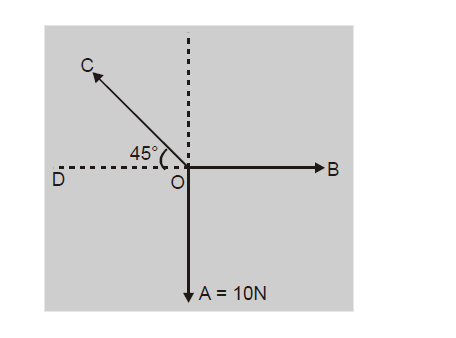
The sum of three vectors shown in figure...

The sum of three vectors shown in figure, is zero.
(i) What is the magnitude of vector `vec(OB)` ?

(ii) What is the magnitude of vector `vec(OC)` ?

Text Solution

Verified by Experts

The correct Answer is:

10 N

Resolve `vec(OC)` into two rectangular components.
`OB=OCcos45^(@) and OA=OCsin45^(@)`
implies `OC=(10)/(sin45^(@))=10sqrt(2)NimpliesOB=(10sqrt(2))((1)/(sqrt(2)))=10N`
Promotional Banner

Similar Questions

Explore conceptually related problems

The sum of three vectors shown in Fig. 2 ( c) . 77. is zero . . (a) What is the magnitude of the vector vec (OB) ? (b) What is the magnitude of the vector vec (OC) ?

The sum of the three vectors shown in figure is zero. Find the magnitudes of the vectors vec(OB) and vec(OC) .

The magnitude of the x-component of vector vec(A) is 3 and the magnitude of vector vec(A) is 5. What is the magnitude of the y-component of vector vec(A) ?

What is the angle between the vector vec(A) and vec(B) as shown in figure ?

a, b are the magnitudes of vectors vec(a) & vec(b) . If vec(a)xx vec(b)=0 the value of vec(a).vec(b) is

vec A is a vector of magnitude 2.7 units due east . What is the magnitude and direction of vector 4 vecA ?

The resultant of two vectors vec(A) and vec(B) is perpendicular to the vector vec(A) and its magnitudes is equal to half of the magnitudes of vector vec(B) (figure). The angle between vec(A) and vec(B) is

A vector vec(B) which has a magnitude 8.0 is added to a vector vec(A) which lies along the x-axis. The sum of these two vector is a third vector which lies along the y-axis and has a magnitude that is twice the magnitude of vec(A) . Find the magnitude of vec(A)

Let vector vec(V)=(2,3) and vector vec(U)=(6,-4) . (i) What is the resultant of vecU and vecV ?

Two vectors vec(A) and vec(B) have equal magnitudes . If magnitude of vec(A) + vec(B) is equal to n times the magnitude of vec(A) - vec(B) , then the angle between vec(A) and vec(B) is
