Home
Class 12
PHYSICS
A particle starts from rest and moves wi...

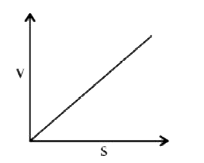
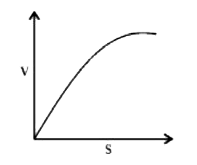
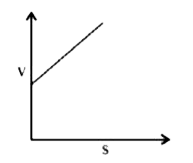
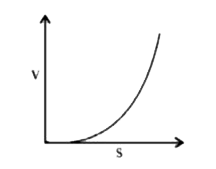
A particle starts from rest and moves with constant acceleration. Then velocity displacement curve is:

A

B

C

D

Text Solution

AI Generated Solution

The correct Answer is:

To solve the problem of determining the velocity-displacement curve for a particle that starts from rest and moves with constant acceleration, we can follow these steps: ### Step 1: Understand the motion The particle starts from rest, which means its initial velocity \( u = 0 \). It moves with constant acceleration \( a \). ### Step 2: Use the equations of motion We can use the third equation of motion, which relates final velocity \( v \), initial velocity \( u \), acceleration \( a \), and displacement \( s \): \[ v^2 = u^2 + 2as \] Since the particle starts from rest, we have \( u = 0 \). Therefore, the equation simplifies to: \[ v^2 = 2as \] ### Step 3: Rearrange the equation We can rearrange the equation to express \( v \) in terms of \( s \): \[ v = \sqrt{2as} \] ### Step 4: Analyze the equation The equation \( v = \sqrt{2as} \) indicates that the velocity \( v \) is proportional to the square root of the displacement \( s \). This relationship suggests that if we plot \( v \) against \( s \), we will get a curve. ### Step 5: Identify the type of curve The equation \( v^2 = 2as \) represents a parabolic relationship between \( v \) and \( s \). Specifically, it is a parabola that opens upwards, starting from the origin (0,0). ### Step 6: Conclusion Thus, the velocity-displacement curve for a particle starting from rest and moving with constant acceleration is an upward-facing parabola. ### Final Answer The velocity-displacement curve is an upward-facing parabola. ---
Promotional Banner

Topper's Solved these Questions

  • Motion in Straight Line

    VMC MODULES ENGLISH|Exercise IN-CHAPTER EXERCISE-F|10 Videos
  • Motion in Straight Line

    VMC MODULES ENGLISH|Exercise IN-CHAPTER EXERCISE-G|10 Videos
  • Motion in Straight Line

    VMC MODULES ENGLISH|Exercise IN-CHAPTER EXERCISE-D|10 Videos
  • MOTION IN A STRAIGHT LINE & PLANE

    VMC MODULES ENGLISH|Exercise IMPECCABLE|52 Videos
  • Motion in Two Dimensions

    VMC MODULES ENGLISH|Exercise MCQ|2 Videos

Similar Questions

Explore conceptually related problems

A body starts from rest and then moves with uniform acceleration. Then.

A body starts from rest and moves with constant acceleration. The ratio of distance covered by the body in nth second to that covered in n second is.

A particle starts from rest and moves with an acceleration of a={2+|t-2|}m//s^(2) The velocity of the particle at t=4 sec is

A particle starts from rest and moves with an acceleration of a={2+|t-2|}m//s^(2) The velocity of the particle at t=4 sec is

A particle starts from rest with constant acceleration. The ratio of space-average velocity to the time average velocity is :-

A particle starting from rest moves with constant acceleration. If it takes 5.0 s to reash the speed 18.0 km/h find a. the average velocity during this period, and b. the distance travelled by the particle during this period.

A particle starts from rest and moves under constant acceleration in a straight line. Find the ratio of displacement (a) in successive second and (b) in successive time interval t_(0) .

A particle starting from rest moves along a straight line with constant acceleration for this velocity displacement graph will have the form-

A particle moves along the x-direction with constant acceleration. The displacement, measured from a convenient position, is 2 m at time t= 0 and is zero when t= 10 s. If the velocity of the particle is momentary zero when t = 6 s, determine the acceleration a and the velocity v when t= 10s.

A particle starts from origin O from rest and moves with a uniform acceleration along the positive x=axis. Identify all figures that correctly represent the motion qualitatively. (a=acceleration , v=velocity, x=displacement,t=time)
