Home
Class 12
PHYSICS
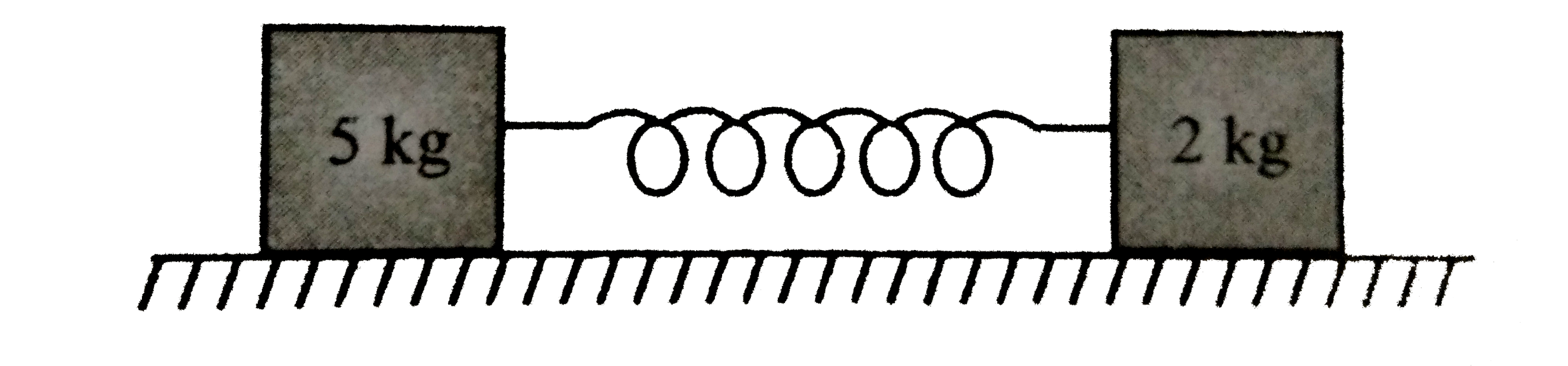
Figure shows two blocks of masses 5 kg a...

Figure shows two blocks of masses `5 kg` and `2 kg` placed on a frictionless surface and connected with a spring. An external kick gives a velocity of `14 m//s` to the heavier block in the direction of lighter one. Deduce (a) velocity gained by the centre of mass and (b) the separate velocities of the two blocks in the centre of mass coordinates just after the kick.

Text Solution

Verified by Experts

(i)Velocity of centre of mass is `v_(cm)(5xx14+2xx0)/(5+2)=10`m/s (ii) Due to kick on 5 kg block, it starts moving with a velocity 14 m/s immediately, but due to inertia 2 kg block remains at rest, at that moment. Thus, velocity of 5 kg block with respect to the center of mass is `v_1 = 14 — 10= 4 m/s` and the velocity of 2 kg block w.r.t. to center of mass is `v_2 = 0 — 10= —10 m/s`.
Promotional Banner

Topper's Solved these Questions

  • SYSTEM OF A PARTICLES & ROTATIONAL MOTION

    VMC MODULES ENGLISH|Exercise SOLVED EXAMPLES|20 Videos
  • SYSTEM OF A PARTICLES & ROTATIONAL MOTION

    VMC MODULES ENGLISH|Exercise PRACTICE EXERCISE-1|4 Videos
  • SIMPLE HARMONIC MOTION

    VMC MODULES ENGLISH|Exercise 7-previous year question|46 Videos
  • SYSTEM OF PARTICLES AND ROTATIONAL MOTION

    VMC MODULES ENGLISH|Exercise IMPECCABLE|56 Videos

Similar Questions

Explore conceptually related problems

Two blocks of masses 5 kg and 2 kg are placed on a frictionless surface and connected by a spring. An external kick gives a velocity of 14 m//s to the heavier block in the direction of lighter one. The magnitudes of velocities of two blocks in the centre of mass frame after the kick are respectively :

Two blocks of masses 5 kg and 2 kg are placed on a frictionless surface and connected by a spring. An external kick gives a velocity of 14 m//s to the heavier block in the direction of lighter one. The magnitudes of velocities of two blocks in the centre of mass frame after the kick are, respectively,

Two blocks of masses 10 kg and 4 kg are connected by a spring of negligible mass and placed on a frictionless horizontal surface. An impulse gives a velocity of 14 m//s to the heavier block in the direction of the lighter block. The velocity of the centre of mass is

Two blocks of masses 5kg and 2kg are connected by a spring of negligible mass and placed on a frictionless horizontal surface. An impulse provides a velocity of 7m/s to the heavier block in the direction of the lighter block. The velocity of the centre of mass is :-

Two blocks of masses 5kg and 2kg are connected by a spring of negligible mass and placed on a frictionless horizontal surface. An impulse provides a velocity of 7m/s to the heavier block in the direction of the lighter block. The velocity of the centre of mass is :-

Two blocks of masses 5kg and 2kg are connected by a spring of negligible mass and placed on a frictionless horizontal surface. An impulse provides a velocity of 7m/s to the heavier block in the direction of the lighter block. The velocity of the centre of mass is :-

Two spring are connected toa block of mass M placed a frictionless surface as shown if both the spring have a spring constant k the frequency of oscillation block is

Two men A and B of masses 50kg and 20g respectively are at rest on a frictionless surface as shown in figure. If A pushes B with relative velocity 0.7m//s then find velocity of A just after the push.

Two blocks of masses of 40 kg and 30 kg are connected by a weightless string passing over a frictionless pulley as shown in the figure.

Two blocks A and B of mass 16kg and 64kg are placed on a smooth horizontal surface. Blocks are connected by a spring of spring constant 100 N//m . Find the ratio of maximum speed of block A to maximum speed of block B .
