Home
Class 12
PHYSICS
A dip circle is at right angles to t...

A dip circle is at right angles to the magnetic meridian. What will be the apparent dip ?

Text Solution

Verified by Experts
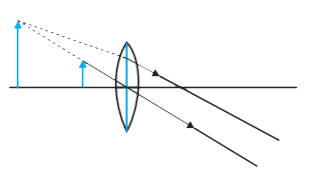
In case of magnifying lens, the lens is convergent and the image is erect, virtual and enlarged and between infinity and the object on the same side of the lens as shown in the above diagram.
So, here
f = + 10 cm, v = -30 cm
Let ‘ x ’ be the object distance
Using lens formula
`1/f = 1/v-1/u` we have, `1/(-30) - 1/(-x) =1/10`
`implies x=7.5cm`
Promotional Banner

Topper's Solved these Questions

  • RAY OPTICS

    VMC MODULES ENGLISH|Exercise Example|21 Videos
  • RAY OPTICS

    VMC MODULES ENGLISH|Exercise PRACTICE EXERCISE-1|1 Videos
  • QUIZ

    VMC MODULES ENGLISH|Exercise PHYSICS|30 Videos
  • RAY OPTICS AND WAVE OPTICS

    VMC MODULES ENGLISH|Exercise IMPECCABLE|58 Videos

Similar Questions

Explore conceptually related problems

The value of dip at a place is 45^@ . The plane of the dip circle is turned through 60^@ from the magnetic meridian. Find the apparent value of dip.

The angle of dip at the magnetic pole is

The true value of dip at a place is 30^(@) . The vertical plane carrying the needle is turned through 45^(@) from the magnetic meridian . Calculate the apparent value of dip .

The angle of dip at the magnetic equator is

The angle of dip at the magnetic equator is

At 45^@ to the magnetic meridian, the apparent dip is 30^@ . Find the true dip.

The dip at a place is delta. For measuring it, the axis of the dip needle is perpendicular to the magnetic meridian. If the axis of the dip needle makes angle theta with the magnetic meridian, the apparent dip will be given tan delta_(1) which is equal to:

Aparant angle of a dip is 30° in a plane at 45° from the magnetic meridian, then the true dip is

A dip circle is adjusted so that its needle moves freely in the magnetic meridian. In this position, the angle of dip ia 40^(@) . Now the dip circle is rotated so that the plane in which the needle moves makes an angle of 30^(@) with the magnetic meridian. In this position the needle will dip by an angle

A dip circle lying initially in the magnetic meridian is rotated through angle theta in the horizontal plane. The ratio of tangent of apparent angle of dip to true angle of dip is

