Home
Class 12
PHYSICS
Two plane mirrors are inclined to each o...

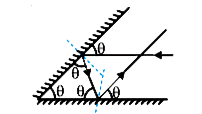
Two plane mirrors are inclined to each other such that a ray of light incident on the first mirror `(M_(1))` and parallel to the second mirror `(M_(2))` is finally reflected from the second mirror `(M_(2))` parallel to the first mirror `(M_(1))`. The angle between the two mirrors will be :

A

`30^@`

B

`60^@`

C

`75^@`

D

`90^@`

Text Solution

Verified by Experts

The correct Answer is:
2

Fromgeometry of figure
`theta+theta+theta=180^@`
`theta=60^@`
Promotional Banner

Topper's Solved these Questions

  • RAY OPTICS

    VMC MODULES ENGLISH|Exercise PRACTICE EXERCISE-1|1 Videos
  • RAY OPTICS

    VMC MODULES ENGLISH|Exercise PRACTICE EXERCISE-2|1 Videos
  • RAY OPTICS

    VMC MODULES ENGLISH|Exercise IN-CHAPTER EXERCISE-J|10 Videos
  • QUIZ

    VMC MODULES ENGLISH|Exercise PHYSICS|30 Videos
  • RAY OPTICS AND WAVE OPTICS

    VMC MODULES ENGLISH|Exercise IMPECCABLE|58 Videos

Similar Questions

Explore conceptually related problems

Two plane mirrors are inclined to each other such that a ray of light incident on the first mirror and parallel to the second is reflected from the second mirror parallel to the first mirror. Determine the angle between the two mirrors:

Find the angle between two plane mirrors such that a ray of light incident on the first mirror and parallel to the second mirror is reflected from the second mirror, parallel to the first mirror.

Two plane mirrors are inclined to each other at an angle 60^(@) if a ray of light incident on first mirror parallel to the second mirror, it is reflected from the second mirror

Two plane mirror are inclined to each other at 90^(@) . A ray of light is incident on one mirror. The ray will undergo a total deviation of

Two plane mirror M_(1) "and" M_(2) are inclined to each other at 70^(@) . A ray incident on the mirror M_(1) at an angle theta fallls on M_(2) and is then reflected parallel to M_(1) for

Two plane mirrror are inclined to each other at 70^(@) . A ray of light is incident on one mirror. They ray after two reflections will undergo a total deviation of :

Rays of light are incident on a plane mirror at 40^@ . At what angle with the first should a second mirror be placed such that the rays emerge from the second mirror parallel to the first mirror.

Two plane mirrors are inclined to each other at an angle theta . A ray of light is reflected at one mirror and then at the other. Find the total deviation of the ray.

Two plane mirrors are inclined at 70^@ . A ray incident on one mirror at incidence angle theta after reflection falls on the second mirror and is reflected from there parallel to the first mirror, The value of theta is

Two plans mirrors are inclined to each other at some angle .A ray of light incident at 30^(@) on one,after reflection form the other retraces its path .The angles between the mirrors is:

VMC MODULES ENGLISH-RAY OPTICS -Example
  1. Two vertical plane mirrors are inclined at an angle of 60^(@) with eac...

    Text Solution

    |

  2. A ray of light makes an angle of 10^(@) with the horizontal above it a...

    Text Solution

    |

  3. Two plane mirrors are inclined to each other such that a ray of light ...

    Text Solution

    |

  4. Two plane mirrors A and B are aligned parallel to each other as shown ...

    Text Solution

    |

  5. A plane mirror and a person are moving towards each other with same ve...

    Text Solution

    |

  6. A convex mirror offocal length fforms an image which is 1/n times the ...

    Text Solution

    |

  7. An object of length 2.5 cm is placed at a distance of 1.5 f from a con...

    Text Solution

    |

  8. The ratio of thickness of plates of two transparent medium A and B is ...

    Text Solution

    |

  9. A ray of light passes from vaccum into a medium of refractive index n....

    Text Solution

    |

  10. A prism (mu=1.5) has the refracting angle of 30^(@) The deviation of a...

    Text Solution

    |

  11. Angle of a prism is 30^(@) and its refractive index is sqrt(2) and one...

    Text Solution

    |

  12. A man can see the objects upto a distance of one metre from his eyes. ...

    Text Solution

    |

  13. a man can see upto 100cm of the distant object. The power of the lens ...

    Text Solution

    |

  14. A thin lens focal length f and its aperture has diameter d. It forms a...

    Text Solution

    |

  15. A thin convergent glass lens (mug=1.5) has a power of +5.0D. When this...

    Text Solution

    |

  16. An electromagnetic wave of wavelength lamda(0) (in vacuum) passes from...

    Text Solution

    |

  17. Two slits at a distance of 1mm are illuminated by a light of wavelengt...

    Text Solution

    |

  18. In Young's double slit experiment the slits, S(1) & S(2) are illuminat...

    Text Solution

    |

  19. In a YDSE experiment two slits S(1) and S(2) have separation of d=2mm ...

    Text Solution

    |

  20. Consider the optical system shown in figure. The point source of ligth...

    Text Solution

    |

