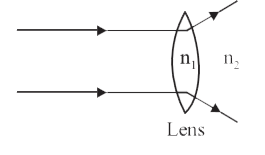
A
B
C
D
Text Solution
Verified by Experts
The correct Answer is:



Topper's Solved these Questions
RAY OPTICS
VMC MODULES ENGLISH|Exercise IN-CHAPTER EXERCISE-D|9 VideosRAY OPTICS
VMC MODULES ENGLISH|Exercise IN-CHAPTER EXERCISE-E|10 VideosRAY OPTICS
VMC MODULES ENGLISH|Exercise IN-CHAPTER EXERCISE-B|10 VideosQUIZ
VMC MODULES ENGLISH|Exercise PHYSICS|30 VideosRAY OPTICS AND WAVE OPTICS
VMC MODULES ENGLISH|Exercise IMPECCABLE|58 Videos
Similar Questions
Explore conceptually related problems
VMC MODULES ENGLISH-RAY OPTICS -IN-CHAPTER EXERCISE-C
- A convex lens of focal length 12 cm is made of glass of mu=(3)/(2). Wh...
Text Solution
|
- A biconvex lens with equal radii curvature has refractive index 1.6 an...
Text Solution
|
- A plano-convex lens is made of glass of refractive index 1.5. The radi...
Text Solution
|
- For a plano convex lens, the radius of curvature of convex surface is ...
Text Solution
|
- A small air bubble in a sphere of glass with radius 4 cm appears to be...
Text Solution
|
- A plano-convex lens (f = 20 cm) is silvered at plane surface. The foca...
Text Solution
|
- The radius of curvature of curved surface of a thin plano-convex lens ...
Text Solution
|
- An equiconvex lens of glass of focal length 0.1 metre is cut along a p...
Text Solution
|
- A double convex thin lens made of glass of refractive index 1.6 has ra...
Text Solution
|
- The relation between n(1) and n(2), if behaviour of light rays is as s...
Text Solution
|