Home
Class 11
CHEMISTRY
The first (IE(1)) and the second (IE(2))...

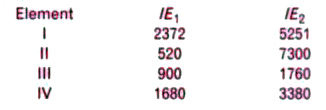
The first (`IE_(1)`) and the second `(IE_(2))` ionisation energies (kJ `mol^(-1)`) of a few elements are given below :

Which of the above elements is likely to be
a reactive metal?

Text Solution

Verified by Experts

Reactive metals include alkali metals that have one valence electron. It is evident in element II that the first ionization energy has a small value of `520" kJmol"^(-1)` but the second IE is massively high. So, element II must be an alkali metal.
Promotional Banner

Topper's Solved these Questions

  • PERIODIC PROPERTIES OF ELEMENTS

    VMC MODULES ENGLISH|Exercise Practice Exercise|29 Videos
  • PERIODIC PROPERTIES OF ELEMENTS

    VMC MODULES ENGLISH|Exercise In Chapter Exercise-A|20 Videos
  • PERIODIC PROPERTIES OF ELEMENTS

    VMC MODULES ENGLISH|Exercise In Chapter Exercise-F|20 Videos
  • QUIZ

    VMC MODULES ENGLISH|Exercise Chemistry|15 Videos

Similar Questions

Explore conceptually related problems

The first ( IE_(1) ) and the second (IE_(2)) ionisation energies (kJ mol^(-1) ) of a few elements are given below : Which of the above elements is likely to be a reactive non-metal?

The first ( IE_(1) ) and the second (IE_(2)) ionisation energies (kJ mol^(-1) ) of a few elements are given below : Which of the above elements is likely to be a noble gas?

The first ( Delta_(i), H_(1) ) and the second ( Delta, H_(2) ) ionisation enthalpies (in kJ mo l^(- 1) ) and the (Delta_(eg)H ) electron gain enthalpy (in kJ mo l^(-1) ) of a few elements are given below : Which of the above elements is likely to be : a reactive metal

The first ( Delta_(i), H_(1) ) and the second ( Delta, H_(2) ) ionisation enthalpies (in kJ mo l^(- 1) ) and the (Delta_(eg)H ) electron gain enthalpy (in kJ mo l^(-1) ) of a few elements are given below : Which of the above elements is likely to be : the least reactive element?

The first (IE_(1)) and second (E_(2)) ionization energies (kJ/mol) of few elements designated by Roman numerals are given below. Which of these would be an alkali metal?

First and second ionisation enthalpies(in KJ/mol) of few elements are given below: Which of the above elements will form halides with formula MX_(2) ?

The first and second ionization enthalpies and electron gain enthalpy of some elements are as given below: Which of these elements is the most reactive metal?

The first and second ionization enthalpies and electron gain enthalpy of some elements are as given below: Which of these elements is the least reactive non-metal?

The first and second ionization enthalpies and electron gain enthalpy of some elements are as given below: Which of these elements is the most reactive non-metal?

Ionization energies of five elements in kcal/mol are given below : Which element is a noble gas ?

VMC MODULES ENGLISH-PERIODIC PROPERTIES OF ELEMENTS -Solved Examples
  1. The first ionization enthalpy of magnesium is higher than that of sodi...

    Text Solution

    |

  2. Arrange the following elements in the increasing order of non metallic...

    Text Solution

    |

  3. The first (IE(1)) and the second (IE(2)) ionisation energies (kJ mol^(...

    Text Solution

    |

  4. The first (IE(1)) and the second (IE(2)) ionisation energies (kJ mol^(...

    Text Solution

    |

  5. The first (IE(1)) and the second (IE(2)) ionisation energies (kJ mol^(...

    Text Solution

    |

  6. The first(IE(1)) and second (IE(2))Ionization energies (KJ/mol) of a f...

    Text Solution

    |

  7. Ionic radii of (1) Ti^(4+) lt Mn^(7+) (2) ""^(35)Cl^(-) lt ""^(37)...

    Text Solution

    |

  8. Which one of the following indicates the correct order of atomic size?...

    Text Solution

    |

  9. If Aufbau rule is not followed, K-19 will be placed in ….. Block (1)...

    Text Solution

    |

  10. Period to which cadmium belongs is

    Text Solution

    |

  11. An element M has an atomic number 9 and mass number 19. Its ion will...

    Text Solution

    |

  12. ""^(238)U(IIIB) changes to ""^(234)Th by emission of alpha-particle. ...

    Text Solution

    |

  13. Which of the following transitions involves maximum energy? (1) M^(-...

    Text Solution

    |

  14. The process requiring absorption of energy is (1) F to F^(-) (2) Cl ...

    Text Solution

    |

  15. The elecron affinity of chlorine is 3. 7 eV. How much energy in kcal i...

    Text Solution

    |

  16. Answer the following question (Based on EA, Delta(eg)H^(ɵ) and IE). I...

    Text Solution

    |

  17. The ground state electron configurations listed here are incorrect. Id...

    Text Solution

    |

  18. The ground state electron configurations listed here are incorrect. Id...

    Text Solution

    |

  19. The ground state electron configurations listed here are incorrect. Id...

    Text Solution

    |

  20. Draw orbital diagrams for atoms with the following electronic configur...

    Text Solution

    |
