Home
Class 12
CHEMISTRY
A compund X(C8H10O) upon treatment with ...

A compund `X(C_8H_10O)` upon treatment with alkaline solution of iodine gives a yellow precipitate. The filtrate on acidifiction gives a whit solid `Y(C_7H_6O_2)` Write the strctures of X and Y.

Text Solution

Verified by Experts
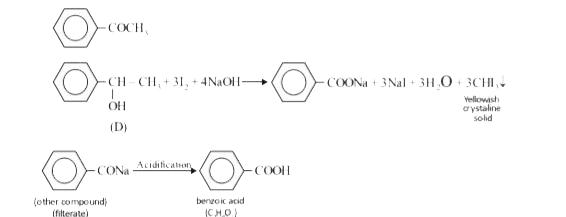
`underset((C_(8)H_(10)O))("Compound D")overset(I_(2)+NaOH)rarr underset("(Yellow ppt.)")(CHI_(3) darr)+"compound (filerate)" underset((C_(7)H_(6)O_(2)))overset("Acid")rarr "compound E"`
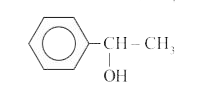
Thus, this reaction indicates the presence of -`COCH_(3)` group of present of `-CHOH-CH_(3)` group in given compound D. On the basis of molecular formula of compound D and above reaction, the possible structure is given below:

Thus, this compound gives iodoform test as in following reaction ( in first step this compound on oxidation with `I_(2)` gives

Hence, compounds
Promotional Banner

Topper's Solved these Questions

  • ALCOHOLS, PHENOLS & ETHERS

    VMC MODULES ENGLISH|Exercise Example|20 Videos
  • ALCOHOLS, PHENOLS & ETHERS

    VMC MODULES ENGLISH|Exercise PRACTICE EXERCISE:1|21 Videos
  • 13-14 HYDROGEN & S-BLOCK ELEMENT

    VMC MODULES ENGLISH|Exercise JEE Advanced Archive|48 Videos
  • ALCOHOLS, PHENOLS & ETHERS

    VMC MODULES ENGLISH|Exercise Impeccable|100 Videos

Similar Questions

Explore conceptually related problems

A compound D(C_(8)H_(10)O) upon treatement with alkaline solution of iodine gives a yellow precipitate. The fibtrate on acidification gives a white solid E(C_(7)H_(6)O_(2)) . Write the structures of D,E .

An organic compound (A) (C_(8)H_(8)O_(3)) was insoluble in water, dilute HCI, and NaHCO_(3) . It was soluble in NaOH. A solution of (A) in dilute NaOH was boiled and steam distilled and distillate was reacted with NaOH to give a yellow precipitate. The alkaline residue is acidifield to give a solid (B) (C_(7)H_(6)O_(3)) . (B) dissolves in aqueous NaHCO_(3) with the evolution of gas. Identify (A) and (B).

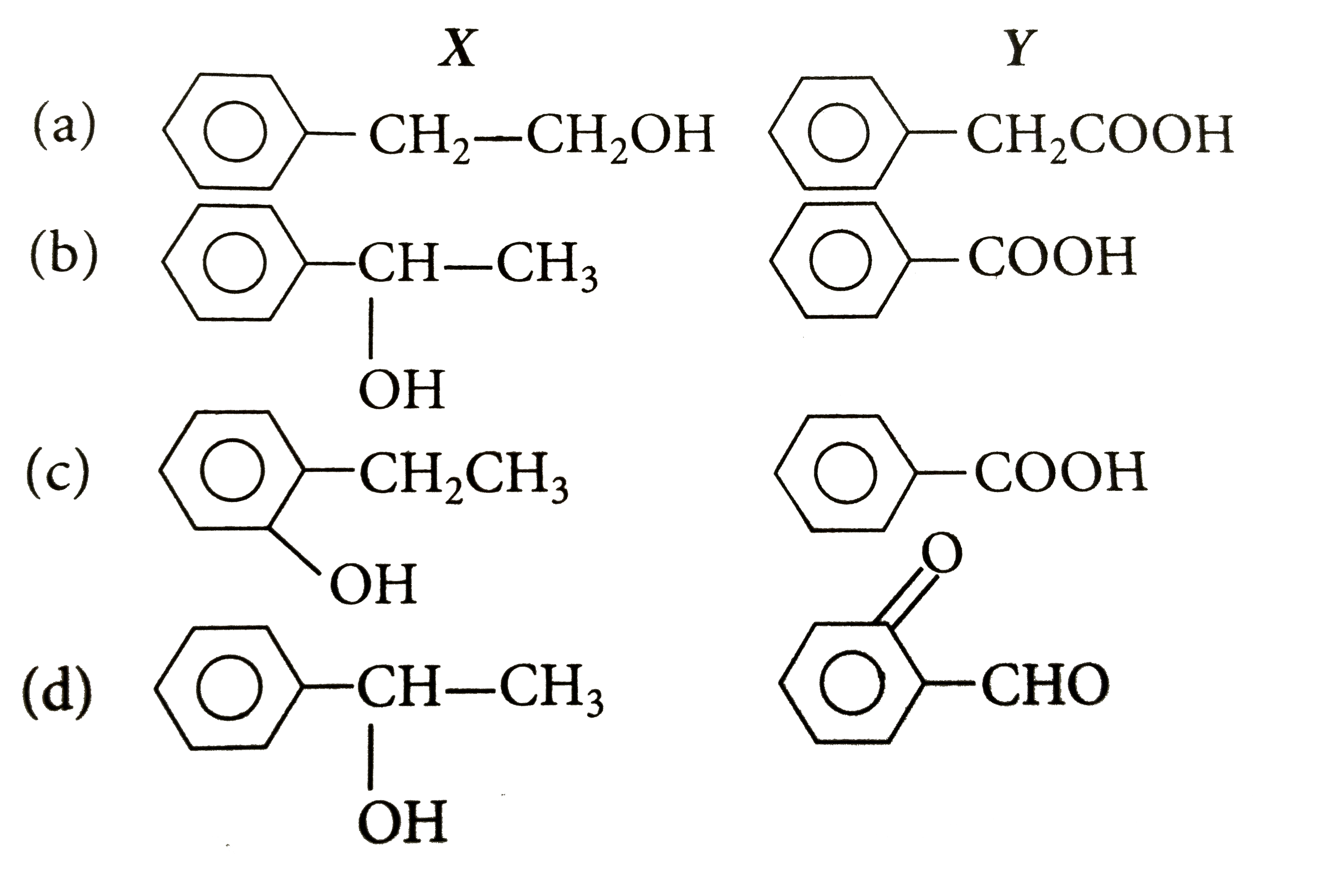
Compound A,C_(8)H_(10)O , is found to react with NaOI (produced by reacting Y with NaOH ) and yields a yellow precipitate with characteristic smell. A and Y are respectively (a) (b) (c) (d)

An aromatic compound (X) (C_(8)H_(8)O) gives positive 2, 4-DNP test. It gives a yellow precipitate of compound (Y) on reaction with iodine and sodium hydroxide solution. (X) does not give Tollens' test on oxidation under drastic conditions. It gives a carboxylic acid (Z) (C_(7)H_(6)O_(2)) .(Z) is also formed with (Y) during the reaction. (X), (Y) and (Z) respectively are

Compound (X) C_(6)H_(5)O gives yellow coloured ppt with 2,4 DNP but does not give red colored ppt with Fehiling's solution (X) on treatement with NH_(2)OH H^(+) gives compound (Y) C_(6)H_(5)NO (Y) when treated with PCl_(5) gives isomeric compound (Z) . (Z) on hydrolysis gives propanoic acid and aniline. what will be the correct structure of (X) ,(Y) and (Z) ?

X' compound (C_(4)H_(8)O) decolorises bromine water react with I_(2) & NaOH it give yellow ppt identify 'X'

The compound C_8H_9Cl(A) on treatments with KCN followed by hydrolysis gives C_9H_10O_2(B) .Ammonium salt of B on dry distillation yields C.Which reacts with alkaline solution of bromine to gives C_8H_11N .(D)Another compound E is obtained by the action of nitrous acid on D. E on oxidation gives F which gives the inner anhydride G on heating. The Compound A is :