Home
Class 12
CHEMISTRY
In the reaction: CH(3)-underset(CH(3))un...

In the reaction: `CH_(3)-underset(CH_(3))underset(|)overset(CH_(3))overset(|)C-OH+HCl rarr CH_(3)-underset(CH_(3))underset(|)overset(CH_(3))overset(|)C-Cl`
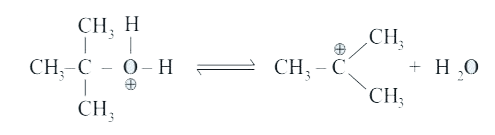
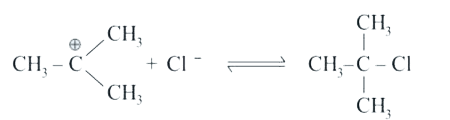
the rate-determining step is:

A

`CH_(3)-underset(CH_(3))underset(|)overset(CH_(3))overset(|)C-OH+H_(3)O^(+)hArrCH_(3)-underset(CH_(3))underset(|)overset(CH_(3))overset(|)C-underset(o+)overset(H)overset(|)O-H-H_(2)O`

B

C

D

all steps take place with equal ease

Text Solution

AI Generated Solution

The correct Answer is:

To determine the rate-determining step in the reaction of a tertiary alcohol with HCl, we can follow these steps: ### Step-by-Step Solution: 1. **Identify the Reactants and Products**: - The reactant is a tertiary alcohol: \( CH_3C(CH_3)_2OH \). - The product is a tertiary alkyl chloride: \( CH_3C(CH_3)_2Cl \). 2. **Understand the Mechanism**: - The reaction involves the protonation of the alcohol by HCl, which leads to the formation of a better leaving group (water). - The HCl dissociates into \( H^+ \) and \( Cl^- \). 3. **Protonation of the Alcohol**: - The \( H^+ \) from HCl attacks the hydroxyl group (-OH) of the alcohol, converting it into water (\( H_2O \)), which is a good leaving group. - This step can be represented as: \[ CH_3C(CH_3)_2OH + H^+ \rightarrow CH_3C(CH_3)_2OH_2^+ \] 4. **Formation of Carbocation**: - The next step involves the loss of water (\( H_2O \)) from the protonated alcohol, leading to the formation of a carbocation. - This is the critical step where the stability of the carbocation plays a significant role. In this case, a tertiary carbocation is formed, which is stabilized by the +I effect of the three methyl groups. - The reaction can be represented as: \[ CH_3C(CH_3)_2OH_2^+ \rightarrow CH_3C(CH_3)_2^+ + H_2O \] 5. **Rate-Determining Step**: - The formation of the carbocation is the slowest step in the mechanism and thus is the rate-determining step. - After the carbocation is formed, the \( Cl^- \) ion can quickly attack the carbocation to form the final product: \[ CH_3C(CH_3)_2^+ + Cl^- \rightarrow CH_3C(CH_3)_2Cl \] 6. **Conclusion**: - The rate-determining step in this reaction is the formation of the carbocation from the protonated alcohol. ### Final Answer: The rate-determining step is the formation of the carbocation.

To determine the rate-determining step in the reaction of a tertiary alcohol with HCl, we can follow these steps: ### Step-by-Step Solution: 1. **Identify the Reactants and Products**: - The reactant is a tertiary alcohol: \( CH_3C(CH_3)_2OH \). - The product is a tertiary alkyl chloride: \( CH_3C(CH_3)_2Cl \). ...
Promotional Banner

Topper's Solved these Questions

  • ALCOHOLS, PHENOLS & ETHERS

    VMC MODULES ENGLISH|Exercise PRACTICE EXERCISE:2|12 Videos
  • ALCOHOLS, PHENOLS & ETHERS

    VMC MODULES ENGLISH|Exercise PRACTICE EXERCISE:3|8 Videos
  • ALCOHOLS, PHENOLS & ETHERS

    VMC MODULES ENGLISH|Exercise Example|20 Videos
  • 13-14 HYDROGEN & S-BLOCK ELEMENT

    VMC MODULES ENGLISH|Exercise JEE Advanced Archive|48 Videos
  • ALCOHOLS, PHENOLS & ETHERS

    VMC MODULES ENGLISH|Exercise Impeccable|100 Videos

Similar Questions

Explore conceptually related problems

CH_(3)-underset(CH_(3))underset(|)overset(CH_(3))overset(|)C-CH=CH-CH_(3)overset(H-Cl)(to) ?

The reaction CH_(3)-underset(CH_(3))underset(|)overset(CH_(3))overset(|)(C )-ONa+CH_(3)CH_(2)ClrarrCH_(3)-underset(CH_(3))underset(|)overset(CH_(3))overset(|)(C )-O-CH_(2)-CH_(3) is called

2CH_(3)-underset(CH_(3))underset(|)overset(CH_(3))overset(|)(C)-CHO+NaOHrarr The product is

The reaction CH_3-underset(CH_3)underset(|)overset(CH_3)overset(|)C-ONa+CH_3CH_2Clunderset(-NaCl)rarrCH_3-underset(CH_3)underset(|)overset(CH_3)overset(|)C-O-CH_2-CH_3 is called

Monomer of [-underset(CH_(3))underset(|)overset(CH_(3))overset(|)C-CH_(2)-]_(n) is

The monomer of the polymer ~CH_(2)-underset(CH_(3))underset(|)overset(CH_(3))overset(|)(C)-CH_(2)-overset(CH_(3))overset(|)underset(CH_(3))underset(|)(C)~

CH_(3)-Br+NaO-underset(CH_(3))underset(|)overset(CH_(3))overset(|)C-CH_(3)to ? The product is

(-- CH_2 - underset(CH_3)underset(|) overset(CH_3)overset(|)C-CH_2 - underset(CH_3)underset(|)overset(CH_3)overset(|)C--)_n is a polymer having monomer units.

VMC MODULES ENGLISH-ALCOHOLS, PHENOLS & ETHERS -PRACTICE EXERCISE:1
  1. Oxo process:

    Text Solution

    |

  2. on dehydration with conc. H(2)SO(4) forms predominantly :

    Text Solution

    |

  3. In the reaction: CH(3)-underset(CH(3))underset(|)overset(CH(3))overset...

    Text Solution

    |

  4. Reduction of gt C = O to gt CH(2) can be carried out with

    Text Solution

    |

  5. The boiling points to isomeric alcohols follow the order

    Text Solution

    |

  6. The acidic character of 1^(@),2^(@),3^(@) alcohls, H(2)O and RC-=CH i...

    Text Solution

    |

  7. In the following reaction sequence : R-OH overset(P+I(2))rarr R-I ov...

    Text Solution

    |

  8. Which of the following is the most reactive with HCl in the presence o...

    Text Solution

    |

  9. Methanol is manufactured by passing ( under pressure ) a mixture of wa...

    Text Solution

    |

  10. CH(3)underset(Br)underset(|)(C)HCH(3)overset("alc."//KOH)toAoverset(HB...

    Text Solution

    |

  11. The compound that reacts fastest with Lucas reagent at room temperatu...

    Text Solution

    |

  12. A compound that gives a positive iodofrm test is :

    Text Solution

    |

  13. One of the cmmercial production methods of methanol is :

    Text Solution

    |

  14. HBr reacts fastest with

    Text Solution

    |

  15. Which of the following compounds is oxidised to prepare methyl ethyl k...

    Text Solution

    |

  16. The order of reactivity of the following alcohols towards conc. HCI is

    Text Solution

    |

  17. The product of acid catalyzed hydration of 2-pheny1propene is

    Text Solution

    |

  18. The best method to prepare cyclohexene form cyclohexanol is by using:

    Text Solution

    |

  19. Consider the following compounds: (I) 1, 2-dihydroxy benzene (II)...

    Text Solution

    |

  20. The reaction of with HBr gives :

    Text Solution

    |
