Home
Class 12
PHYSICS
A satellite of mass 'M' is projected rad...

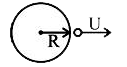
A satellite of mass 'M' is projected radially from surface of earth with speed 'u'. When is reaches a height equal to radius of earth, it ejects a rocket of mass `( M)/(10 )`and it itself starts orbiting the earth in circular path of radius 2R, find the kinetic energy of rocket.

A

`m/10(25U^(2)-(84GM)/(3R))`

B

`m/10(15U^(2)-(74 GM)/(3R))`

C

`m/8(U-sqrt((10GM)/(3R)))`

D

`m/6(25U^(2)-(94GM)/(3R))`

Text Solution

Verified by Experts

The correct Answer is:
A


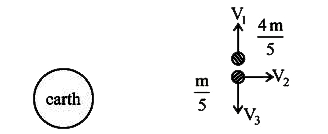
`(-GMm)/R+1/2"mu"^(2)=(-TMm)/(3R)+1/2mv^(2)`….i
After ejection of rocket `impliesmV^(2)=mU^(2)-4/3(GMm)/R`
`vecP_("in"=vecP_(f)`
`impliesmv=m/5v_(2)^(2)` and `(4m)/5 v_(1)m/5v_(3)`
`v_(2)=5v" "v_(3)=4v_(1)=4sqrt((GM)/(3R))`
K.E of rocket `=1/2 m/5(v_(2)^(2)+v_(3)^(2))`
`=m/10(25v^(2)+(16 GM)/(3R))`
`=1/10(25m^(2)U^(2)-4/3(GMm)/R)+(16 GMm)/(3R)`
`=1/10(25m^(2)U^(2)-(84GMm)/(3R))`
Promotional Banner

Topper's Solved these Questions

  • MOCK TEST 10

    VMC MODULES ENGLISH|Exercise PHYSICS (SECTION 2)|5 Videos
  • MOCK TEST 1

    VMC MODULES ENGLISH|Exercise PART I : PHYSICS (SECTION-2)|10 Videos
  • MOCK TEST 11

    VMC MODULES ENGLISH|Exercise Physics (Section-2)|5 Videos

Similar Questions

Explore conceptually related problems

A satellite of mass m is launched vertically upwards with an initial speed U from the surface of the Earth. After it reaches height 2 R (R = radius of Earth) it ejects a rocket of mass (m)/(5) So, that subsequently the satellite moves in a circular orbit. The kinetic energy of rocket is (M is mass of Earth)

A satellite of mass m is launched vertically upwards with initial kinetic energy K from the Earth’s surface. After it reaches height R (R = radius of earth). It ejects a rocket of mass m/5 so that subsequently the satellite moves in a circular orbit. The kinetic energy of rocket is [G is gravitational constant, M is the mass of the earth, take (GMm)/(R)=K ]

The work done to raise a mass m from the surface of the earth to a height h, which is equal to the radius of the earth, is :

A satellite of mass m is launched vertically upwards with an initial speed sqrt((GM)/®) from the surface of the earth. After it reaches height R (R = radius of the earth), it ejects a rocket of mass m/10 in a direction opposite to the initial direction of the satellite, so that subsequently the satellite escapes to infinity. The minimum kinetic energy of the rocket at ejection needed is (G is the gravitational constant, M is the mass of the earth):

A satellite of mass m is just placed over the surface of earth. In this position mechanical energy of satellite is E_(1) . Now it starts orbiting round the earth in a circular path at height h = radius of earth. In this position, kinetic energy potential energy and total mechanical energy of satellite are K_(2) , U_(2) and E_(2) respectively. Then

A body of mass m is taken from earth surface to the height h equal to radius of earth, the increase in potential energy will be

A satallite of mass m , initally at rest on the earth, is launched into a circular orbit at a height equal to the the radius of the earth. The minimum energy required is

A satallite of mass m , initally at rest on the earth, is launched into a circular orbit at a height equal to the the radius of the earth. The minimum energy required is

An object of mass m is raised from the surface of the earth to a height equal to the radius of the earth, that is, taken from a distance R to 2R from the centre of the earth. What is the gain in its potential energy ?