Home
Class 12
PHYSICS
Two fixed long parallel horizontal rails...

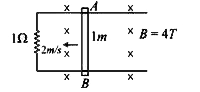
Two fixed long parallel horizontal rails, a distance 1 m apart are joined at one end by a resistance `1Omega`. A rod AB of negligible resistance slides towards the resistance. A magnetic field of magnitude 4T perpendicular to the plane of rails exists. Find the current flowing (in Ampere) in the resistance, at an instant when the velocity of the rod is 2 m/s.

Text Solution

Verified by Experts

The correct Answer is:

8

EMF induced `=BLV=4xx2xx1=8V`
Current produced `=(BLV)/( R )=(8)/(1)=8A`
Promotional Banner

Topper's Solved these Questions

  • MOCK TEST 1

    VMC MODULES ENGLISH|Exercise PART I : PHYSICS (SECTION-2)|10 Videos
  • MAGNETIC EFFECTS OF CURRENT

    VMC MODULES ENGLISH|Exercise JEE Advanced (Archive)|78 Videos
  • MOCK TEST 10

    VMC MODULES ENGLISH|Exercise PHYSICS (SECTION 2)|5 Videos

Similar Questions

Explore conceptually related problems

Two long parallel horizontal rails a, a distance d aprt and each having a risistance lambda per unit length are joing at one end by a resistance R. A perfectly conduction rod MN of mass m is free to slide along the rails without friction (see figure). There is a uniform magnetic field of induction B normal to the plane of the paper and directed into the paper. A variable force F is applied to the rod MN such that, as the rod moves a constant current flows through R. (i) Find the velocity of the rod and the applied force F as function of the distance x of the rod from R. (ii) What fraction of the work done per second by F is converted into heat?

AB and CD are two parallel conductors kept 1 m apart and connected by a resistance R of 6Omega , as shown in figure below. They are placed in a magnetic field B = 3 xx 10^(-2) T which is perpendicular to the plane of the conductors and directed into the paper. A wire MN is placed over AB and CD and then made to slide with a velocity 2 ms^(-1) (Neglect the resistance of AB, CD, and MN.) Calculate the induced current flowing through the resistor R.

A copper rod of mass m slides under gravity on two smooth parallel rails l distance apart set at an angle theta to the horizontal. At the bottom, the rails are joined by a resistance R . There is a uniform magnetic field perpendicular to the plane of the rails. the terminal valocity of the rod is

A vertical ring of radius r and resistance on R falls vertically. It is in contact with two vertical rails which are joined at the top. The rails are without friction and resistance. There is a horizontal uniform, magnetic field of magnitude B perpendicular to the plane of the ring and the rails. When the speed of the ring is v , the current in the section PQ is

A vertical ring of radius r and resistance on R falls vertically. It is in contact with two vertical rails which are joined at the top. The rails are without friction and resistance. There is a horizontal uniform, magnetic field of magnitude B perpendicular to the plane of the ring and the rails. When the speed of the ring is v , the current in the section PQ is

Figure shows a wire of resistance R sliding on two parallel, conducting fixed thick rails placed at a separation l. A magnetic fild B exist in a direction perpendicular to the plane of the rails. The wire is moving with a constant velocity v. Find current through the wire

A metal rod of resistance R is fixed along a diameter of a conducting ring of radius r. There is a magnetic field of magnitude B perpendicular to the plane of the loop. The ring spins with an angular velocity omega about its axis. The centre of the ring is joined to its rim by an external wire W. The ring and W have no resistance. The current in W is

A conducting rod MN of mass m and length 'l' is placed on parallel smooth conducting rails connected to an uncharged capacitor of capacitance C and a battery of emf epsilon as shown. A uniform magnetic field B is existing perpendicular to the plane of the rails. The steady state velocity acquired by the conducting rod MN after closing switch S is (neglect the resistance of the parallel rails and the conducting rod)

A rod of length l and resistance r rotates about one end as shown in figure.Its othr end touches a conducting ring a of negligible resistance. A resistance R is connected between centre and periphery.Draw the electrical equivalence and find the current in the resistance R .There is a uniform magnetic field B directed as shown.

Two long parallel conducting rails are placed in a uniform magnetic field. On one side, the rails are connected with a resistance R . Two rods MN and M'N' each having resistance r are placed as showing in Fig. Now on the rods MN and M'N' forces are applied such that the rods move with constant velocity v . (i). The current flowing through resistance R if the rod Mn moves toward left and the rod M'N' moves toward the right is
