Home
Class 12
PHYSICS
A long solenoid of radius R carries a ti...

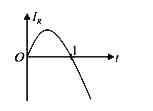
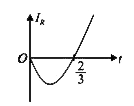
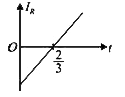
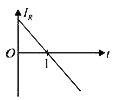
A long solenoid of radius R carries a time (t)-dependent current `I(t)= I_(0)t^(2) (1-t)`. A conducting ring of radius 3R is placed co-axially near its middle. During the time interva `0 le t le 1`, the induced current `(I_(R ))` in the ring varies as: [Take resistance of ring to be `R_(0)`]

A

B

C

D

Text Solution

AI Generated Solution

The correct Answer is:

To solve the problem step by step, we will analyze the given information and apply relevant physics concepts. ### Step 1: Understand the Current in the Solenoid The current in the solenoid is given by: \[ I(t) = I_0 t^2 (1 - t) \] This indicates that the current varies with time. ### Step 2: Calculate the Magnetic Field Inside the Solenoid The magnetic field \( B \) inside a long solenoid is given by: \[ B = \mu_0 n I \] where \( n \) is the number of turns per unit length. Assuming the solenoid has \( n \) turns and using the given current: \[ B(t) = \mu_0 n I_0 t^2 (1 - t) \] ### Step 3: Determine the Area of the Conducting Ring The radius of the conducting ring is \( 3R \). The area \( A \) of the ring is: \[ A = \pi (3R)^2 = 9\pi R^2 \] ### Step 4: Calculate the Magnetic Flux through the Ring The magnetic flux \( \Phi \) through the ring is given by: \[ \Phi = B \cdot A \] Substituting the expressions for \( B \) and \( A \): \[ \Phi(t) = \mu_0 n I_0 t^2 (1 - t) \cdot 9\pi R^2 \] \[ \Phi(t) = 9\mu_0 n I_0 \pi R^2 t^2 (1 - t) \] ### Step 5: Find the Induced EMF According to Faraday's law of electromagnetic induction, the induced EMF \( \mathcal{E} \) is given by: \[ \mathcal{E} = -\frac{d\Phi}{dt} \] Differentiating \( \Phi(t) \): \[ \frac{d\Phi}{dt} = 9\mu_0 n I_0 \pi R^2 \frac{d}{dt}(t^2 (1 - t)) \] Using the product rule: \[ \frac{d}{dt}(t^2 (1 - t)) = 2t(1 - t) - t^2 = 2t - 3t^2 \] Thus, \[ \mathcal{E} = -9\mu_0 n I_0 \pi R^2 (2t - 3t^2) \] ### Step 6: Calculate the Induced Current The induced current \( I_R \) in the ring can be calculated using Ohm's law: \[ I_R = \frac{\mathcal{E}}{R_0} \] Substituting for \( \mathcal{E} \): \[ I_R = -\frac{9\mu_0 n I_0 \pi R^2 (2t - 3t^2)}{R_0} \] ### Step 7: Determine When the Induced Current is Zero To find when the induced current is zero, set the expression \( 2t - 3t^2 = 0 \): \[ t(2 - 3t) = 0 \] This gives: 1. \( t = 0 \) 2. \( t = \frac{2}{3} \) ### Conclusion The induced current varies as a function of time and is zero at \( t = 0 \) and \( t = \frac{2}{3} \). The nature of the function \( I_R \) indicates it is a quadratic function of time, which opens downwards (as indicated by the negative coefficient of \( t^2 \)).

To solve the problem step by step, we will analyze the given information and apply relevant physics concepts. ### Step 1: Understand the Current in the Solenoid The current in the solenoid is given by: \[ I(t) = I_0 t^2 (1 - t) \] This indicates that the current varies with time. ### Step 2: Calculate the Magnetic Field Inside the Solenoid ...
Promotional Banner

Topper's Solved these Questions

  • MOCK TEST 11

    VMC MODULES ENGLISH|Exercise Physics (Section-2)|5 Videos
  • MOCK TEST 10

    VMC MODULES ENGLISH|Exercise PHYSICS (SECTION 2)|5 Videos
  • MOCK TEST 12

    VMC MODULES ENGLISH|Exercise PHYSICS (SECTION 2)|5 Videos

Similar Questions

Explore conceptually related problems

A long solenoid of radius R carries a time dependent current I = I_(0) t(1 – t) . A ring of radius 2R is placed coaxially near its centre. During the time interval 0 le t le 1 , the induced current I_(R) and the induced emf VR in the ring vary as:

long solenoid of radius R carries a time –dependent current I(t) = I_(0) (12t - t^(3)) . A ring of radius 2R is placed coaxially near its middle. During the time interval 0 le t le 2 sqrt(3) , the induced current (I_(R)) and the induced EMF (V_(R)) in the ring change as :

A long solenoid of radius R carries a time (t) – dependent current I=I_(0)(t-2t^(2)) A circular ring of radius = R is placed near the centre of the solenoid and plane of ring makes an angle 30^(@) with the axis of solenoid. The time at which magnetic flux through the ring is maximum is :

A long solenoid of radius R carries a time (t) – dependent current I=I_(0)(t-2t^(2)) A circular ring of radius = R is placed near the centre of the solenoid and plane of ring makes an angle 30^(@) with the axis of solenoid. The time at which magnetic flux through the ring is maximum is :

A conducting ring of radius b is placed coaxially in a long solenoid of radius a (b < a) having n turns per unit length. A current i = i_(0) , cos omega t flows through the solenoid. The induced emf in the ring is

Switch is closed at t = 0 then the current in the circuit at t = L/2R is

The diagram shows a solenoid carrying time varying current I=I_0t ( I_0 is constant) on the axis of this solenoid a conducting ring is being placed as shown in the figure. The mutual inductance of the ring and the solenoid is M and self inductance of the ring is L . if the resistance of the ring is R then the maximum current which can flow through the ring is

If i= t^(2), 0 lt t lt T then r.m.s. value of current is

A current (I) carrying circular wire of radius R is placed in a magnetic field B perpendicular to its plane. The tension T along the circumference of the wire is

A very long solenoid of radius R is carrying current I(t)=kte^(-alphat) (kgt0), as a function of time (tge0) . Counter clockwise current is taken to be positive. A circular conducting coil of radius 2R is placed in the equatorial plane of the solenoid and concentric with the solenoid. the current induced inthe outer coil is correctly depicted, as function of time by :
