Home
Class 12
PHYSICS
A particle (m=1kg) slides down in fricti...

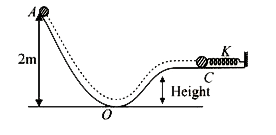
A particle (m=1kg) slides down in frictionless-track AOC starting from rest at a point A(height 2m). After reaching on horizontal smooth track compresses a light spring of spring constant K= 100N/m, by distance 0.5 m before coming to rest. The height (in m) of horizontal track is.........(Take `g= 10 m//s^(2)`)

Text Solution

Verified by Experts

The correct Answer is:

0.75

`PE_(A)= PE_(C )+ SPE_(C ) rArr mgh_(A)= mgh_(C )+ (1)/(2) kx^(2)`
`rArr h_(C )= h_(A) -(kx^(2))/(2mg) = 2m- (100 xx 1)/(2 xx 1 xx 10 xx 4)m`
`=(2-1.25)m = 0.75m`
Promotional Banner

Topper's Solved these Questions

  • MOCK TEST 11

    VMC MODULES ENGLISH|Exercise Physics (Section-2)|5 Videos
  • MOCK TEST 10

    VMC MODULES ENGLISH|Exercise PHYSICS (SECTION 2)|5 Videos
  • MOCK TEST 12

    VMC MODULES ENGLISH|Exercise PHYSICS (SECTION 2)|5 Videos

Similar Questions

Explore conceptually related problems

A particle slides down a frictionless track AOC starting from rest at a point A (height 2m). After reaching on horizontal smooth track compresses a light spring of spring constant k=100n/m by distance 0.5 m before coming to rest. The height (in m) of horizontal track is ........... (Take g = 10 m//s^(2))

A particle (m = 3 kg) slides down a frictionless track (AOC) starting from rest at a point A (height 2m). After reaching C, the particle continues to move freely in air as a projectile. When it reaching its highest point P (height 1.5 m) the kinetic energy of the prarticle (in J) is : Figure drawn is schematic and not to scale , take g = 10 ms^(-2)

A particle (m = 3 kg) slides down a frictionless track (AOC) starting from rest at a point A (height 2m). After reaching C, the particle continues to move freely in air as a projectile. When it reaching its highest point P (height 1.5 m) the kinetic energy of the prarticle (in J) is : Figure drawn is schematic and not to scale , take g = 10 ms^(-2)

A particle (m = 1kg) slides down a frictionless track (AOC) starting from rest at a point A (height 2m). After reaching C, the particle continues to move freely in air as a projectile. When it reaches point C (height 1 m), the vertical speed of the particle (in m/s) is (Figure drawn is schematic and not to scale , take g = 9.8 m/ sec^(2) ) [Take ]

A particle (m = 1kg) slides down a frictionless track (AOC) starting from rest at a point A (height 2m). After reaching C, the particle continues to move freely in air as a projectile. When it reaches point C (height 1 m), the vertical speed of the particle (in m/s) is (Figure drawn is schematic and not to scale , take g = 9.8 m/ sec^(2) ) [Take ]

A particle (m = 2 kg) slides down a smooth track AOC starting from rest at point A (height = 5m). After reaching point C (height =1m), the particle continues to move freely in air as a projectile. The particle velocity at point C is at angle 60^(@) with the horizontal. The maximum height attained by particle after leaving point C is _____(in m). [figure drawn is schematic and hot to scale : take =ms^(-2) ]

A particle (m = 2 kg) slides down a smooth track AOC starting from rest at point A (height = 5m). After reaching point C (height =1m), the particle continues to move freely in air as a projectile. The particle velocity at point C is at angle 60^(@) with the horizontal. The maximum height attained by particle after leaving point C is _____(in m). [figure drawn is schematic and hot to scale : take =ms^(-2) ]

A man M slides down a curved frictionless track, starting from rest. The curve obeye the equation y=(x^(2))/(2) . The tangential acceleration of man is

A body of mass 5 kg moving with a speed of 1.5 m/s on a horizontal smooth surface collides with a nearly weightless spring of force constant k = 5 N/m. The maximum compression of the spring would be

A mass of 0.5 kg moving with a speed of 1.5 m//s on a horizontal smooth surface, collides with a nearly weightless spring of force constant k =50 N//m The maximum compression of the spring would be.
