Home
Class 12
CHEMISTRY
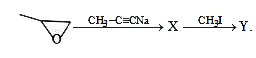
. Y will be...

. Y will be

A

`{:(CH_(3)-CH-CH_(2)-C-=C-CH_(3)),(" |"),(" "OCH_(3)):}`

B

`{:(CH_(3)-CH_(2)-CH-C-=C-CH_(3)),(" |"),(" "OCH_(3)):}`

C

`{:(CH_(3)-CH-CH_(2)-C-=C-CH_(3)),(" |"),(" "OH):}`

D

`{:(CH_(3)-CH_(2)-CH-C-=C-CH_(3)),(" |"),(" "OH):}`

Text Solution

Verified by Experts

The correct Answer is:

A

Promotional Banner

Topper's Solved these Questions

  • MOCK TEST 11

    VMC MODULES ENGLISH|Exercise CHEMISTRY (Section-2)|5 Videos
  • MOCK TEST 10

    VMC MODULES ENGLISH|Exercise CHEMISTRY (SECTION 2)|5 Videos
  • MOCK TEST 12

    VMC MODULES ENGLISH|Exercise CHEMISTRY (SECTION 2)|5 Videos

Similar Questions

Explore conceptually related problems

If a function is represented parametrically be the equations x=(1+(log)_e t)/(t^2); y=(3+2(log)_e t)/t , then which of the following statements are true? y^(x-2x y^(prime))=y y y^(prime)=2x(y^(prime))^2+1 x y^(prime)=2y(y^(prime))^2+2 y^(y-4x y^(prime))=(y^(prime))^2

If y=sinp x and y_n is the n t h derivative of y , then |[y, y_1,y_2],[y_3,y_4,y_5],[y_6,y_7,y_8]|i s (a)1 (b) 0 (c) -1 (d) none of these

The quotient of x\ b y\ y added to the product of x\ a n d\ y is written as (a) x/y+x y (b) y/x+\ x y (c) (x y+x)/y (d) (x y+y)/x

If y = y ( x ) is the solution of differential equation sin y (dy ) /(dx ) - cos y = e ^ ( - x ) such that y ( 0 ) = ( pi ) /(2) then y (A) is equal to

Define the symbol # by the following equations: {:(x#y = (x - y)^(2),", if" x > y),(x#y = x + y//4,", if" x le y):} If x # y = -1 , which of the following could be true?

If [x,y] [{:(,x),(,y):}]=[25] and [-x,y] [{:(,2x),(,y):}]=[-2,]2 find x and y if: (i) x, y in W (whole numbers) (ii) x,y in Z (integers)

For all nonzero numbers x and y, the operation grad is defined by the equation x grad y = (|x|)/(x^(2))+(y^(2))/(|y|) when x gt y and by the equation x grad y = (|x|)/(y^(2))-(x^(2))/(|y|) when x le y . If x grad y lt 0 , then which of the following could be true ? I. x^(3)=y^(3) II. (y+x)(y-x)gt 0 III. x-y gt 0

If y= sin px and y_(n) is the nth derivative of y, then |{:(y,y_(1),y_(2)),(y_(3),y_(4),y_(5)),(y_(6),y_(7),y_(8)):}| is

