Home
Class 12
CHEMISTRY
A solution of Benzylamine, Cyclohexanol ...

A solution of Benzylamine, Cyclohexanol and Picric acid in ethyl acetate was extracted initially with a saturated solution of `NaHCO_(3)` to give fraction A. The left over organic phase was extracted with chloroform with KOH give fraction B. The final organic layer was labelled as fraction C. Fractions A, B and C contain respectively :

A

Picric acid, Benzylamine, Cyclohexanol

B

Benzylamine, Picric acid, Cyclohexanol

C

Picric acid, Cyclohexanol, Benzylamine

D

Benzylamine, Cyclohexanol, Picric acid

Text Solution

Verified by Experts

The correct Answer is:
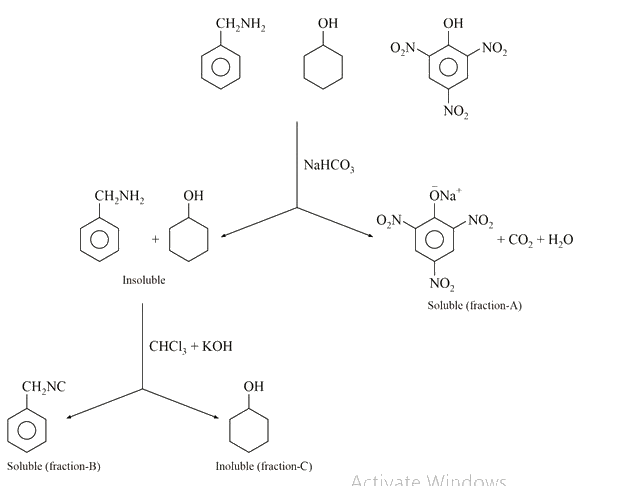
A

Promotional Banner

Topper's Solved these Questions

  • MOCK TEST 12

    VMC MODULES ENGLISH|Exercise CHEMISTRY (SECTION 2)|5 Videos
  • MOCK TEST 11

    VMC MODULES ENGLISH|Exercise CHEMISTRY (Section-2)|5 Videos
  • MOCK TEST 13

    VMC MODULES ENGLISH|Exercise CHEMISTRY ( SECTION-2)|5 Videos

Similar Questions

Explore conceptually related problems

A solution of m - chloroaniline, m- chlorophenol and m - chlorobenzoinc acid in ethyl acetate was extracted initially with a saturated solution of Na HCO _ 3 to give fraction A. The left over organic phase was extracted with dilute NaOH solution to give fraction B. The final organic layer was labelled as fraction C. Fractions A, B and C, contain respectively :

A solution of Benzyl chloride, Benzoic acid and Aniline was extracted initially with a HCl solution of to give fraction A. The left over organic phase was extracted with conc. NaOH solution to give fraction B. The final organic layer was labelled as fraction A, B and C contain respectively

The sodium extract of an organic compound on acidified with acetic acid and addition of lead acetate solution gives a back precipitate. The organic compound contains :

Give five examples each of: a. proper fractions b. improper fractions c. mixed fractions

The sodium extract on acidification with acetric acid and then adding lead acetate solution gives a black precipitate. The organic compound contains.

A certain ideal solution of two liquids A and B has mole fraction of 0.3 and 0.5 for the vapour phase and liquid phase, respectively. What would be the mole fraction of B in the vapour phase, when the mole fraction of A in the liquid is 0.25 ?

The vapour pressures of pure liquids A and B are 400 and 600 mmHg , respectively at 298K . On mixing the two liquids, the sum of their initial volumes is equal to the volume of the final mixture. The mole fraction of liquid B is 0.5 in the mixture. The vapour pressure of the final solution, the mole fractions of components A and B in vapour phase, respectively are:

The vapour pressures of pure liquids A and B are 400 and 600 mm Hg respectively at 298 K. On mixing the two liquids, the sum of their initial volumes is equal to the volume of the final mixture. The mole fraction of liquid B is 0.5 in the mixture. The vapour pressure of the final solution, the mole fractions of components A and B in vapour phase, respectively are :

The vapour pressures of pure liquids A and B are 400 and 600 mm Hg respectively at 298 K. On mixing the two liquids, the sum of their initial volumes is equal to the volume of the final mixture. The mole fraction of liquid B is 0.5 in the mixture. The vapour pressure of the final solution, the mole fractions of components A and B in vapour phase, respectively are :

The vapour pressures of pure liquids A and B are 400 and 600 mm Hg respectively at 298 K. On mixing the two liquids, the sum of their initial volumes is equal to the volume of the final mixture. The mole fraction of liquid B is 0.5 in the mixture. The vapour pressure of the final solution, the mole fractions of components A and B in vapour phase, respectively are :

