

Home
Class 11
PHYSICS
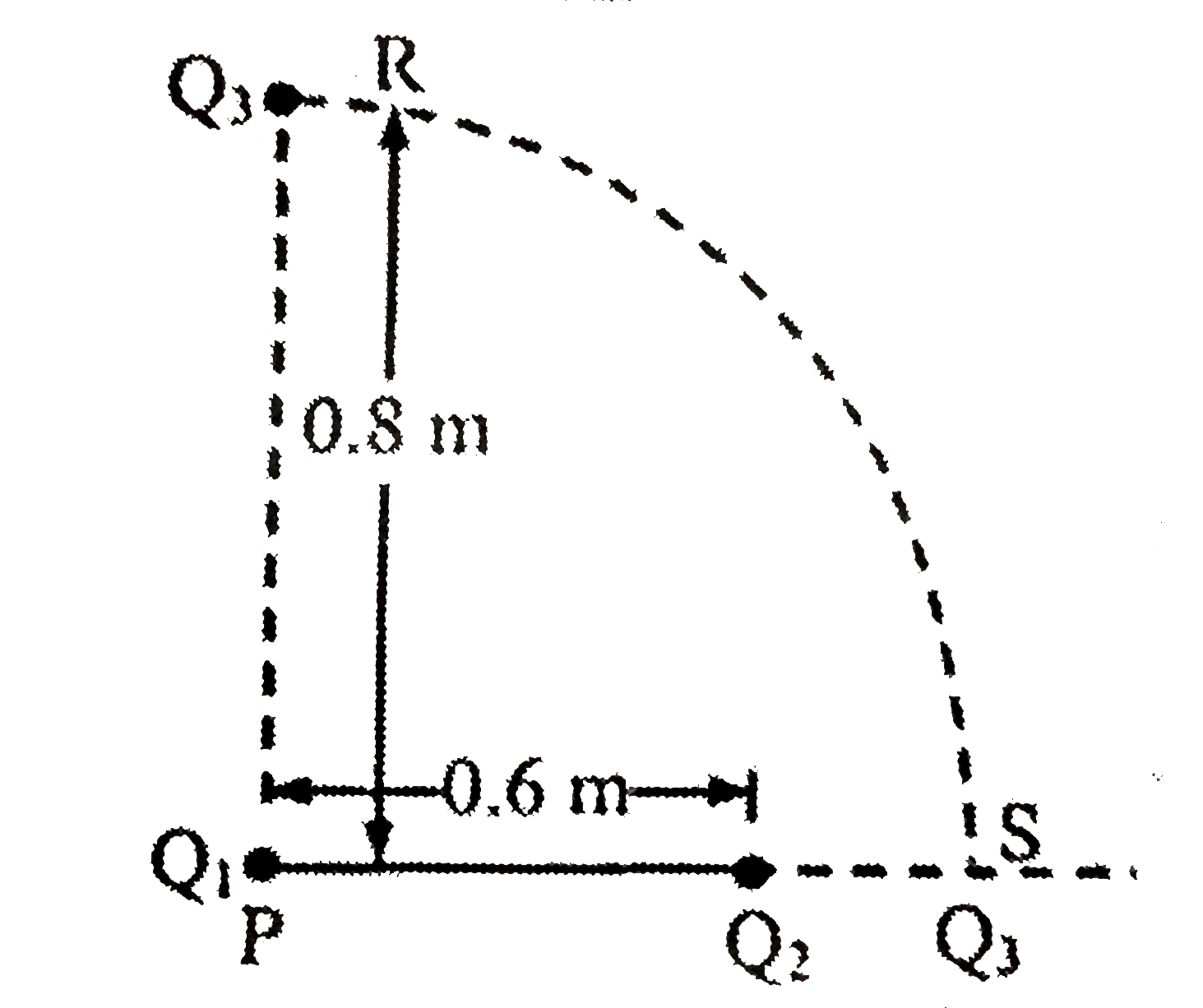
Two charges Q(1) and Q(2) coulombs are s...

Two charges `Q_(1)` and `Q_(2)` coulombs are shown in figure. A third charge `Q_(3)` coulombs is moved from points R to S along a circular path. Change in potential energy of the charge is -

Promotional Banner

Similar Questions

Explore conceptually related problems

Two charges q_(1) and q_(2) are placed 30 cm apart, as shown in the figure. A third charge q_(3) is moved along the arc of a circle of radius 40 cm from C to D . The change in the potential energy o fthe system is (q_(3))/(4pi epsilon_(0))k ., where k is

The value of charge q_1 ,q_2 and q_3 as shown in the figure are

A point charge Q is moved along a ciruclar path around another fixed point charge. The work done is zero

2q and 3q are two charges separated by a distance 12cm on x-axis .A third charge q is placed at 5cm on y-axis as shown in figure .Find the change in potential energy of the system if 3q is moved from initial position to a point on X-axis in circular path

A particle of mass m and carrying charge -q_(1) is moving around a charge +q_(2) along a circular path of radius r period of revolution of the charge -q_(1) about +q_(2) is

A two point charges 4q and -q are fixed on the x - axis x=-d/2 and x = d/2 , respectively. If a third point charge 'q' is taken from the origin to x = d along the semicircle as shown in the figure, the energy of the charge will

A charge of 70 A-h (ampere-hours) moves through a potential difference of 25 V. What are (a) the charge in coulombs and (b) the magnitude of the change in the potential energy of the charge?

Assertion (A): Three point charges Q_(1), Q_(2) and Q_(3) are shown in the figure. The flux over the Gaussian surface depends on only one charge point. Reason (R): Electric flux depends on the all charges nearby.