Home
Class 12
MATHS
If z(1),z(2)andz(3) are the affixes of t...

If `z_(1),z_(2)andz_(3)` are the affixes of the vertices of a triangle having its circumcentre at the
origin. If zis the affix of its orthocentre, prove that
`Z_(1)+Z_(2)+Z_(3)-Z=0.`

A

`z_(1)+z_(2)+z_(3)+z=0`

B

`z_(1)+z_(2)+z_(3)-z=0`

C

`z_(1)-z_(2)+z_(3)+z=0`

D

`z_(1)+z_(2)-z_(3)+z=0`

Text Solution

Verified by Experts

The correct Answer is:
B

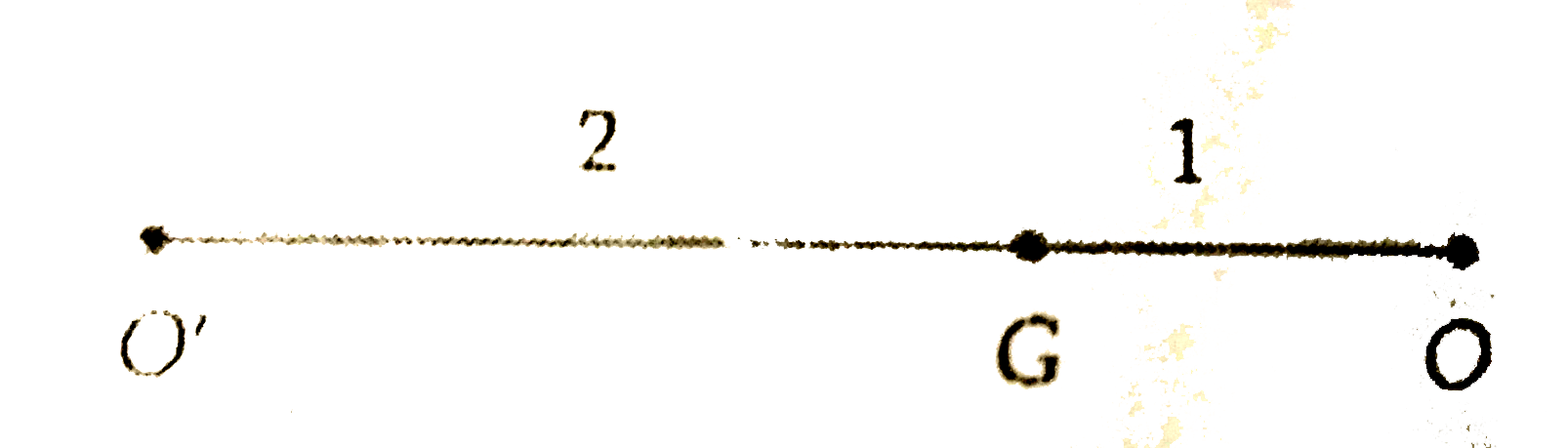
We know that the centroid G, circumference O, and orthocenter `O^(')` of a triangle are collinear such that G divides `OO^(')` in the ratio `1:2`. Since, affix of G is `(z_(1)+z_(2)+z_(3))/3` and O is the origin.

`(z_(1)+z_(2)+z_(3))/(3) = (1 xx z + 2 xx 0)/(1+2)`
`rArr z=z_(1) + z_(2)+z_(3) rArr z_(1)+z_(2)+z_(3)-z=0`
Promotional Banner

Topper's Solved these Questions

  • COMPLEX NUMBERS

    OBJECTIVE RD SHARMA ENGLISH|Exercise Section I - Solved Mcqs|141 Videos
  • COMPLEX NUMBERS

    OBJECTIVE RD SHARMA ENGLISH|Exercise Section II - Assertion Reason Type|15 Videos
  • CIRCLES

    OBJECTIVE RD SHARMA ENGLISH|Exercise Chapter Test|53 Videos
  • CONTINUITY AND DIFFERENTIABILITY

    OBJECTIVE RD SHARMA ENGLISH|Exercise Exercise|87 Videos

Similar Questions

Explore conceptually related problems

If z_(1),z_(2),z_(3) are the vertices of an isoscles triangle right angled at z_(2) , then

If z_1, z_2, z_3 be the affixes of the vertices A, B and C of a triangle having centroid at G such ;that z = 0 is the mid point of AG then 4z_1 + z_2 + z_3 =

If z_1, z_2, z_3 be the affixes of the vertices A, B Mand C of a triangle having centroid at G such ;that z = 0 is the mid point of AG then 4z_1 + Z_2 + Z_3 =

If z_(1),z_(2)andz_(3) are the vertices of an equilasteral triangle with z_(0) as its circumcentre , then changing origin to z^(0) ,show that z_(1)^(2)+z_(2)^(2)+z_(3)^(2)=0, where z_(1),z_(2),z_(3), are new complex numbers of the vertices.

Let the complex numbers z_(1),z_(2) and z_(3) be the vertices of an equailateral triangle. If z_(0) is the circumcentre of the triangle , then prove that z_(1)^(2) + z_(2)^(2) + z_(3)^(2) = 3z_(0)^(2) .

Find the relation if z_1, z_2, z_3, z_4 are the affixes of the vertices of a parallelogram taken in order.

Find the relation if z_1, z_2, z_3, z_4 are the affixes of the vertices of a parallelogram taken in order.

If the points z_(1),z_(2),z_(3) are the vertices of an equilateral triangle in the Argand plane, then which one of the following is not correct?

If z_(1),z_(2),z_(3) be vertices of an equilateral triangle occurig in the anticlockwise sense, then

z_(1),z_(2),z_(3) are the vertices of an equilateral triangle taken in counter clockwise direction. If its circumference is at the origin and z_(1)=1+i , then

OBJECTIVE RD SHARMA ENGLISH-COMPLEX NUMBERS -Chapter Test
  1. If z(1),z(2)andz(3) are the affixes of the vertices of a triangle havi...

    Text Solution

    |

  2. The locus of the center of a circle which touches the circles |z-z1|=a...

    Text Solution

    |

  3. Prove that for positive integers n(1) and n(2), the value of express...

    Text Solution

    |

  4. The value of abs(sqrt( 2i) - sqrt(2i)) is :

    Text Solution

    |

  5. Prove that the triangle formed by the points 1,(1+i)/(sqrt(2)),a n di ...

    Text Solution

    |

  6. The value of ((1+ i sqrt(3))/(1-isqrt(3)))+ ((1-isqrt(3))/(1+isqrt(3)...

    Text Solution

    |

  7. If alpha+ibeta=tan^(-1) (z), z=x+iy and alpha is constant, the locus o...

    Text Solution

    |

  8. If cosA+cosB+cosC=0,sinA+sinB+sinC=0andA+B+C=180^(@) then the value of...

    Text Solution

    |

  9. Find the sum 1xx(2-omega)xx(2-omega^(2))+2xx(-3-omega)xx(3-omega^(2))+...

    Text Solution

    |

  10. The value of the expression (1+(1)/(omega))+(1+(1)/(omega^(2)))+(2+(1)...

    Text Solution

    |

  11. The condition that x^(n+1)-x^(n)+1 shall be divisible by x^(2)-x+1 is ...

    Text Solution

    |

  12. The expression (1+i)^(n1)+(1+i^(3))^(n2) is real iff

    Text Solution

    |

  13. If |{:(6i,3i,1),(4,3i,-1),(20,3,i):}|=x+iy, then (x, y) is equal to

    Text Solution

    |

  14. If cosalpha+2cosbeta+3cosgamma=sinalpha+2sinbeta+3singamma=0,t h e nt ...

    Text Solution

    |

  15. If cosalpha+2cosbeta+3cosgamma=sinalpha+2sinbeta+3singamma=0,t h e nt ...

    Text Solution

    |

  16. Sum of the series sum(r=0)^n (-1)^r ^nCr[i^(5r)+i^(6r)+i^(7r)+i^(8r)] ...

    Text Solution

    |

  17. If az(1)+bz(2)+cz(3)=0 for complex numbers z(1),z(2),z(3) and real num...

    Text Solution

    |

  18. If 2z1-3z2 + z3=0, then z1, z2 and z3 are represented by

    Text Solution

    |

  19. If Re((z+4)/(2z-1)) = 1/2 then z is represented by a point lying on

    Text Solution

    |

  20. The vertices of a square are z(1),z(2),z(3) and z(4) taken in the anti...

    Text Solution

    |

  21. Let lambda in R . If the origin and the non-real roots of 2z^2+2z+lam...

    Text Solution

    |

