Home
Class 12
MATHS
Let S=S1 nn S2 nn S3, where s1={z in ...

Let `S=S_1 nn S_2 nn S_3`, where `s_1={z in C :|z|<4}, S_2={z in C :ln[(z-1+sqrt(3)i)/(1-sqrt(31))]>0} and `
`S_3={z in C : Re z > 0}` Area of S=

A

`(10pi)/3`

B

`(20pi)/3`

C

`(16pi)/3`

D

`(32pi)/3`

Text Solution

Verified by Experts

The correct Answer is:
B

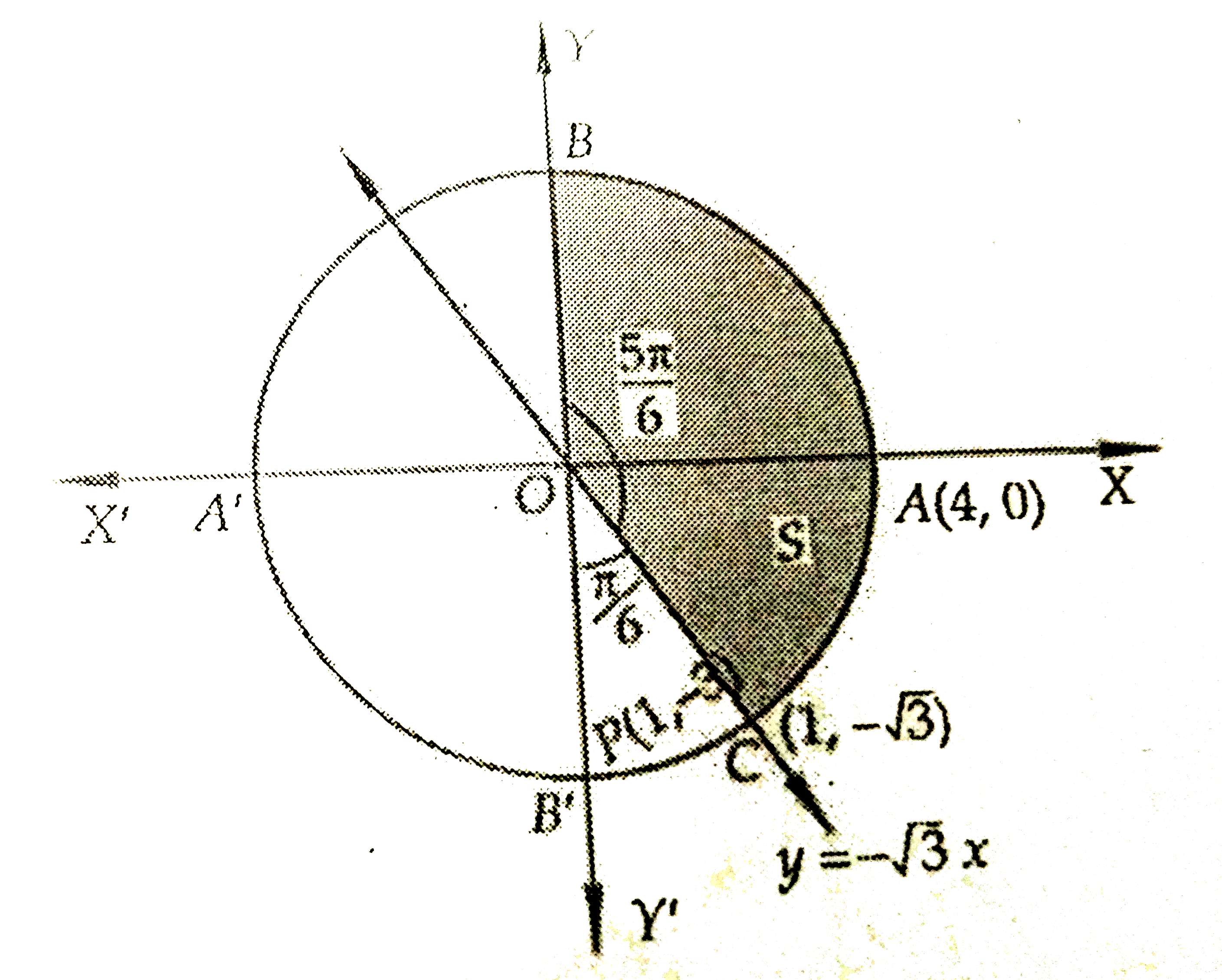
Clearly, `S_(1)` represents the interior of the region bounded by the circle having center at the origin and radius 4 units.

Let `z=x+iy`, then
`(z-1+isqrt(3))/(1-isqrt(3))=(x+iy)/(1-isqrt(3))-1`
`=((x+iy)(1+isqrt(3))/((1-isqrt(3))(1+isqrt(3))-1)) = (x-sqrt(3)y-4)/(4)+i(y+sqrt(3)x)/(4)`
`therefore "Im"(z-1+isqrt(3))/(1-isqrt(3)0 gt 0) rArr ((y+sqrt(3)x)/4) gt 0 rArr y gt -sqrt(3)x`
Thus, `S_(2)` represents the region lying above the line `y=-sqrt(3)x`. Clearly, `S_(3)` represents region representing on the right sides of y-axis.
Hence, `S=S_(1) frown S_(2) frown S_(3)` represents the shaded region shown in Fig.
Area of region S =Area of semi cricel -Area of the sector `OB^(')C`
`=1/2pi(4)^(2)-1/2(4)^(2) xxpi/6 = (20pi)/3` sq. units.
Promotional Banner

Topper's Solved these Questions

  • COMPLEX NUMBERS

    OBJECTIVE RD SHARMA ENGLISH|Exercise Section II - Assertion Reason Type|15 Videos
  • COMPLEX NUMBERS

    OBJECTIVE RD SHARMA ENGLISH|Exercise Exercise|129 Videos
  • COMPLEX NUMBERS

    OBJECTIVE RD SHARMA ENGLISH|Exercise Chapter Test|58 Videos
  • CIRCLES

    OBJECTIVE RD SHARMA ENGLISH|Exercise Chapter Test|53 Videos
  • CONTINUITY AND DIFFERENTIABILITY

    OBJECTIVE RD SHARMA ENGLISH|Exercise Exercise|87 Videos

Similar Questions

Explore conceptually related problems

Let S=S_1 nn S_2 nn S_3 , where s_1={z in C :|z| 0} and S_3={z in C : Re z > 0} Area of S=

Let S = S_(1) nnS_(2)nnS_(3) , where S_(1)={z "in" C":"|z| lt 4} , S_(2)={z " in" C":" Im[(z-1+sqrt(3)i)/(1-sqrt(3i))] gt 0 } and S_(3) = { z "in" C : Re z gt 0} underset(z in S)(min)|1-3i-z|=

Let w = ( sqrt 3 + iota/2) and P = { w^n : n = 1,2,3, ..... }, Further H_1 = { z in C: Re(z) > 1/2} and H_2 = { z in c : Re(z) < -1/2} Where C is set of all complex numbers. If z_1 in P nn H_1 , z_2 in P nn H_2 and O represent the origin, then /_Z_1OZ_2 =

Let 0 ne a, 0 ne b in R . Suppose S={z in C, z=1/(a+ibt)t in R, t ne 0} , where i=sqrt(-1) . If z=x+iy and z in S , then (x,y) lies on

The equation of a circle S_1 is x^2 + y^2 = 1 . The orthogonal tangents to S_1 meet at another circle S_2 and the orthogonal tangents to S_2 meet at the third circle S_3 . Then (A) radius of S_2 and S_3 are in ratio 1 : sqrt(2) (B) radius of S_2 and S_1 are in ratio 1 : 2 (C) the circles S_1, S_2 and S_3 are concentric (D) none of these

Let each of the circles, S_(1)=x^(2)+y^(2)+4y-1=0 , S_(2)=x^(2)+y^(2)+6x+y+8=0 , S_(3)=x^(2)+y^(2)-4x-4y-37=0 touches the other two. Let P_(1), P_(2), P_(3) be the points of contact of S_(1) and S_(2), S_(2) and S_(3), S_(3) and S_(1) respectively and C_(1), C_(2), C_(3) be the centres of S_(1), S_(2), S_(3) respectively. Q. The co-ordinates of P_(1) are :

Let each of the circles S_(1)-=x^(2)+y^(2)+4y-1=0 S_(1)-= x^(2)+y^(2)+6x+y+8=0 S_(3)-=x^(2)+y^(2)-4x-4y-37=0 touch the other two. Also, let P_(1),P_(2) and P_(3) be the points of contact of S_(1) and S_(2) , S_(2) and S_(3) , and S_(3) , respectively, C_(1),C_(2) and C_(3) are the centres of S_(1),S_(2) and S_(3) respectively. The ratio ("area"(DeltaP_(1)P_(2)P_(3)))/("area"(DeltaC_(1)C_(2)C_(3))) is equal to

Let each of the circles, S_(1)=x^(2)+y^(2)+4y-1=0 , S_(2)=x^(2)+y^(2)+6x+y+8=0 , S_(3)=x^(2)+y^(2)-4x-4y-37=0 touches the other two. Let P_(1), P_(2), P_(3) be the points of contact of S_(1) and S_(2), S_(2) and S_(3), S_(3) and S_(1) respectively and C_(1), C_(2), C_(3) be the centres of S_(1), S_(2), S_(3) respectively. Q. P_(2) and P_(3) are image of each other with respect to line :

Consider the region S of complex numbers a such that |z^(2) - az + 1|=1 , where |z|=1 . Then area of S in the Argand plane is

In the arrangement shown in Fig., slits S_(1) and S_(4) are having a variable separation Z. Point O on the screen is at the common perpendicular bisector of S_(1) S_(2) and S_(3) S_(4) . The minimum value of Z for which the intensity at O is zero is

OBJECTIVE RD SHARMA ENGLISH-COMPLEX NUMBERS -Section I - Solved Mcqs
  1. Let complex numbers alpha and 1/alpha lies on circle (x-x0)^2+(y-y0)^2...

    Text Solution

    |

  2. about to only mathematics

    Text Solution

    |

  3. Let S=S1 nn S2 nn S3, where s1={z in C :|z|<4}, S2={z in C :ln[(z-...

    Text Solution

    |

  4. Let S=S1 nn S2 nn S3, where s1={z in C :|z|<4}, S2={z in C :ln[(z-...

    Text Solution

    |

  5. Let z(k)=cos(2kpi)/10+isin(2kpi)/10,k=1,2,………..,9. Then, 1/10{|1-z(1)|...

    Text Solution

    |

  6. In Q. No. 121, 1-sum(k=1)^(9)cos(2kpi)/10 equals

    Text Solution

    |

  7. If z is a complex number such that |z|geq2 , then the minimum value...

    Text Solution

    |

  8. A complex number z is said to be unimodular if abs(z)=1. Suppose z(1) ...

    Text Solution

    |

  9. about to only mathematics

    Text Solution

    |

  10. f(n) = cot^2 (pi/n) + cot^2\ (2 pi)/n +...............+ cot^2\ ((n-1) ...

    Text Solution

    |

  11. If z(1) and z(2) are the complex roots of the equation (x-3)^(3) + 1=...

    Text Solution

    |

  12. If |z-1| =1 and arg(z)=theta, where z ne 0 and theta is acute, then (1...

    Text Solution

    |

  13. If z is a complex number lying in the first quadrant such that "Re"(z)...

    Text Solution

    |

  14. about to only mathematics

    Text Solution

    |

  15. If z is a complex number satisfying ∣z 2 +1∣=4∣z∣, then the minimum ...

    Text Solution

    |

  16. Locus of z if arg[z-(1+i)] = {:{(3pi//4 when |z| lt = |z-2|), (-pi//4 ...

    Text Solution

    |

  17. Let z in C and if A={z,arg(z)=(pi)/(4)} and B={z,arg(z-3-3i)=(2pi)/(3)...

    Text Solution

    |

  18. If z is any complex number satisfying |z - 3 - 2i | less than or equal...

    Text Solution

    |

  19. Let z=1+ai be a complex number, a > 0,such that z^3 is a real number....

    Text Solution

    |

  20. Let a,b in R and a^(2)+b^(2) ne 0. Suppose S={z in C:z=(1)/(a+ibt),t...

    Text Solution

    |

