

Home
Class 12
PHYSICS
Two identical masses are connected to a ...

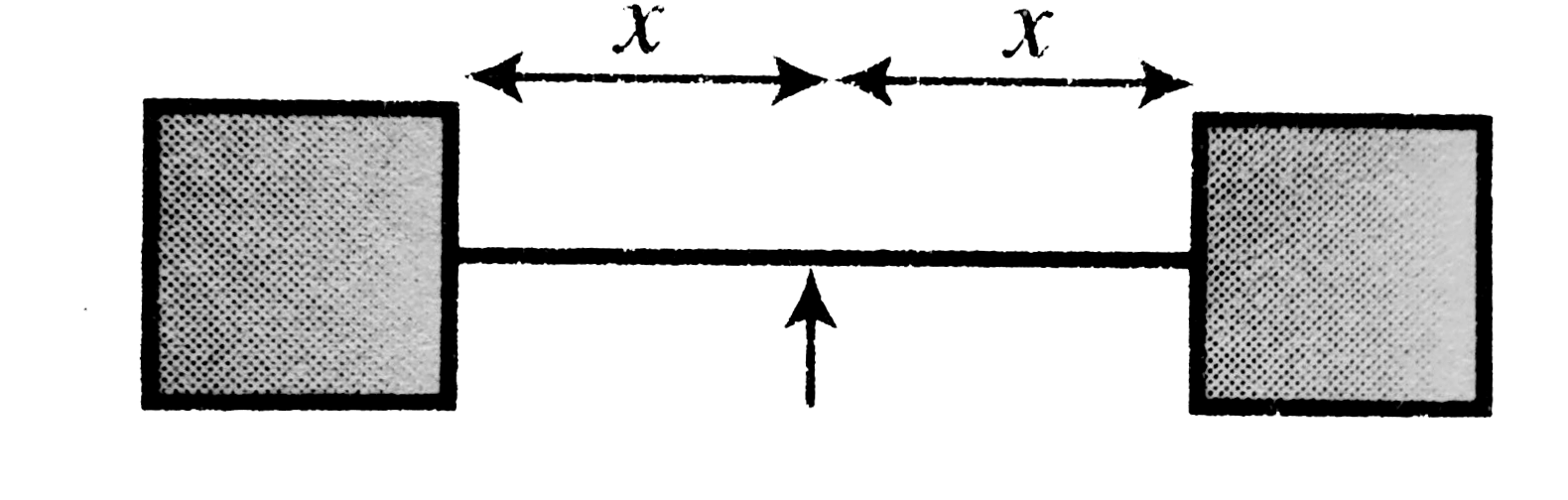
Two identical masses are connected to a horizontal thin massless rod as shown in the figure. When their distance from the pivot is `x`, a torque produces an angular acceleration `alpha_(1)`. If the masses are now repositioned so that they are at distance `2x` each from the pivot, the same torque will produce an angular acceleration `alpha_(2)` such that ,

Promotional Banner

Similar Questions

Explore conceptually related problems

A particle is at a distance r from the axis of rotation. A given torque tau produces some angular acceleration in it. If the mass of the particle is doubled and its distance from the axis is halved, the value of torque to produce the same angular acceleration is -

Two identical thin uniform rods of length L each are joined to form T shape as shown in the figure. The distance of centre of mass from D is

Two uniform thin rods each of length L and mass m are joined as shown in the figure. Find the distance of centre of mass the system from point O

Two equal and opposite forces are allplied tangentially to a uniform disc of mass M and radius R as shown in the figure. If the disc is pivoted at its centre and free to rotate in its plane, the angular acceleration of the disc is :

A torque of 2 newton-m produces an angular acceleration of 2 rad//sec^(2) a body. If its radius of gyration is 2m, its mass will be:

Two masses are attached to a rod end to end . If torque is applied they rotate with angular acceleration alpha . If their distances are doubled and same torque is applied, then they move with angular acceleration.

A uniform thin rod is released from rest in the horizontal position as shown in the figure. For what value of x, the angular acceleration is maximum.

A system consists of two masses connected by a massless rod lies along x-axis. The distance of centre of mass from O is

If a wheel has mass 70 kg and radius of gyration 1 m, then the torque required an angular 1 m, then the torque required an angular acceleration of "2 rev"//s^(2) will be