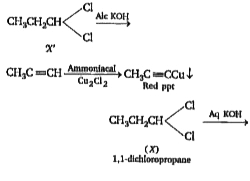
Home
Class 12
CHEMISTRY
A dihalogen derivative X of a hydrocarbo...

A dihalogen derivative X of a hydrocarbon witn three carbon atom react with alocholic `KOH` and produces another hydrocarbon which forms a red precipitate with ammoniacal `Cu_2 Cl_2 * X` gives 'an aldehyde on reaction with aqueous KOH. The compound `X` is

A

a) 1,3 - dichloropropane

B

b) 1,2 - dichloropropane

C

c) 2,2 -dichloropropane

D

d) 1,1 -dichloropropane

Text Solution

Verified by Experts

The correct Answer is:
D

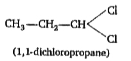
X is a three carbon compound with two halogenatom , so its molecular formula is `C_(3)H_(6)Cl_(2)` . Only terminal alkynes give red ppt with ammoniacal `Cu_(2)Cl_(2)` , so the hydrocarbon produced by the reaction of .X. with alc KOH , must be a terminal alkyne (ie , `CH_(3)C-=CH)`
`C_(3)H_(6)Cl_(2)overset("Alc KOH")toCH_(3)C-=CHoverset("Amm"Cu_(2)Cl_(2))tounderset("Red ppt")(CH_(3)C-=)C Cdarr`
Compound (X) gives an aldehyde when reacts with aqueous KOH .This suggests that both the halogens are present on same terminal carbon atom . Thus , the formula of compound (X) is

and the reactions are as follows :

Promotional Banner

Similar Questions

Explore conceptually related problems

The details of the hydrocarbon 'P' are given below. i) There are 3 carbon atoms. ii) The family of compounds with 'P' as a member has a general formula C_(n)H_(2n) iii) The IUPAC name of 'P' is propene. a) Write the condensed formula of the compound b) Write the IUPAC name of the compound which is before 'P' in the homologous series. c) Give the molecular formula of the compound succeeding 'P' in the series.

An organic compound X on treatment with K_(2)Cr_(2)O_(7) in anhydrous medium gives a compound Y which reacts with I_(2) and sodium carbonate to form triiodomethane. The compound X is

An aqueous blue coloured solution of a transition metal sulphate reacts with H2S in acidic medium to give a black precipitate A, which is insoluble in warm aqueous solution of KOH. The blue solution an treatment with KI is weakly acidic medium, turns yellow and produces a white precipitate B. Identify the transition metal ion. Write the chemical reactions involved in the formation of A and B.

Which of the following statements is true : Trimethylamine forms a soluble compound with Hinsberg's reagent and KOH , Dimethylamine reacts with KOH -and phenol to form an azodye, Methylamine reacts with nitrous acid and liberates N_2 form' aqueous solution, none

Sodium salt of an organic acid 'X' produces effervesence with conc. H_(2)SO_(4) . X reacts with acidified aqueous CaCl_(2) solution to give a white precipitate which decolourises acidified KMnO_(4) . 'X' is