Home
Class 12
CHEMISTRY
Using the following thermocchemical eq...

Using the following thermocchemical equations
(i) `S(g)+3//2O_(2)(g)toSO_(3)(g)DeltaH=-2xkJmol^(-1)`
(ii) `SO_(2)(g)+1//2O_(2)(g)toSO_3()(g)DeltaH=-ykJmol^(-1)` Find out the heat of formation of `SO_(2)(g)` in kJ `mol^(-1)`

A

`(2x+y)`

B

`(x+y)`

C

`(2x//y)`

D

`(y-2x)`

Text Solution

Verified by Experts

The correct Answer is:
D

Given
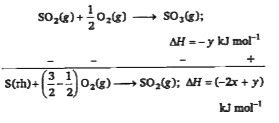
`S(rh)+(3)/(2)O_(2)(g)toSO_(3)(g)`,
`DeltaH=-2xkj " mol"^(-1)` ..(i)
`SO_(2)(g)+(1)/(2)O_(2)(g)toSO_(3)(g)`,
`DeltaH=-ykJ " mol"^(-1)` ..(ii)
`S(s)+O_(2)(g)toSO_(2)(g),DeltaH=`?
Subtract Eq (ii) from Eq (i)
`S(rh)+(3)/(2)O_(2)(g)toSO_(3)(g), DeltaH=-2x kJ "mol" ^(-1)`
`SO_(2)(g)+(1)/(2)O_(2)(g)toSO_(3)(g),DeltaH=-y kJ "mol"^(-1)`
`s(rh)+((3)/(2)-(1)/(2))O_(2)(g)toSO_(2)(g),DeltaH=(-2x +y) kJ "mol"^(-1)`

`S(rh)+O_(2)(g)toSO_(2)(g),DeltaH=(y-2x) kJ "mol "^(-1)`
Promotional Banner

Similar Questions

Explore conceptually related problems

Justify the following reaction is redox reaction 4NH_3(g) + 5O_2 (g) to 4NO (g) + 6H_2O (g)

The following thermochemical equations represent combustion of ammonia and hydrogen: 4 NH_3(g)+3 O_2(g) rarr 6H_2 O(l)+2 N_2(g) , Delta H=-1516 k J 2 H_2(g)+O_2(g) rarr 2 H_2 O(l) , Delta H=-572 kJ Calculate enthalpy of formation of ammonia.

The equations representing the combustion of carbon and carbon monoxide are: 'C(s)+O_2(g) rarr CO_2(g) Delta H=394 kJ / mol' 'CO(s)+1/2 O_2(g) rarr CO_2(g) Delta H=-284.5 kJ / mol' the heat of formation of 1 mol of 'CO(g)' is

Predict the sign of entropy change in the following reactions. i) O_2(g)+2 SO_2(g) rarr 2 SO_3(g) ii) 2 H_2(g)+O_2(g) rarr 2 H_2 O(g)

The enthalpy change in a process is the same, whether the process is carried out in a single step or inseveral steps. a) Identify tha law stated here. b) Calculate the enthalpy of formation of CH_4 from the following data : i) C_((s))+O_(2(g))rightarrowCO_(2(g)) DeltaH = -393.7kJ/mol ii) H_(2(g))+frac{1}{2}O_(2(g))rightarrowH_2O_((l)) DeltaH = -285.8kJ/mol iii) CH_(4(g))+2O_(2(g))rightarrowCO_(2(g)) DeltaH =-890.4kJ/mol

The formation of the oxide ion O^(2-) (g) requires first an exothermic and then an endothermic step as shown below, O(g)+ e^(-) = O^(-)(g), DeltaH^(@)= -142kJmol^(-1) O^(-)(g) +e^(-) =O^(2-)(g), DeltaH^(@)= 844 kJmol^(-1) This is because : oxygen is more electronegative, oxygen has high electron affinity, O^(-) ion will tend to resist the addition of another electron , O^(-) ion has comparatively larger size than oxygen atom

