Home
Class 12
PHYSICS
A magnetic dipole is under the influence...

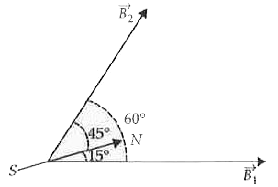
A magnetic dipole is under the influence of two magnetic fields. The angle between the field directions is `60^(@)` and one of the fields has a magnitude of `1.2 xx 10^(-2)` T. If the dipole comes to stable equilibrium at an angle of `15^(@)` with this field, what is the magnitude of the other field?

A

`3(sqrt3-1)xx10^(-3)T`

B

`(sqrt3-1)xx10^(-3)T`

C

`6(sqrt3-1)xx10^(-3)T`

D

`2(sqrt3-1)xx10^(-3)T

Text Solution

Verified by Experts

The correct Answer is:
C


Here, `theta = 60^@, B_1 = 1.2 xx 10^(-2) T`
`theta_1 = 15^@ , theta_2 = 60^@ - 15^@= 45^@`
In equillibrium , torque due to two fields must balance `tau_1 = tau _2`
`MB_1 sin theta_1 = MB_2 sin theta_2`
`B_(2) = (B_1 sin theta_1)/(sin theta_2) = (1.2 xx 10^-2 sin 15^@)/(sin 45^@)`
`=(1.2 xx 10^-2 (sin 45^@ cos30^@- cos 45^@sin 30^@))/(sin 45^@)`
` =1.2 xx 10^(-2) [cos 30^@ - sin 30^@]`
`1.2 xx 10^(-2) ((sqrt(3))/(2)-1/2) = 6 (sqrt(3) - 1) xx 10^(-3) T`.
Promotional Banner

Topper's Solved these Questions

  • MAGNETIC EFFECTS OF CURRENT AND MAGNETISM

    MTG GUIDE|Exercise NEET CAFE (TOPICWISE PRACTICE QUESTIONS)(MAGNETIC FIELD LINES AND GAUSS.S LAW IN MAGNETISM)|8 Videos
  • MAGNETIC EFFECTS OF CURRENT AND MAGNETISM

    MTG GUIDE|Exercise NEET CAFE (TOPICWISE PRACTICE QUESTIONS)(MAGNETIC PROPERTIES OF MATERIALS)|20 Videos
  • MAGNETIC EFFECTS OF CURRENT AND MAGNETISM

    MTG GUIDE|Exercise NEET CAFE (TOPICWISE PRACTICE QUESTIONS)(MAGNETIC FIELD DUE TO A MAGNETIC DIPOLE (BAR MAGNET))|2 Videos
  • ELECTROSTATICS

    MTG GUIDE|Exercise AIPMT/NEET (MCQ.s)|34 Videos
  • OPTICS

    MTG GUIDE|Exercise AIPMT/NEET|55 Videos

Similar Questions

Explore conceptually related problems

A magnetic dipole is under the influence of two magnetic fields. The angle between the two field directions is 60^(@) and one of the fields has a magnitude of 1.2xx10^(-2)T . If the dipole comes to stable equilibrium at an angle of 15^(@) with this field, what is the magnitude of the other field?

A magnetic dipole is under the influence of trwo magnetic fields. The angle between the two field directionss is 60^(@) and one of the fields has a magnitudeo f1.2xx10^(-2)T . Of the dipole comes to stable equilibrium at an angle of 15^(0) with this field, what is the magnitude of the other field?

A magnetic dipole is under the influence of two magnetic fields. The angle between the field directions is 60^@ and one of the fields has a magnitude of 1*2xx10^-2 tesla. If the dipole comes to stable equilibrium at an angle of 15^@ with this field, figure, what is the magnitude of the other field?

A magnetic dipole is under the influence of two magnetic fields. The angle between the field direction is 60^(@) and one of the fields has magnitude of 1.2 xx 10^(-2)T . If the dipole comes to stable equilibrium at an angle of 30^(@) with this Held, then the magnitude of the field is

A magnetic dipole is under the influence of two magnetic fields. The angle between the field directions is 60^@ and one of the fields has a magnitude of 1*25xx10^-2T . If the dipole comes to stable equilibrium at an angle of 15^@ with this field, find the magnitude of other magnetic field.

A magnetic dipole is under the influence of two magnetic fields. The angle between the field directions is 60^(circ) and one of the fields has a magnitude of 1.2 xx 10^(-1)T . If the dipole comes to stable equilibrium at an angle of 30^(circ) with this field, then the magnitude of the field (in tesla) is x xx 10^(2) T . Find x ,

A magnetic dipole is under the inflluence of two magnetic fields having an angle of 120^(0) between them. One of the fields has a magnitude 1.2xx10^(-2)T . If the dipole comes to stable equilibrium at an angle of 30^(0) with this field, then magnitude of the other field is

A bar magnet is suspended in a region where it is acted upon by two magnetic fields inclined at an angle of 60^@ to each other. One of the fields has a magnitude of 1*2xx10^-2T . The magnet attains stable equilibrium at an angle of 15^@ with this field. Calculate the magnitude of other field. Ignore earth's field.

