

Home
Class 9
MATHS
We have given the timings of the gold me...

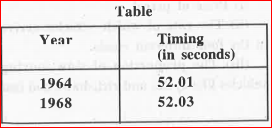
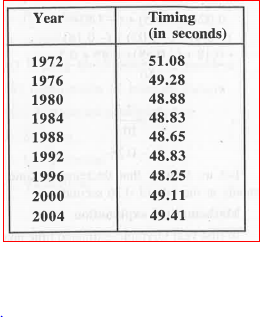
We have given the timings of the gold medalists in the 400-metre race from the time the event was included in the Olympics, in table below. Contruct a mathematical model relating years and timings. Use it to estimate the timing in the next Olympics.

Promotional Banner

Topper's Solved these Questions

  • INTRODUCTION TO MATHEMATICAL MODELLING

    PSEB|Exercise EXAMPLE|4 Videos
  • HERON’S FORMULA

    PSEB|Exercise EXAMPLE|6 Videos
  • LINEAR EQUATIONS IN TWO VARIABLES

    PSEB|Exercise EXAMPLE|19 Videos

Similar Questions

Explore conceptually related problems

Agreat physicist of this century (RA.M. Dirac) loved playing with numerical values of Fundamental constants of nature. This led him to an interesting observation. Dirac found that from the basic constants of atomic physics (c, e, mass of electron, mass of proton) and the gravitational constant G, he could arrive at a number with the dimension of time. Further, it was a very large number, its magnitude being close to the present estimate on the age of the universe (~15 billion years) . From the table of fundamental constants in this book, try to see if you too can construct this number (or any other interesting number you can think of). If its coincidence with the age of the universe were significant, what would this imply for the constancy of fundamental constants ?

Classically, an electron can be in any orbit around the nucleus of an atom. Then what determines the typical atomic size? Why is an atom not, say, thousand times bigger than its typical size? The question had greatly puzzled Bohr before he arrived at his famous model of the atom that you have learnt in the text. To simulate what he might well have done before his discovery, let us play as follows with the basic constants of and see if we can get a quantity with the dimensions of length that is roughly equal to the known of an atom (~ 10^ -10 m).- Construct a quantity with the dimensions of length from the fundamental constants e, m_e , and c. Determine its numerical value.

classically an electron can be in any orbit around nucleus of an atom. Then what determines the typical atomic size? Why is an atom not, say, thousand times bigger than its typical size? Thequestion had greatly puzzled Bohr before he arrived at his famous model of the atom that you have learnt in the text. To simulate what he might well have done before his discovery, let us play as followswith the basic constants of nature e, me, c and see if we can get a quantity with the dimensions of length that is roughly equal to the known size of an atom (~ 10 m).- You will find that the length obtained above is many orders of magnitude smaller than the atomic dimensions. Further, it involves c. But energies of atoms are mostly in non-relativistic domain where c is not expected to play any role. This is what may have suggested Bohr to discard c and look for else h had already made its appearance elsewhere. Bohr lay in recognising that h, m_e , and e will yield the right atomic size. Construct a quantity with the dimension of length from h, me, and e and confirm that its numerical value has indeed the correct order of magnitude.

There is another useful system of units, besides the SI/MKS. A system, called the cgs system. In this system Coulumb's law is given by vecF = (Qq)/(r^2) hatr where the distance r is measured in cm (=10^(-2) m) , F in dynes (= 10^(-5) N) and the charges in electrostatic units (es units), where 1es unit of charge = 1/[3] xx 10^(-9) C . The number [3] actually arises the speed of light in vacuum which now taken to be exactly given by c = 2.99792458 xx 10^8 m/s . An approximate value of c then is c = [3] xx 10^8 m/s . Write 1 esu of charge = x C, where x is a dimensoinless number. Show that this gives 1/(4pi epsilon_0) = (10^(-9)/x^2)(N.m^2)/(C^2) with x = 1/[3] xx 10^(-9) , we have 1/(4pi epsilon_0)= [3]^2 xx 10^9 (Nm^2)/(C^2) or 1/(4pi epsilon_0)= (2.99792458)^2 xx 10^9 (Nm)^2/(C)^2 (exactly).