Home
Class 9
MATHS
P is the mid-point of side A B of a para...

`P` is the mid-point of side `A B` of a parallelogram `A B C D` . A Line through `B` parallel to `P D` meets `D C` at `Q` and `A D` produced at `R` . Prove that (i) `A R=2B C` (ii) `B R=2B Qdot`

Text Solution

Verified by Experts
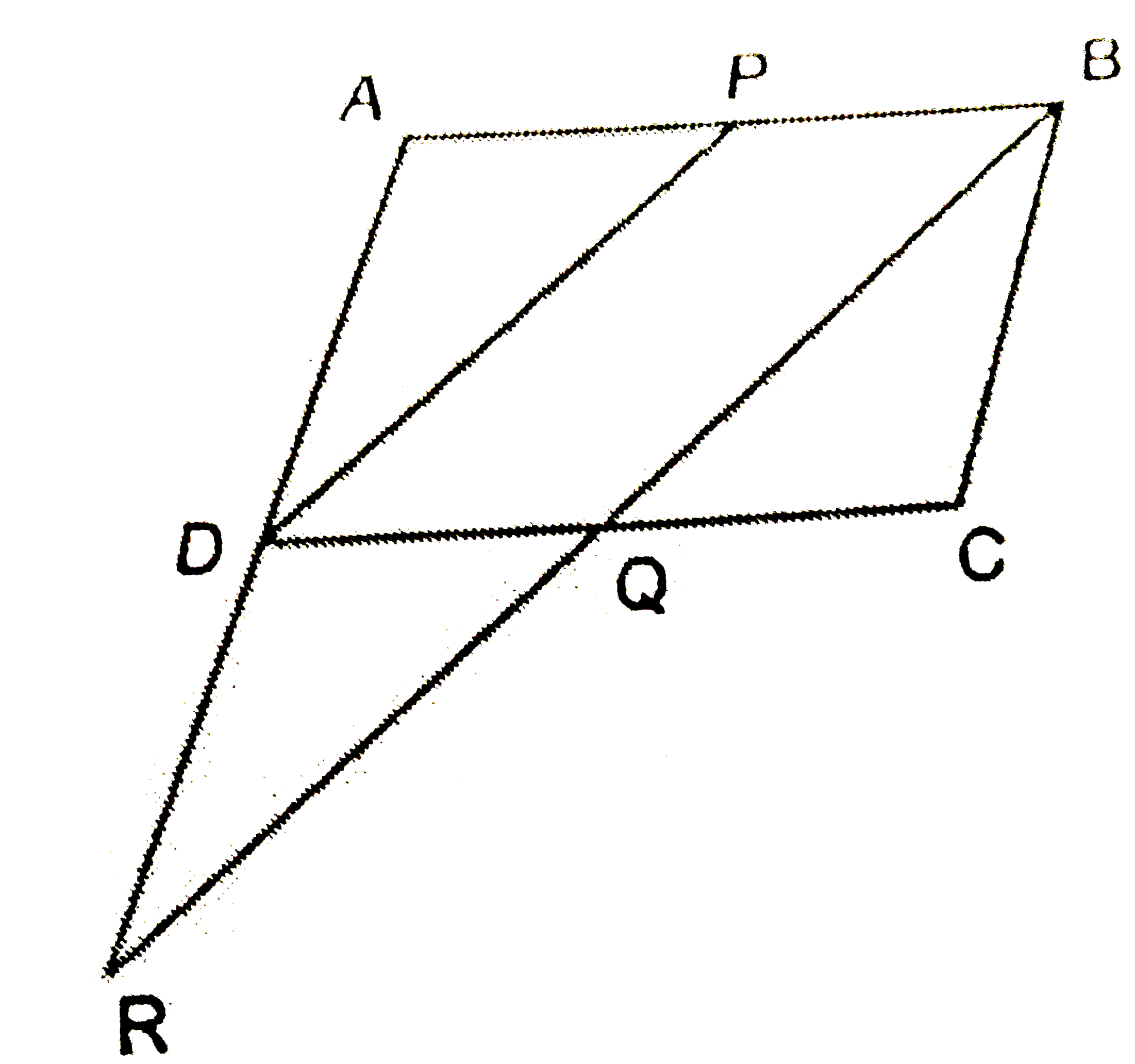
In `DeltaARB,P` is the mid-point of AB and PD is a parallel to BR.
`therefore` D will be the mid-point of AR.
`i.e." "AR=2AD`
But ABCD is a parallelogram.
`{:(therefore,AD=BC),("Therefore,",AR=2BC):}`
Which is part (i).
`squareABCD` is a parallelogram.

`{:(implies,DC"||"AB),(implies,DQ"||"AB):}`
In `DeltaRAB`
D is the mid-point of RA.
and `DQ"||"AB`
`therefore` Q is the mid-point of RB.
`implies" "BR=2BQ`
which is part (ii)
Promotional Banner

Topper's Solved these Questions

  • QUADRILATERALS

    NAGEEN PRAKASHAN ENGLISH|Exercise Problems From NCERT/exemplar|11 Videos
  • QUADRILATERALS

    NAGEEN PRAKASHAN ENGLISH|Exercise Exercise 8a|29 Videos
  • PROBABILITY

    NAGEEN PRAKASHAN ENGLISH|Exercise Revision Exercise (very Short Answer /short Answer Questions)|10 Videos
  • STATISTICS

    NAGEEN PRAKASHAN ENGLISH|Exercise Revision Exercise|12 Videos

Similar Questions

Explore conceptually related problems

P is the mid-point of side A B of a parallelogram A B C D . A line through B parallel to P D meets D C at Q\ a n d\ A D produced at R . Prove that: (i) A R=2B C (ii) B R=2\ B Q

In Figure, A B C D E\ is a pentagon. A line through B parallel to A C meets D C produced at F . Show that: (i) a r\ ( A C B)=a r\ ( A C F) (ii) a r\ (A E D F)=a r\ (A B C D E)

The side A B of a parallelogram A B C D is produced to any point Pdot A line through A parallel to C P meets C B produced in Q and the parallelogram P B Q R completed. Show that a r(llgm A B C D)=a r(llgm B P R Q)dot CONSTRUCTION : Join A C and PQ. TO PROVE : a r(llgm A B C D)=a r(llgm B P R Q)

The side A B of a parallelogram A B C D is produced to any point Pdot A line through A parallel to C P meets C B produced in Q and the parallelogram P B Q R completed. Show that a r(^(gm)A B C D)=a r(^(gm)B P R Q)dot CONSTRUCTION : Join A C and PQ. TO PROVE : a r(^(gm)A B C D)=a r(^(gm)B P R Q)

The side AB of a parallelogram ABCD is produced to any point P. A line through A and parallel to CP meets CB produced at Q and then parallelogram PBQR is completed. Show that a r\ (A B C D)\ =\ a r\ (P B Q R) .

A B C D is a quadrilateral. A line through D , parallel to A C , meets B C produced in P as shown in figure. Prove that a r (triangle A B P) =a r (Quad. A B C D) .

The side A B of a parallelogram A B C D is produced to any point Pdot A line through A and parallel to C P meets C B produced at Q and then parallelogram P B Q R is completed as shown in Figure. Show that a r(^(gm)A B C D)=a r ^(gm)P B Q R)dot

A B C D is a parallelogram whose diagonals A C and B D intersect at Odot A Line through O intersects A B at P and D C at Qdot Prove that a r( P O A)=a r( Q O C)dot

O is any point on the diagonal B D of the parallelogram A B C D . Prove that a r( /_\O A B)=a r( /_\O B C)

A B C D is a trapezium with A B||D C . A line parallel to A C intersects A B\ at X\ a n d\ B C at Ydot Prove that a r( A D X)=a r(\ A C Y)dot

