Home
Class 9
MATHS
BE and CF are two equal altitudes of ...

BE and CF are two equal altitudes of a triangle ABC. Using RHS congruence rule, prove that the triangle ABC is isosceles

Text Solution

Verified by Experts
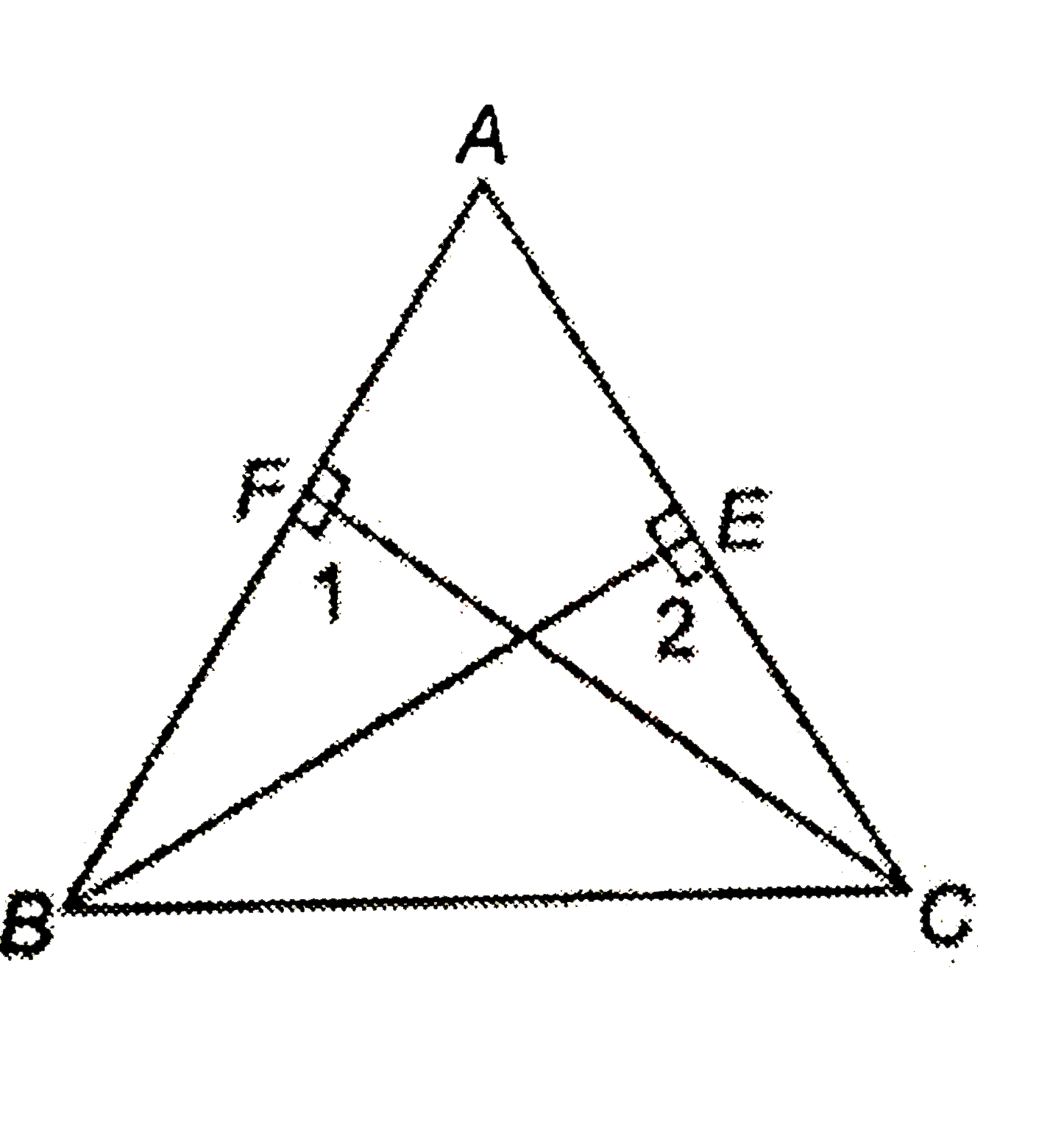
Given : `DeltaABC` in which BE and CF are the altitudes such that `BE=CF`. To prove : `DeltaABC` is an isosceles triangle i.e., `AB = AC`.
Proof : Since BE and CF are the altitudes
`:. angle1 = angle2" "("each "90^(@))`
Now, in `DeltaBFC` and `DeltaBEC`,
`:' {(angle1=angle2,("given")),(BC=BC,("common")),(CF=BE,("given")):}`
`:. DeltaBFC cong DeltaBEC` (RIIS)
`:. angleB=angleC` (c.p.c.t)
`implies AC = AB` (sides opposite to equal angles are equal)
`:. DeltaABC` is an isosceles triangle. Hence Proved.
We can also prove this by taking AAS congruence rule in `Deltas` ABE and AFC, if no particular method is asked)
Promotional Banner

Topper's Solved these Questions

  • TRIANGLES

    NAGEEN PRAKASHAN ENGLISH|Exercise Problems From NCERT/exemplar|5 Videos
  • TRIANGLES

    NAGEEN PRAKASHAN ENGLISH|Exercise Exercise 7a|35 Videos
  • SURFACE AREA AND VOLUME

    NAGEEN PRAKASHAN ENGLISH|Exercise Revision Exercise (long Answer Questions)|10 Videos

Similar Questions

Explore conceptually related problems

In a triangle ABC

If the altitudes from two vertices of a triangle to the opposite sides are equal, prove that the triangle is isosceles.

If the altitudes from two vertices of a triangle to the opposite sides are equal, prove that the triangle is isosceles.

If A, B, C are the angles of a triangle ABC and if cosA=(sinB)/(2sinC) , show that the triangle is isosceles.

Prove that the altitudes of a triangle are concurrent.

AD, BE and CF , the altitudes of triangle ABC are equal. Prove that ABC is an equilateral triangle.

In triangle ABC , if cosA+sinA-(2)/(cosB+sinB)=0 then prove that triangle is isosceles right angled.

If atanA+btanB=(a+b)tan((A+B)/2) prove that triangle ABC is isosceles.

The sides AB and BC and the median AD of triangle ABC are equal to the sides PQ and QR and the median PM of triangle PQR respectively. Prove that the triangles ABC and PQR are congruent.

If in a triangle ABC, (bc)/(2 cos A) = b^(2) + c^(2) - 2bc cos A then prove that the triangle must be isosceles.

