Home
Class 10
MATHS
If a parallelogram circumscribes a circl...

If a parallelogram circumscribes a circle then prove that it must be a rhombus.

Text Solution

Verified by Experts

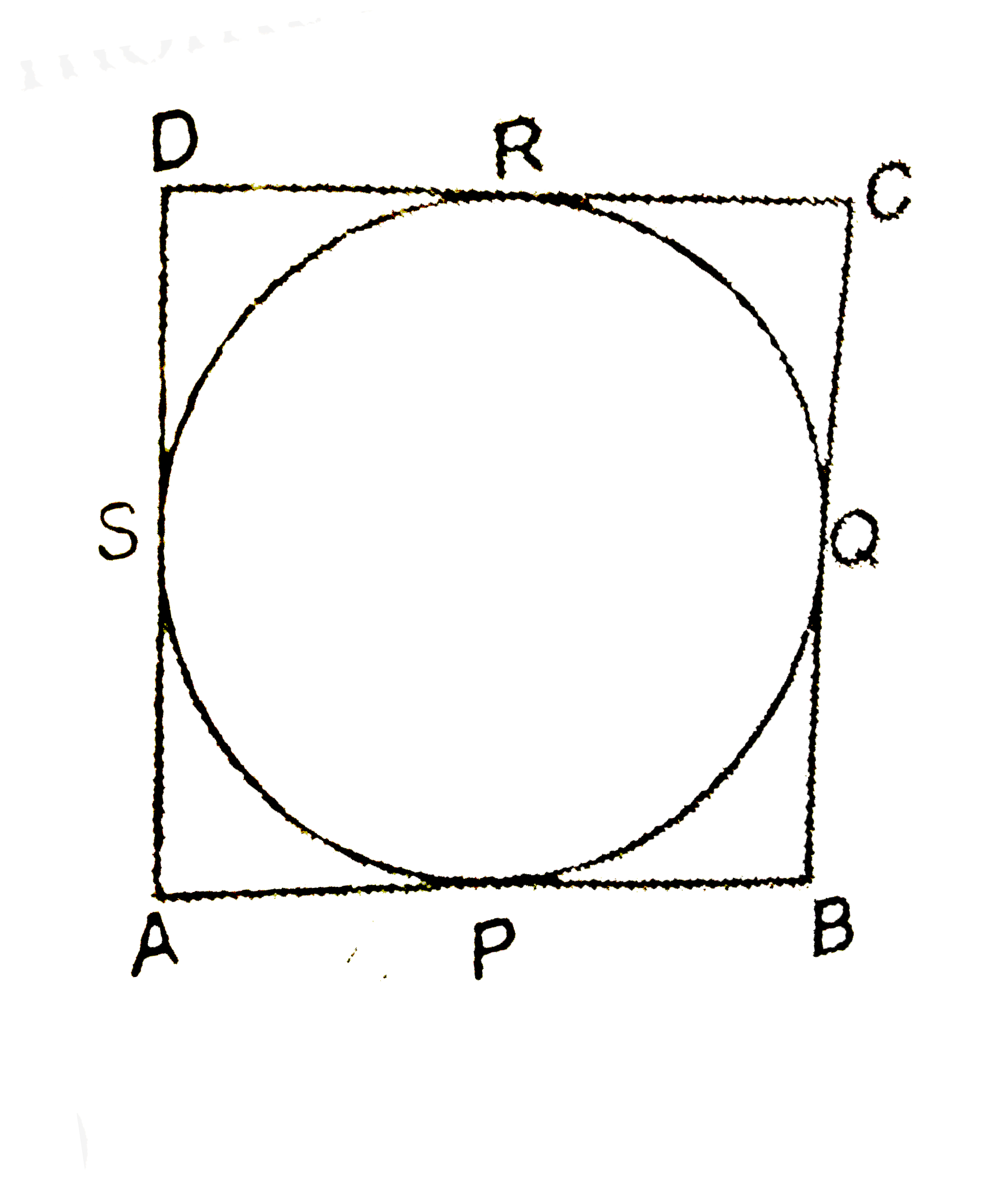
Given a parallelogram, say ABCD, Let this parallelogram touch the circle at the point P, Q, R and S.
As AP and AS are tangents to the circle drawn from an external point A.
`AP=AS" "…(1)`
Similarly,`" "BP=BQ" "…(2)`
`CR=CQ" "...(3)`
`DR=DS" "...(4)`
Circles
Adding (1), (2), (3) and (4), we get
`implies" "AP+BP+CR+DR=AS+BQ+CQ+DS`
`implies" "(AP+BP)+(CR+DR)=(AS+DS)+(BQ+CQ)`
`implies" "AB+CD=AD+BC`
`implies" "AB+AB=AD+AD`
(CD=AB, DB=AD, opposite sides of a parallelogram)
`implies" "2AB=2AD`
`implies" "AB=AD`
Hence, ABCD is a rhombus. (`because` adjacent sides of a parallelogram are equal) Hence Proved.
Promotional Banner

Topper's Solved these Questions

  • CIRCLES

    NAGEEN PRAKASHAN ENGLISH|Exercise Problems From NCERT/exemplar|11 Videos
  • CIRCLES

    NAGEEN PRAKASHAN ENGLISH|Exercise Exercise|32 Videos
  • ARITHMETIC PROGRESSION

    NAGEEN PRAKASHAN ENGLISH|Exercise Revision Exercise Long Answer Question|5 Videos
  • CO-ORDINATE GEOMETRY

    NAGEEN PRAKASHAN ENGLISH|Exercise Revision Exercise Short Answer Questions|10 Videos

Similar Questions

Explore conceptually related problems

If the sides of a parallelogram touch a circle prove that the parallelogram is a rhombus.

If all the side of a parallelogram touch a circle, show that the parallelogram is a rhombus. OR Prove that a parallelogram circumscribing a circle is a rhombus.

Prove that the parallelogram circumscribing a circle is a rhombus.

Prove that the parallelogram circumscribing a circle is a rhombus.

Prove that the parallelogram circumscribing a circle is a Rhombus.

if diagonals of a parallelogram bisect each other,prove that its a rhombus

The diagonal BD of a parallelogram ABCD bisects angles B and D. Prove that ABCD is a rhombus.

If a hexagon ABCDEF circumscribe a circle, prove that AB + CD + EF=BC+DE+FA

If a hexagon ABCDEF circumscribe a circle, prove that AB + CD + EF=BC+DE+FA

Prove that opposite sides of a quadrilateral circumscribing a circle subtend supplementary angles at the centre of the circle.
