Home
Class 9
MATHS
The diagonals AC and BD of a cyclic quad...

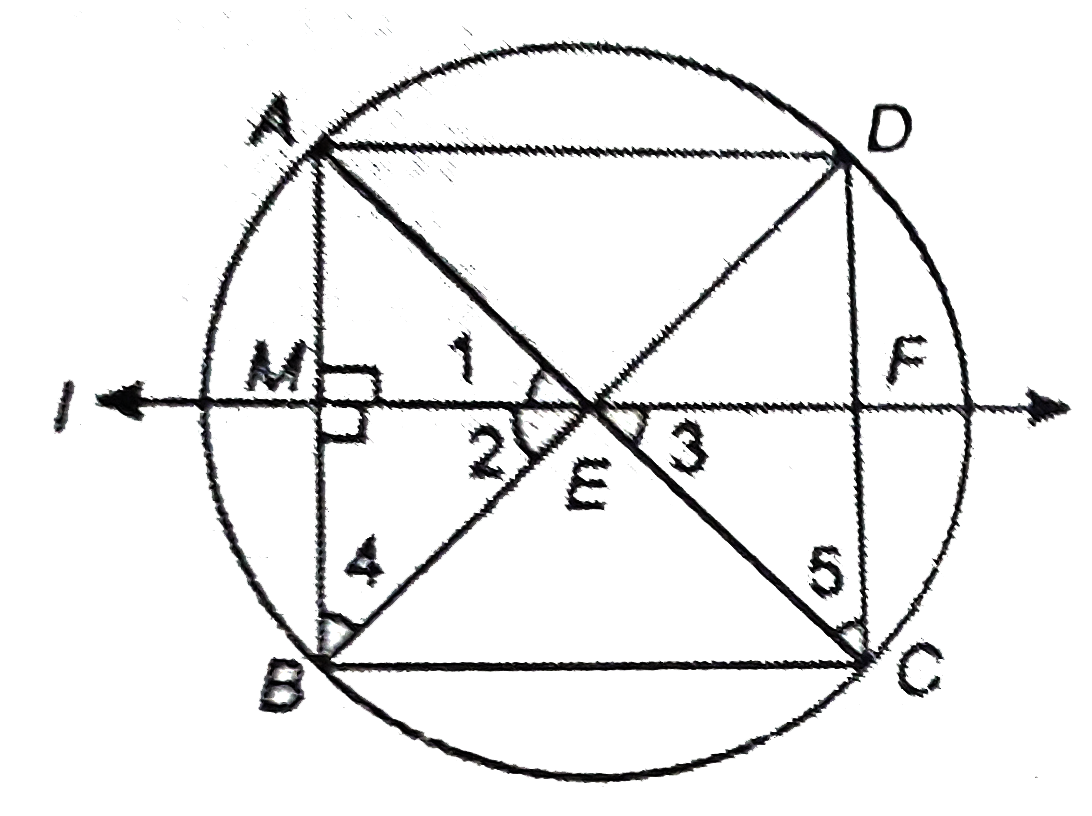
The diagonals `AC` and `BD` of a cyclic quadrilateral `ABCD` interest at right angles at E (figure). A line l drawn through E and perpendicular to AB meets CD at F. Prove that F is the mid-point of CD.

Text Solution

Verified by Experts

ABCD is a cyclic quadrilateral in which diagonals AC and BD intersect in E at right angles , l is a line through E and perpendicular to AB meets CD in F.
We have `angle AEB=90^@ " "(because "the diagonals are at right angles")`
`rArrangle1_angle2 =90^@`
`angle1 =90^@-angle2` .....(1)
`rArrangle1 =90^@-angle2" "(because EMbotAB)`
Again `angle EMB=90^@`
In `Delta EMB`, we have
`angle2+angle4=90^@`
`rArrangle4=90^@-anlge2` .......(2)
From eqs.(1) and (2) , we get
`angle1=angle4`
But `angle1 =angle3` (vertically opposite angles)
`therefore angle3=angle4`
Also, ` angle4=angle5` (angles in the same segment of a circle are equal)
`rArr angle3=angle5`
`rArrCF=EF` (sides opposite to equal angles of a triangle are equal)
Similarly , `DF=EF`
`rArrCF=DF`
Hence, F is the mid-point of CD.
Promotional Banner

Topper's Solved these Questions

  • CIRCLE

    NAGEEN PRAKASHAN ENGLISH|Exercise Exercise 10a|22 Videos
  • CIRCLE

    NAGEEN PRAKASHAN ENGLISH|Exercise Exercise 10b|19 Videos
  • AREA OF PARALLELOGRAMS AND TRIANGLES

    NAGEEN PRAKASHAN ENGLISH|Exercise Revision Exercise (long Answer Question)|5 Videos
  • CO-ORDINATE GEOMETRY

    NAGEEN PRAKASHAN ENGLISH|Exercise Exercise|8 Videos

Similar Questions

Explore conceptually related problems

AB and CD are the parallel sides of a trapeziuml. E is the mid-point of AD. A line through E and parallel to side AB meets the line BC at point F. Prove that F is the mid-point of BC.

In the figure shown, ABC is a triangle, right angled at B. Through B, a line is drawn perpendicular to AC which meets AC in D. What is the length of BD?

E is the mid-point of the side AD of the tarapezium ABCD with AB||DC . A line through E drawn parallel to AB intersects BC at F. Show that F is the mid-points of BC.

D and F are the mid-points of sides AB and AC of a triangle ABC. A line through F and parallel to AB meets BC at point E. Prove that BDFE is a parallelogram

The diagonals of a quadrilateral intersect at right angles. Prove that the figure obtained by joining the mid-points of the adjacent sides of the quadrilateral is a rectangle.

If ABCD is a cyclic quadrilateral, then prove that AC.BD=AB.CD+BC.AD

In triangle ABC, D is mid-point of AB and CD is perpendiicular to AB. Bisector of angleABC meets CD at E and AC at F. Prove that: F is equidistant from AB and BC.

In a right triangle ABC, right angled at A, AD is drawn perpendicular to BC. Prove that: AB^(2)-BD^(2)= AC^(2)-CD^(2)

ABCD is a trapezium in which A B\ ||\ D C , BD is a diagonal and E is the mid-point of AD. A line is drawn through E parallel to AB intersecting BC at F (see Fig. 8.30). Show that F is the mid-point of BC.

In a quadrilateral ABCD, it is given that AB |\|CD and the diagonals AC and BD are perpendicular to each other. Show that AD.BC >= AB. CD .
