Home
Class 9
MATHS
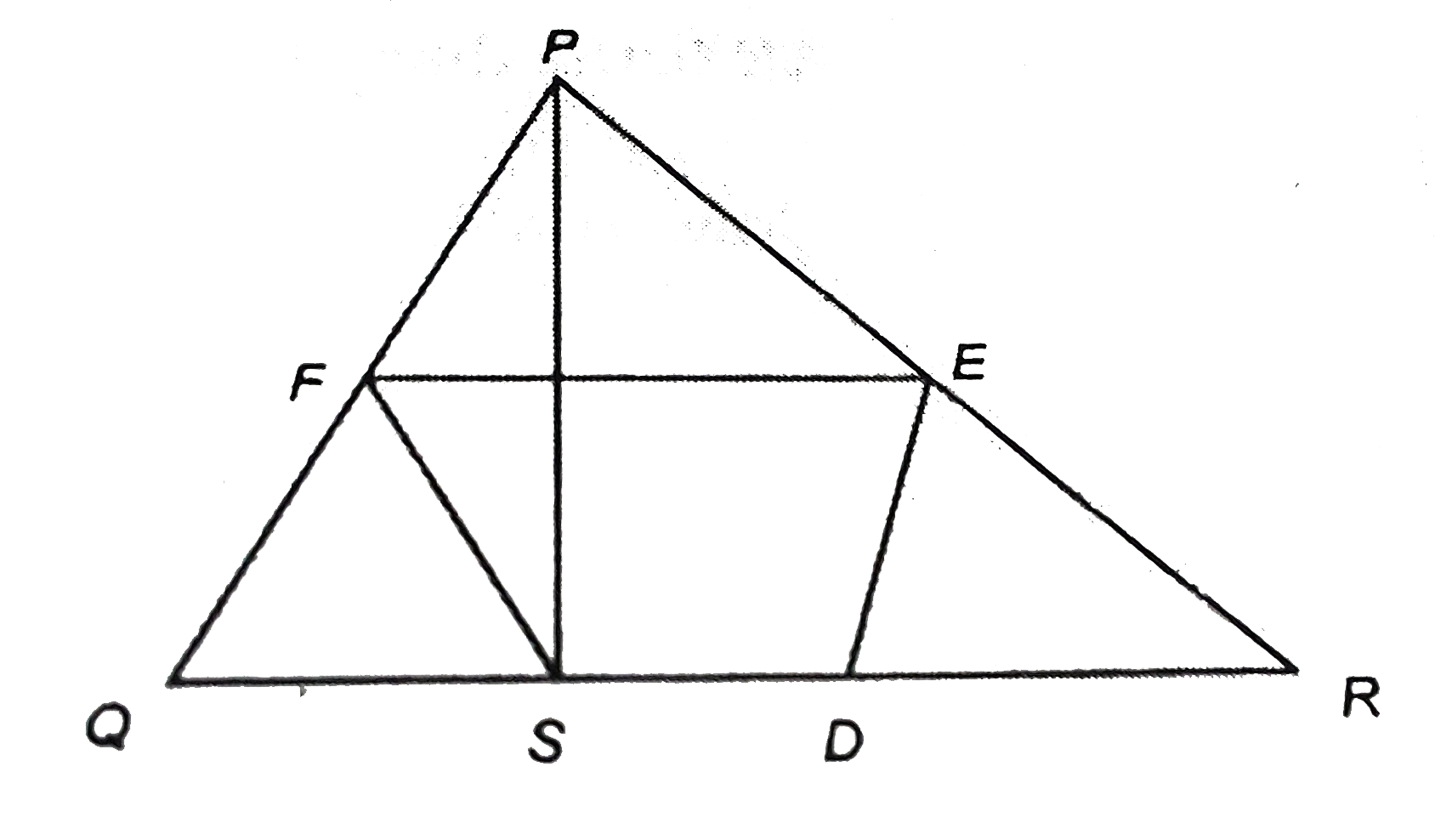
In the adjoining figure, D,E and F are t...

In the adjoining figure, D,E and F are the mid- points of the sides of `DeltaPQR` and 'S' is the fooot of perpendicualar form P to side S.
Prove that:
(i) `FQ=FS` and `angleFQS=angle FSQ`.
(ii)` angle FQS=angleFED`.
(iii) square `FSDE` is a cyclic quadrilateral.

Text Solution

Verified by Experts

(i) `PS bot QR`
`rArrangle PSQ=90^@`
F is the mid-point of PQ.
`therefore FS =(1)/(2)PQ` or `FS=FP`
Now, `DeltaPQS` is right-angled triangle and we know that the mid-point of hypotenuse is equidistant form the vertices of a triangle.
`thereforeFQ=FP =FS`
`rArrFQ=FS`
`rArrangleFSQ=angleFQS` ..........(1)
(ii) F is the mid-point of PQ and E is the mid-point of PR.
`thereforeFE|\ |QR`
`rArrFE|\ |QD`
Similarly, `FQ|\ |ED`
`therefore square FEDQ` is a parallelogram.
We know that opposite angles of a parallelogram are equal.
`therefore angle FQS=angle FED`
(iii) Now from eqs. (1) and (2),
`angle FSQ=angleFED`
But `angleFSQ` is the exterior angle of square `FSDE`.
square ` FSDE` is a cyclic quadrilateral.
Promotional Banner

Topper's Solved these Questions

  • CIRCLE

    NAGEEN PRAKASHAN ENGLISH|Exercise Exercise 10a|22 Videos
  • CIRCLE

    NAGEEN PRAKASHAN ENGLISH|Exercise Exercise 10b|19 Videos
  • AREA OF PARALLELOGRAMS AND TRIANGLES

    NAGEEN PRAKASHAN ENGLISH|Exercise Revision Exercise (long Answer Question)|5 Videos
  • CO-ORDINATE GEOMETRY

    NAGEEN PRAKASHAN ENGLISH|Exercise Exercise|8 Videos

Similar Questions

Explore conceptually related problems

In the adjoining figure D, E and F are the mid-points of the sides BC, CA and AB of the equilateral DeltaABC. Prove that DeltaDEF is also an equilateral triangle.

In the adjoining figure D, E and F are the mid-points of the sides BC, CA and AB respectively of Delta ABC . Prove that: (i) square BDEF is a parallelogram (ii) area of Delta DEF = (1)/(4) xx " area of " Delta ABC (iii) square BDEF = (1)/(2) xx " area of " Delta ABC

In Figure, D ,E and F are, respectively the mid-points of sides B C ,C A and A B of an equilateral triangle A B C . Prove that D E F is also an equilateral triangle.

In Figure, D ,E and F are, respectively the mid-points of sides B C ,C A and A B of an equilateral triangle A B C . Prove that D E F is also an equilateral triangle.

In the adjoining figure, D is the mid-point of side AB of Delta ABC and P be any point on side BC. If CQ ||PD , then prove that: area of Delta BPQ = (1)/(2) xx " area of " Delta ABC

If D,E and F are the mid-points of the sides BC,CA and AB, respectively of a DeltaABC and O is any point, show that (i) AD+BE+CF=0 (ii) OE+OF+DO=OA

P, Q , R and S are respectively the mid-points of the sides AB, BC, CD and DA of a quadrilateral ABCD in which AC = BD. Prove that PQRS is a rhombus.

P, Q, R and S are respectively the mid-points of sides AB, BC, CD and DA of quadrilateral ABCD in which AC=BD and ACbotBD . Prove that PQRS is a square.

In the given figures , O is the centre of the given circle. AB is a side of a square ,BC is a side of regular pentagon and CD is a side of regular hexagon. Find: (i) angle AOB (ii) angle AOC (iii) angle AOD (iv) angle BCD

D, E and F are the mid-points of the sides AB, BC and CA respectively of A ABC. AE meets DF at O. P and Q are the mid-points of OB and OC respectively. Prove that DPOF is a parallelogram.
