Home
Class 11
MATHS
PQRS is a square of side 'b'. Prove that...

PQRS is a square of side 'b'. Prove that the equation of circumcircle of square PQRS, where PQ and PS are the axes, is `x^(2)+y^(2)=b(x+y)`.

Text Solution

Verified by Experts
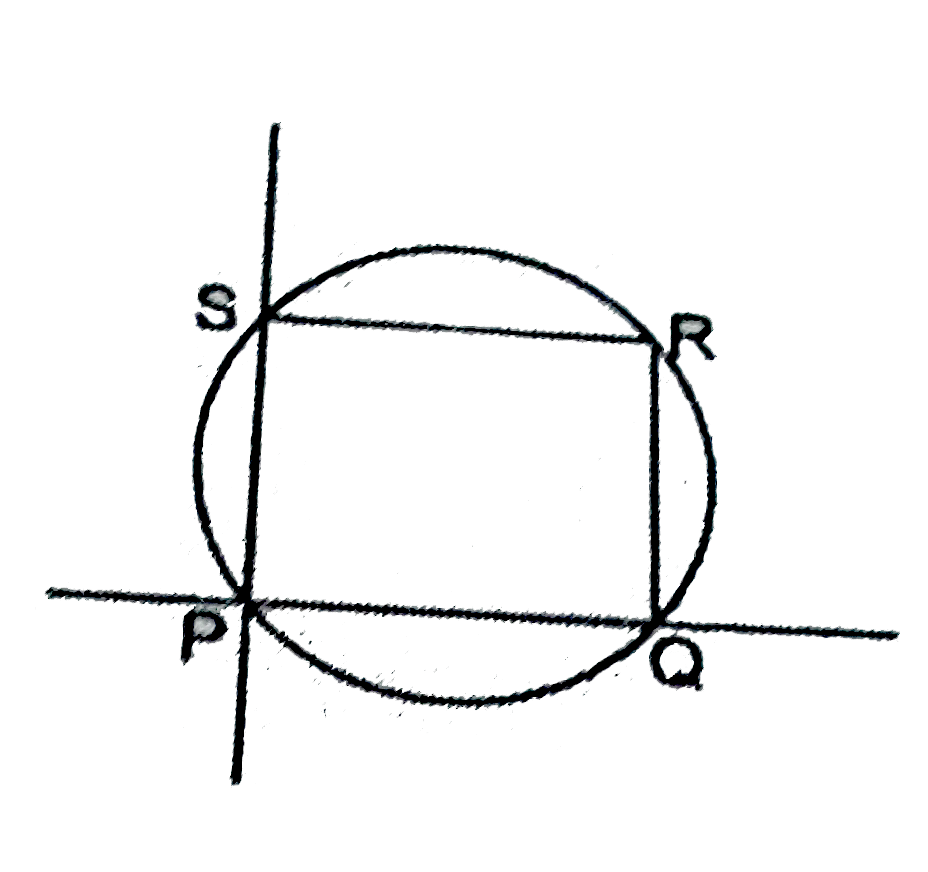
Draw a square of side 'b' taking PS as the axes. Now the co-ordinates of its vertices are `P(0,0), Q(b,0),R(b,b) and S(0,b)`
From the equation of circumcircle of square PQRS,
`(x_(1),y_(1))=(0,0) and (x_(2),y_(2))=(b,b)`
Equation of circle
`(x-x_(1))(x-x_(2))+(y-y_(1))(y-y_(2))=0`
`rArr (x-0)(x+b)+(y-0)(y-b)=0`
`rArr x^(2) -bx + y^(2) -by =0`
`rArr x^(2) +y^(2)=b(x+y)`.
Promotional Banner

Topper's Solved these Questions

  • CONIC SECTION

    NAGEEN PRAKASHAN ENGLISH|Exercise Miscellaneous Example|3 Videos
  • CONIC SECTION

    NAGEEN PRAKASHAN ENGLISH|Exercise Exercise 11A|37 Videos
  • COMPLEX NUMBERS AND QUADRATIC EQUATION

    NAGEEN PRAKASHAN ENGLISH|Exercise MISCELLANEOUS EXERCISE|20 Videos
  • INTRODUCTION OF THREE DIMENSIONAL GEOMETRY

    NAGEEN PRAKASHAN ENGLISH|Exercise Miscellaneous Exercise|6 Videos

Similar Questions

Explore conceptually related problems

Find the equation of circumcircle of the triangle whose sides are 2x +y = 4,x + y = 6 and x +2y=5 .

The sides of a square are x =4, x = 7, y =1 and y = 4 . The equation of the circumcircle of the square is :

ABCD is a square in first quadrant whose side is a, taking AB and AD as axes, prove that the equation to the circle circumscribing the square is x^2+ y^2= a(x + y) .

An equilateral triangle PQR is circumscribed about a given DeltaABC. Prove that the maximum area of Delta PQR is 2 Delta + (a^(2) +b^(2)+c^(2))/(2sqrt3)). Where a,b,c are the sides of Delta ABC an Delta is its area.

The sides of a square are x=2,x=3,y=1andy=2 . Find the equation of the circle drawn on the diagonals of the square as its diameter.

A circle C of radius 1 is inscribed in an equilateral triangle PQR. The points of contact of C with the sides PQ, QR, RP are D, E, F, respectively. The line PQ is given by the equation sqrt3 x+ y -6 = 0 and the point D is ((3sqrt3)/2, 3/2) . Further, it is given that the origin and the centre of C are on the same side of the line PQ. (1)The equation of circle C is (2)Points E and F are given by (3)Equation of the sides QR, RP are A. y=(2)/(sqrt3)+x+1,y=-(2)/(sqrt3)x-1 B. y=(1)/(sqrt3)x,y=0 C. y=(sqrt3)/(2)x+1,y=-(sqrt3)/(2)x-1 D. y=sqrt3x,y=0

The sides of a square are x=1, x=3, y=2 and y=4 .Find the equation of the circle drawn on the diagonal of the square as its diameter.

The sides of a square are x=6,\ x=9,\ y=3\ a n d\ y=6. Find the equation of a circle drawn on the diagonal of the square as its diameter.

The asymptotes of a hyperbola are y = pm b/a x , prove that the equation of the hyperbola is x^(2)/a^(2) - y^(2)/b^(2) = k , where k is any constant.

One side of a square makes an angle alpha with x axis and one vertex of the square is at origin. Prove that the equations of its diagonals are x(sin alpha+ cos alpha) =y (cosalpha-sinalpha) or x(cos alpha-sin alpha) + y (sin alpha + cos alpha) = a , where a is the length of the side of the square.

