Home
Class 11
PHYSICS
State parallelogram law of vectors. Deri...

State parallelogram law of vectors. Derive an expression for the magnitude and direction of the resultant vector.

Text Solution

Verified by Experts
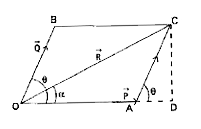
Statement : If two vectors acting at a point are represented by the adjacent sides of a parallelogram in magnitude and direction, then their resultant is represented by the diagonal of the parallelogram in magnitude and direction drawn from the same point.
Explanation : Let two forces `vec(P)` and `vec(Q)` act at a point O. Let `theta` be the angle between two forces. Let the side `OA = vec(P)` and `OB = vec(Q)`. The parallelogram OACB is completed. The points O and C are joined.
Now `OC = vec(R)`
Resultant magnitude :
In fig `vec(OA) = vec(P), vec(OB) = vec(Q), vec(OC) = vec(R)`
In the triangle `COD, OC^(2) = OD^(2) + CD^(2)`
`OC^(2) = (OA + AD)^(2) + CD^(2) (because OD = OA + AD)`
`OC^(2) = OA^(2) + AD^(2) + 2OA. D + CD^(2)`

`OC^(2) = OA^(2) + AC^(2) + 2OA.AD` ..........(1)
from `Delta^(l e) CAD, AD^(2) + CD^(2) = AC^(2)`
From `Delta^(l e) CAD, cos theta = (AD)/(AC)` ...........(2)
`AD = AC cos theta`
`therefore R^(2) = P^(2) + Q^(2) + 2PQ cos theta`
`R = sqrt(P^(2) + Q^(2) + 2PQ cos theta)` ...........(3)
Resultant direction :
Let `alpha` be the angle made by the resultant vector `vec(R)` with `vec(P)`
Then `tan alpha = (CD)/(OD)`
`tan alpha = (CD)/(OA + AD)` ..........(4)
In the triangle CAD, `sin theta = (CD)/(AC)`
`CD = AC sin theta`
`CD = Q sin theta` ...........(5)
`therefore tan alpha = (Q sin theta)/(P + Q cos theta) (because AD = Q cos theta)`
`alpha = tan^(-1)((Q sin theta)/(P + Q cos theta))` ..............(6)
Promotional Banner

Similar Questions

Explore conceptually related problems

When two vectors vecA and vecB of magnitude a and b are added, the magnitude of the resultant vector is always

State and explain the triangle law of vectors.

State and explain the polygon law of vectors.

The resultant of two vectors vecP and vecQ is vecR . If the magnitude of vecQ is doubled, the new resultant becomes perpendicular to vecP , then the magnitude of vecR is

A vector has x component of -25.0 units and y component of 40.0 units find the magnitude and direction of the vector.

